SAN DIEGO --- New finding show that our big sister galaxy Andromeda contains chains of giant clouds of frigid molecular gas that are similar to those from which most of our own galaxy's stars and planets were formed, say University of Maryland astronomers in a report being presented at the American Astronomical Society meeting in San Diego.
Graduate research assistant Kartik Sheth and astronomy professor Stuart Vogel say the new observations indicate that conditions for star and planet formation in Andromeda are similar to those in the neighborhood of the Sun. The largest gas clouds detected in Andromeda extend over more than 250 light years, contain a mass more than half a million times larger than the Sun, and are at a temperature of only 10-20 degrees above absolute zero. Andromeda is the nearest spiral galaxy to our own Milky Way. At about two million light years from the Sun, it is the most distant object that can be seen with the naked eye.
Though sightings of such clouds in Andromeda were first made more than a decade ago, the current findings are the first to clearly show how closely the clouds in Andromeda resemble the clouds that form our own galaxy's "stellar nurseries".The new study adds support to previous findings that the gas clouds are arranged in links of thin chains called spiral arms that wrap for as much as 100,000 light years around the galaxy. The origin of the spiral arms is poorly understood, but there is evidence that shock waves traveling through the disk of the galaxy concentrate the gas in the arms.
The gas clouds detected are called giant ``molecular'' clouds (GMCs) because a majority of the atoms in the clouds are in molecules. As with most stars (such as the Sun), hydrogen constitutes about 70% of the mass; however, emission from molecular hydrogen cannot be detected under normal conditions in GMCs. The most detectable emission is from the carbon monoxide molecule (CO), which is what Sheth and Vogel observed.
The observations by Sheth & Vogel were made with the Berkeley-Illinois-Maryland (BIMA) radio telescope in Hat Creek, California, operating at millimeter wavelengths where emission from CO can be detected. The telescope is operated by the Universities of California (Berkeley), Illinois, and Maryland, with support from the Radio Astronomy program at the National Science Foundation. More information about the BIMA telescope can be found on the Internet at http://bima.astro.umd.edu.
The University of Maryland astronomers surveyed an area of 3000 x 12000 light years in the Andromeda galaxy and found more than a dozen GMCs with masses greater than 10,000 solar masses. The clouds have a distribution of masses, dimensions, temperatures, and motions similar to Milky Way GMCs. Observations of GMCs in the Milky Way galaxy have been made by many observers during the past 25 years since they were discovered, and their properties have been summarized by Dr. Leo Blitz (University of California, Berkeley).
Although Andromeda is somewhat larger than the Milky Way, it is often regarded by astronomers as more deficient in gas. However, ``our discovery of an abundance of garden-variety giant molecular gas clouds contradicts the widespread notion that Andromeda is a wimpy gas galaxy,'' said Sheth. ``At this point, we can't distinguish the Andromeda clouds in our survey from those in our galaxy near the Sun,'' Sheth said.
Vogel said that ``giant molecular clouds are the star factories that make the stars and planets in the Milky Way, but even though we can observe them only 1000 light years away in our own galaxy, we don't have the perspective to understand what creates the clouds or what triggers them to make stars. In the same way that scientists studying the Amazon rain forest find that satellite images from high above the Earth complement data from the forest floor, we observe giant molecular clouds 2 million light years away in Andromeda to study them in various galactic environments to understand how they are formed and destroyed.''
Sheth and Vogel said that their survey probably probes
regions that are typical of much of Andromeda, but that further observations
are needed to confirm this. And in some regions, gas clouds are known
to have different properties; for example, Dr. Ron Allen (Space Telescope
Science Institute) has presented evidence that clouds in the central region
of Andromeda are colder and perhaps larger than those found by Sheth and
Vogel in the outer regions of Andromeda .
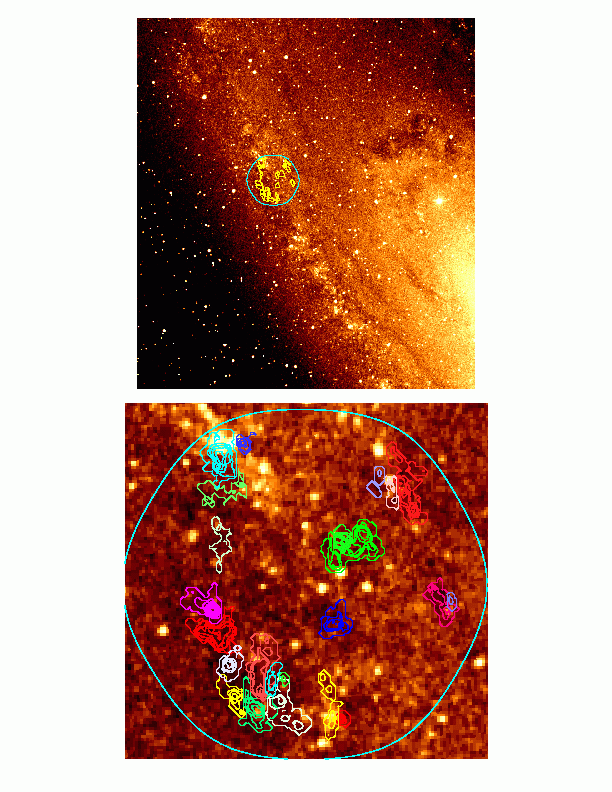
PHOTO CREDIT: Kartik Sheth, Stuart Vogel, University of Maryland
Figure 1 shows an optical image of the Andromeda
Galaxy with the area surveyed by the BIMA telescope highlighted by the
blue hexagon. The yellow contours are outlines of the giant gas
clouds observed by Sheth and Vogel. The clouds
lie in the thin dust lanes which run along the disk of the galaxy.
This material is being presented to the American Astronomical Society meeting
in San Diego, CA on June 11, 1998. An enlargement is shown in Figure 2.
The optical image of Andromeda was obtained from the Digitized Sky Survey
and { Skyview} developed by Space Telescope Science Institute and
Goddard Space Flight Center with support from NASA.
Figure 2 shows a close-up view of the giant
gas clouds. The contours are similar to contours on a topographic
map --- these contours indicate the intensity of the carbon monoxide emission
in these clouds which was observed using the Berkeley-Illinois-Maryland
(BIMA) millimeter wavelength telescope. This material is being presented
to the American Astronomical Society meeting in San Diego, CA on June 11,
1998.
[an error occurred while processing this directive]
Page last modified:
Thursday, 17-Mar-2016 13:48:31 EDT.