
AMI is an interferometer, in which pairs of antennas are used to measure structure in the sky on individual angular scales. To make images on angular scales around an arcminute, AMI needs baselines of a few hundred to about a thousand wavelengths. It also needs longer baselines, up to several thousand wavelengths, to identify the extragalactic radio sources that would otherwise contaminate the observations. AMI achieves this large range of baselines by using two sets of antennas. The longer baselines use the 13-m antennas of the present Ryle Telescope; the shorter ones come from a new array of ten 3.7-m antennas. Both arrays operate at frequencies of 12-18 GHz (about 2 cm wavelength). In this frequency range very low noise receivers are available, and the atmosphere in Cambridge is very transparent, allowing high sensitivity to faint structures in the CMB.
|
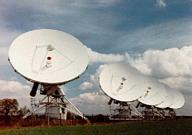
The 13-m antennas of the Ryle Telescope that will provide the long baselines of AMI. |
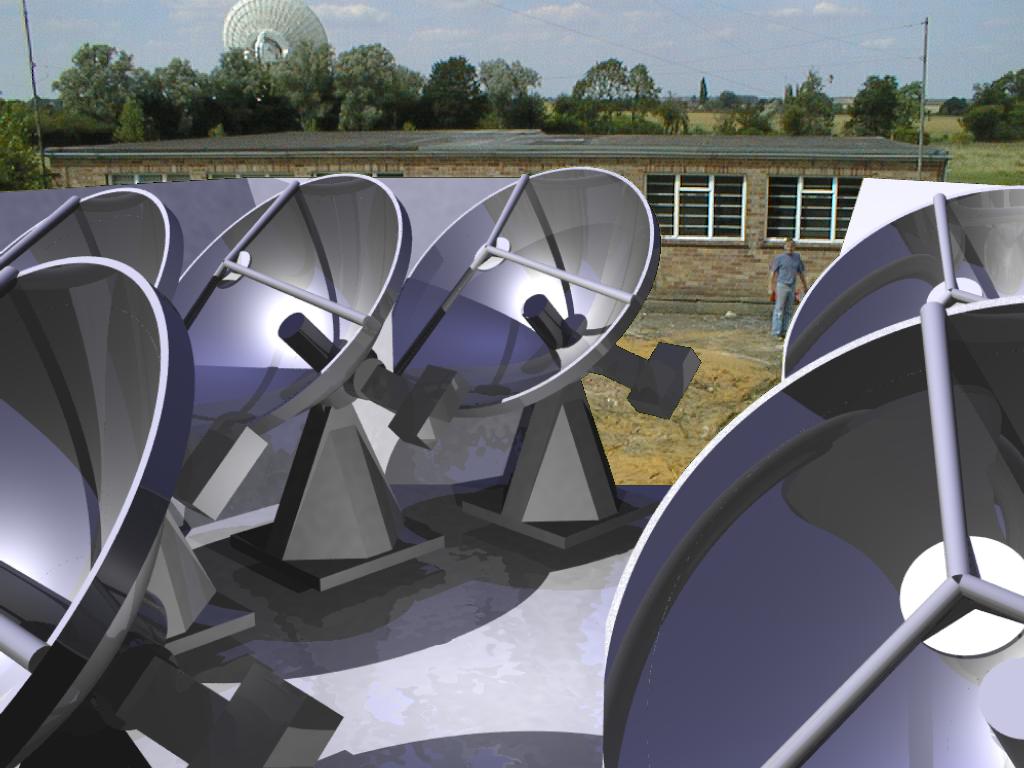
| Artist's impression of the array of 3.7-m antennas that will provide the short baselines and high sensitivity to arcminute-scale features in the CMB. | |
AMI will use an analogue correlator system to combine the signals from all the pairs of antennas. The full 12-18 GHz bandwidth of the receivers will be correlated, split into 1-GHz bands in order to reduce chromatic aberration in the resulting images.
 Last Modified 23 August 1999
Webpage Administrator.