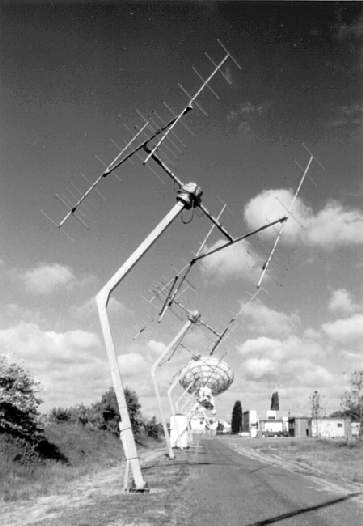
The Cambridge Low-Frequency Synthesis Telescope (CLFST) is an east-west aperture synthesis telescope currently operating at 151 MHz. It consists of 60 tracking yagis on a 4.6 km baseline, giving 776 simultaneous baselines. These provide a resolution of 70×70 cosec(declination) arcsec2, with a sensitivity of about 30 to 50 mJy/beam, and a field of view of about 9°×9°.
The CLFST has been making a survey - the 7C survey - of much of the northern sky, and this is currently being analysed. Also see the information about the earlier, lower resolution, 6C survey at 151 MHz, and the 8C survey at 38 MHz.
Picture: one group of antennas of the CLFST, with one antenna of the Ryle Telescope in the background. Sharp eyed browsers will note that in this picture the antennas of the CLFST are not all pointing in the same direction. This is because the telescope is in a special observing mode to search for radio emission from Gamma Ray Bursters, in conjunction with the BACODINE system. (© Mullard Radio Astronomy Observatory, 1995.)