Cosmology
Much of the effort of the Observatory is directed towards imaging
the cosmic microwave background radiation. This radiation is a very
faint relic of the stage when the Universe was a small hot fireball
with an age of only some 300,000 years. In the time since it was
emitted the expansion of the Universe has caused the radiation to cool
to a temperature of only 2.7 degrees above absolute zero, and it is
now detectable only at radio wavelengths. By mapping differences in
radiation intensity from point to point across the sky, one can find
out about the growth of material structures in the Universe as the
fireball phase was ending. This tells us about the formation of the
galaxies and galaxy clusters that populate the Universe now, and
allows us to infer the physical conditions in the Universe when it was
only a fraction of a second old.
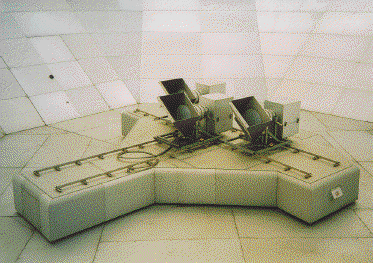 The difficulty with microwave background imaging, however, is that the
point-to-point intensity variations are only about one part in one
hundred thousand, requiring extremely sensitive purpose-built
telescopes. One telescope designed to map the microwave background is
the Cosmic Anisotropy Telescope - CAT - shown on the right. This has
3 receiving horn aerials working at 2 cm wavelength and maps the
fluctuations on a scale of about half a degree.
The difficulty with microwave background imaging, however, is that the
point-to-point intensity variations are only about one part in one
hundred thousand, requiring extremely sensitive purpose-built
telescopes. One telescope designed to map the microwave background is
the Cosmic Anisotropy Telescope - CAT - shown on the right. This has
3 receiving horn aerials working at 2 cm wavelength and maps the
fluctuations on a scale of about half a degree.
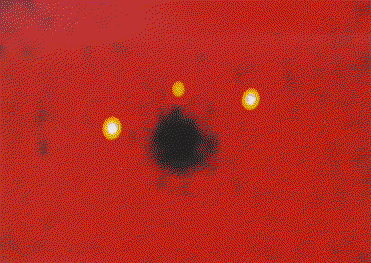
The Ryle telescope is also used
for microwave background mapping. It is sensitive to scales from 1
second of arc to several minutes. It has recently provided the image
below of a faint dip (shown black) in the intensity of the background (shown
in red) as the radiation travels towards us through a galaxy
cluster. The size of the dip and the cluster's recession speed have
enabled us to estimate the age of the Universe as nearly 20 billion
years.
 The MRAO
An Introduction to Radio Telescopes
Stars - Birth and Death
Aperture Synthesis with Light
Galaxies and Quasars
[ Cavendish |
Astrophysics Home |
The MRAO ]
 Last Modified 13 October 1998
Webpage Administrator.