

|
|
| Superconducting Detectors | Optical Physics | Instrumentation | Group Facilities | Publications |
|
Millimetrewave Direct Detectors |
SIS Mixers | STS Optical Detectors |
STS X-ray Detectors |
TES X-ray Detecrors |
Superconducting Electromagnetics |
The Superconducting Tunnel junction (STJ) offers the capability of simultaneous high resolution energy and timing measurement on single photons with a dynamic range from the infra-red (IR) through optical, ultra-violet (UV) to soft X-rays.
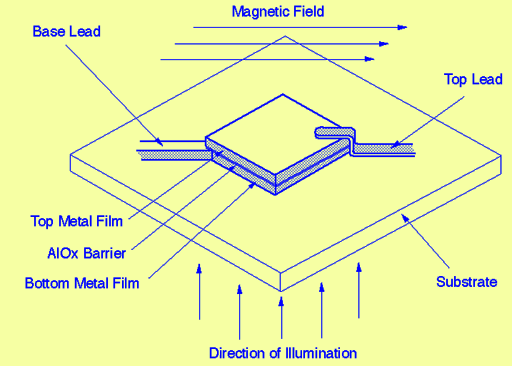
The STJ consists of two superconducting films each typically 100-150 nm thick separated by a very thin, electrically isolating barrier. We make these using UHV sputtering and photolithographic patterning in our Class 10 Cleanroom. The very high quality of the sputtered films produces ultra-low leakage current devices (essential for low electrical noise and low energy thresholds) and very long electronic mean-free-paths. For more information on how an STJ works click here.
Our devices for the IR-UV range have been developed over the past decade in association with the European Space Agency, Astrophysics Division. The STJs use tantalum and aluminium for the superconducting films and these are processed into small to medium-sized arrays with pixels of typically 30 to 40 µm side-length, each with its own electrical contact wiring. The STJs have been fabricated into small arrays of pixels which were used for S-Cam1 and S-Cam2.
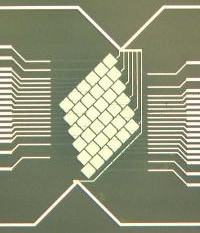
Picture of S-Cam2 device
More information and results on S-Cam can be found at the ESA/ESTEC Astrophysics S-Cam homepage including some very impressive time-resolved astronomical images.
More recently we have fabricated larger 12x10 arrays that will be used for S-Cam3.
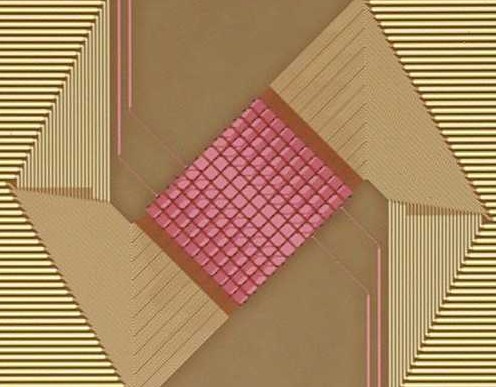
Detail of the S-Cam3 array.
| Back | | | Home |