|
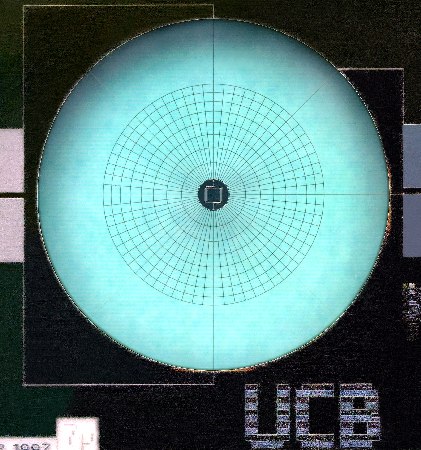
The bolometer is supported by a 1µm thick silicon nitride
(Si3N4) mesh patterned to resemble a spiderweb
to reduce the cosmic-ray cross section. The 3.5mm diameter mesh has
7µm wide members and ~150µm spaces. The mesh is metallized to absorb
far-infrared and mm-waves. It is supported by eight 7µm wide and 1mm
long legs which thermally isolate the mesh from the heat sink. The
200µm × 200µm superconducting thermistor is defined on a
continuous region of Si3N4 at the center of the
mesh. Both the absorber and the thermistor consist of a trilayer of
500Å of Ti, 500Å of Al, and 500Å of Ti. This
``proximity sandwich'' was chosen to achieve a useful transition
temperature of Tc=380mK. The width of the resistive
transition was 2.0mK (10%-90%) and the maximum value of (d log R)/(d log
T), which measures the steepness of the transition, was 800. In future
devices the two upper layers can be removed from the absorber to
reduce its heat capacity and to increase its impedance, thereby
optimizing the optical efficiency. Superconducting contact to the
thermistor is made by 3µm wide leads with Tc~1K, which are
a sandwich of 1000Å of Al on top of the trilayer. These leads
dominate the G=1.0 × 10⁻¹⁰W/K thermal conductance of
the bolometer.
|