|

|

|

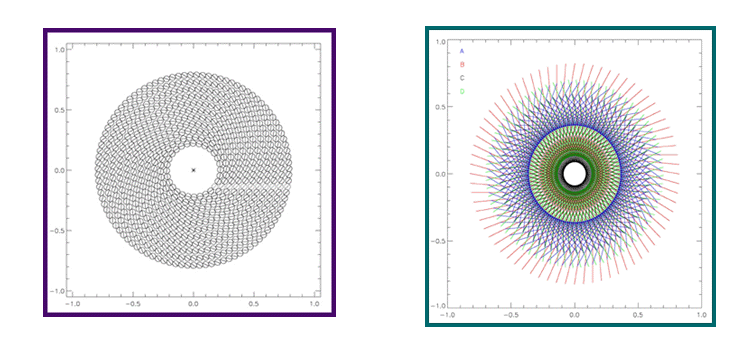
Scan Patterns and Detection Axes. The azimuth scan patterns for the four
receivers (lower left) and an example of the detection axis orientation
over the cap for receiver D’s east scans (lower right). In each case,
the vertical and horizontal axes are degrees in the sky.
The Azimuth Scan Pattern (2003):
The four receivers are placed in a diamond pattern, each 0.25 degrees
away from the center of the array, which points at the NCP. The telescope
scans the sky by moving one degree in the azimuth (horizontal) direction
while pointing at a constant elevation. Although the telescope only moves
horizontally, the sky’s rotation throughout the day allows a cap of sky
to be observed. The Ring Scan Pattern (2004): Sixteen
receivers are placed on the circumference of a circle, with the
NCP also on the circumference. The telescope moves such that each
of the receivers passes through the NCP. Since the sky rotates, this
scan pattern also covers a cap of sky about the NCP. An advantage of
this proposed scan pattern includes more cross-linked coverage per pixel.
However, with the telescope pointing at different elevations, this scanning
method may introduce some systematic errors due to the changing height
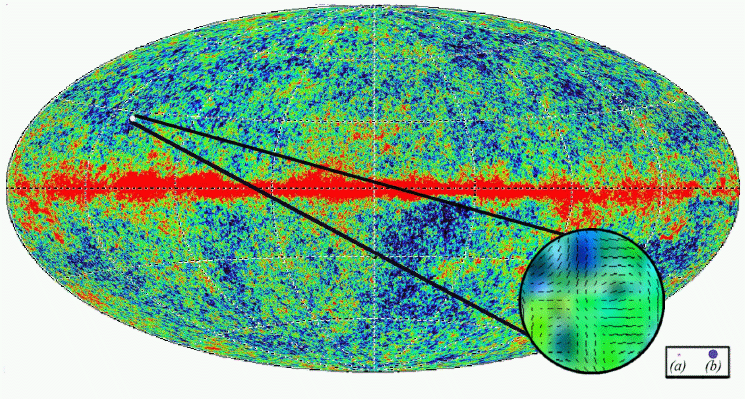
of the atmosphere. WMAP W-band (94 GHz). WMAP’s measurements
of CMB intensity in the entire sky at 94 GHz with CAPMAP’s one degree
observation cap around the NCP shown in greater detail. This image
is shown in galactic coordinates such that the galaxy lies on the equator.
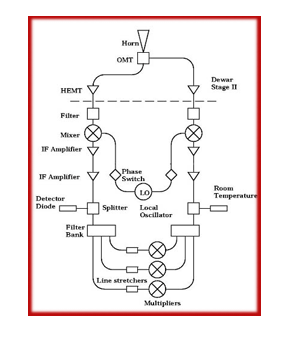
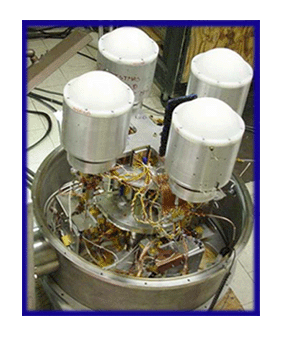
The Radiometer Since the amount of radiation contained in the CMB is that of a ~3K black body, the CMB is weak compared to other microwave sources such as atmospheric or ground emissions (~30 K and 300K). The polarized portion of the CMB is even weaker (~7-10 microK). In order to detect such small variations in the CMB, the receivers are designed to add as little noise as possible. These radiometers, also called polarimeters, are contained in a dewar, which is placed at the focal plane of the telescope. The dewar is evacuated to 0.01 microatm and cryogenically cooled to ~20 K in order to reduce the receiver’s noise contribution. The radiation is coupled to the radiometer through a feed horn and is then split into two phase-matched orthogonal components, E1 and E2. Each of these components is coherently amplified through state-of-the-art microwave amplifiers using high electron mobility transistors (HEMTs). After amplification, the signals are mixed down from the RF band (84-100 GHz) to the IF band (2-18 GHz) using a narrow band source at 82 GHz (the local oscillator or LO). After all these steps, the E1 and E2 components of the signal are coherently multiplied together. Since noise has random phases in each component, the multiplier time-averages this unwanted noise to zero while keeping in-phase signals intact. The output voltage of the multiplier is the difference in power along orthogonal “detection axis”, Ea and Eb, which are rotated 45 degrees from E1 and E2. CAPMAP (2004) will contain 16 polarimeters, 12 of which will operate at 90 GHz and 4 at 40 GHz. The Dewar and Radiometers. Block diagram of the radiometer (lower
left), picture of the actual dewar (lower right). Note the large
polyethylene lenses over the feedhorns which are hidden inside the
cylinders.
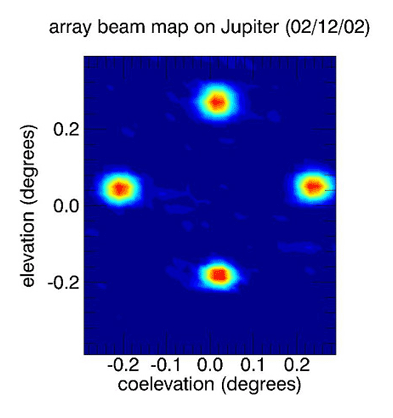
Observing Jupiter. The image of Jupiter (below) as detected by the four receivers in total power (unpolarized mode). These observations were used to determine the pointing and beam size of each receiver.
Original Poster By: Jennifer Hou, Harvard ’06 Jae-Young Lee, ’06 Sameer Shariff ,’06 Last updated 7/29/03 |