1.Daily flare, preflare and integral Solar flux monitoring with the with the following analysis of flare mechanism using SOHO/YOHKOH, Nobeyama, Metsahovi, RATAN-600 data is a traditional scientific and educational task which may be dealt with MSRT in MM band. Preferable monitoring frequencies for MSRT with 2 m dish are 26 GHz, 30 GHz, 36 GHz, 94 GHz and 150 GHz with two beams of circular polarizations(L/R). A third and quater of 2 m MSRT dish may be used for Solar flare/flux monitoring at 94 GHz and 150 GHz
2.The multibeam technique for observations of solar bursts was inicially developed for Itapetinga radio telescope (R.Herrman, A.Magun, P.Kaufman et al. "Astronomy and Astrophysics", v.317, 1997). The method allows to define the fast time structures present in the flux time profiles, providing at the same time their spatial resolution 5-20 times higher than HPBW. It is also possible to use a steep differencial beam pattern to locate position of bright simple Solar sources with spatial resolution much higher than HPBW. This task may be dealt with MSRT (5 m dish) equipped by 5x5 focal receiver array at 3 mm as scientific-methodological and educational task.
3.If the receiver system has high enough time resolution (better than 10 ms) and a few narrow spectral channels (<1% bandwidth) + circular polarisation we still have a chance to observe with MSRT the fine spatial structure in a solar magnetic field and temperature in burst regions in MM band. It opens a unique possibility for diagnostics of pre-flare and flare process. In the absence of high enough spatial resolution the degree of circular polarisation contains very useful information in addition to total flux measurements especially if time profiles are simple (a single source). Solar observations at Institute of applied physics of Bern University at frequencies 35.0 GHz, 50 GHz and 92.5 GHz with spatial resolution of all antennas 1 degree only give us a good example (Bruggman and Magun. Astronomy and Astrophysics, 239, 1990). For this task MSRT (5 m) should be equipped by 8x8 circular polarised (L/R) receiver array at 3 MM.
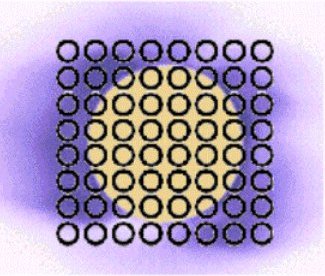
4.Another exciting solar task for MSRT is to detect very weak (0.1%) and slow (10-30 minutes) quasi-periodical oscillations of flux at MM waves caused by the correspondent magnetic field variation. The nature of flux variations: a/140 minute solar oscillations, b/ instability of magnetic structure before flares(L.Pustil'nik,2000). When we have two or more physically independent antenna beams and receivers directed to the different regions of the Sun (one beam to the active region, one to quiet one) we can use high accurate differential method. It will increase sensitivity to weak events (preflare) and to quasi-periodical long time flux variations. A differencial beam pattern will reduce atmospheric variations as well. This task may be dealt with MSRT (2m-5 m) equipped by 8x8 circular polarized (L/R) receiver array at 3 mm. (Fig 1).
5.Measrument of quiet Sun temperature/flux in the process of observations of enhanced temperature regions (ETR) in polar zones of the Sun at Metsahovi radio telescope (A.Riehokainen, S.Urpo, E.Valtaoja, "Astronomy and Astrophysics", 1999, S.Pohjolainen et al, "Astronomy and Astrophysics", 1999) at 8 mm/3 mm. ETR at 8 mm/3 mm is 100-400 K/60-70 K while quiet Sun temperature (7800 K/7200 K) is measured with accuracy limited by short term changes in atmospheric attenuation at level 100 K/30 K. Using smaller multi-beam radio telescope we can measure quiet Sun temperature/flux more accurately. For this task MSRT(5 m) should be equipped by a 3x3 or 5x5 focal receiver array at 8mm/3 mm. On and off-axis radiation patterns of 2 m MSRT at 30 GHz and 100 GHz are given in Fig.2.
Fig1.The simulated field of view of MSRT with 8x8 focal array at 2 mm/5 mm, dish diameter is 2 m/5 m

Fig2. On- and off-axis radiation patterns of 2m MSRT at 30 GHz (top) and 100 GHz (bottom)