LONG TIME COSMIC SORCE TRACKING AT RATAN-600
The long time cosmic source tracking is one most difficult and unsolved problems at RATAN-600. Antenna system "South sector + Periscope" gives a chance to track sources a few hours (Khaikin et al, 1972). The initial solution to change the antenna profile with change of cosmic source azimuth is the most effective but extremely difficult as we should control 3x225 panel coordinates in a real time scale. Cosmic source tracking with unmoveable main mirror in a form of cylinder requires either a special secondary mirror of double curvature (12 m size) (Vavilova, 1969) or a phased array in the focal plane of the ordinary secondary mirror (Kajdanovskij,1980). In Radio-Schmidt mode (Majorova, Khaikin 1999) the RATAN-600 main and periscope mirrors are calculated as two-mirror aplanatic system free from spherical and coma like aberrations. A flat periscope mirror is given the necessary curvature to remove spherical aberration caused by the main mirror in the form of unmoveable "flattened" cylinder. This is technically possible for an effective aperture size of 170 m. In "quickset" mode (Khaikin, Majorova, Chukhlebov,1997) optimal antenna precalculation and antenna element presetting are used to realize quazi-tracking in "start-stop" mode with nonsignificant reduction of horisontal aperture size (10-20%). In any tracking mode the Secondary mirror should move with high accuracy under dynamic control.
In a tracking mode an average speed of the Secondary mirror movement should be a constant with accyracy 0.1%-0.01% or slowly changed on known law for a source with delta more than +-20 degrees. In table 1 calculated tracking speed is given as function of time after meridian and delta of a cosmic source.
Table 1
|
Tracking time |
Tracking speed, mm/sec |
||
|
T, min |
Delta=0 degree |
Delta=10 degrees |
Delta=20 degrees |
|
0 |
11.7264 |
11.5483 |
11.0193 |
|
10 |
11.7264 |
11.5480 |
11.0181 |
|
20 |
11.7264 |
11.5470 |
11.0144 |
|
30 |
11.7264 |
11.5453 |
10.0081 |
|
40 |
11.7264 |
11.5429 |
10.9993 |
|
50 |
11.7264 |
11.5398 |
10.9878 |
|
60 |
11.7264 |
11.5358 |
10.9733 |
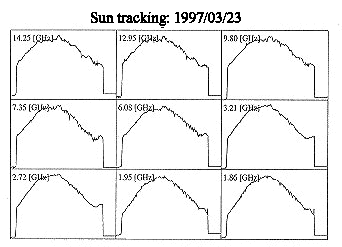
Fig. 1. The Sun in channels of the panoramic spectrum analyser of the RATAN-600 observation cabin No 3 during trial one hour Sun tracking in half-automatic mode with 80 m aperture.
In Fig.1 first Sun tracking with "shortened" aperture during one hour is shown. We used a manual control of Secondary mirror speed in this experiment.

Fig.2.Observation cabin N3 with new degital drive in the end of arcway.
To realize high accuracy dynamic control of the Secondary mirror old DC drive was replaced on modern AC drive with MOVITRAC 31C frequency inverter. Speed control mode is provided by using of incremental 10 bits encoder, fitted directly onto the AC squirrel-cage motor shaft. MOVITRAC 31C with FRN 31C speed control optional PCB has an improved static and dynamic characteristics and a control of braking. The built-in PI-regulator provides maintenance with high accuracy of average speed control in the process the Secondary mirror movement. As a result a given speed of the secondary mirror movement on arc railway is supported with accuracy 0.1% in 10 min. intervals. The FPI 31C position control optional PCB together with computer controlled system of electronic markers, placed on arc rail way with an interval 5 m gives a possibility of the Secondary mirror setting in a given point of arc railway of 160 m length with a maximum position error +-2 mm. The Secondary mirror N3 and new

Fig.3. New digital drive Movitrac-31C (SewEurodrive) of observation cabin N3 (left) and special control block developed (right)
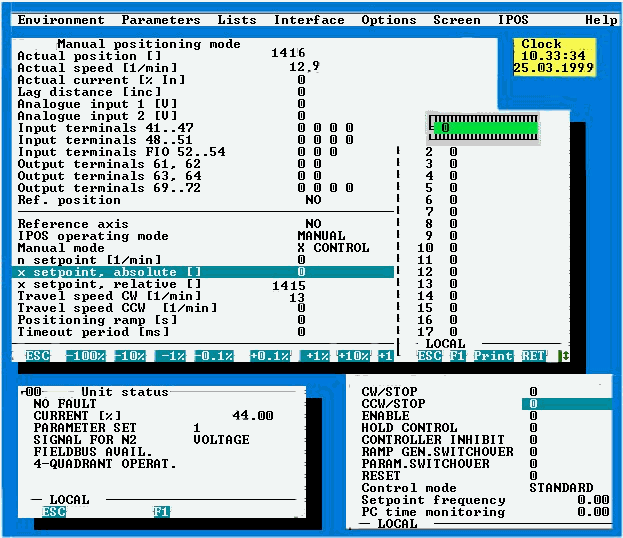
Fig. 4. Screen PC interface of MOVITRAC-31C in the positioning or control speed mode
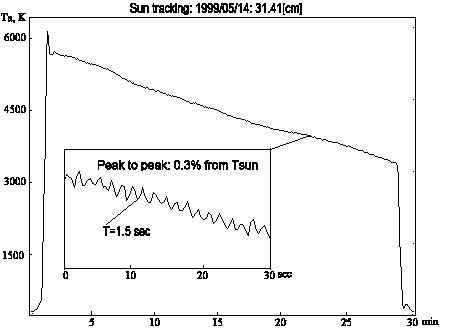
Fig.5. First trial Sun tracking with new drive in speed control mode during half an hour beginning in 5 min. after passing a meridian. Horizontal aperture size is 240 m.
digital drive with a screen interface are shown in Fig.2-3-4. Fig. 5 shows the Sun tracking with new drive in speed control mode starting in 5 min after passing meridian[4]. The slow fal l of antenna temperature during Sun tracking in Fig.1. and Fig.5. is caused by unnoptimal curvature of the arcway and unoptimal configuration of the main mirror in both experiments. An optimal arcway for cosmic source tracking with an unmovable main mirror should have curvature radius R=244-245 m instead of R=156 m now which is optimal for "running parabola" mode. Visible harmonic variations of Tsun at Fig 5. is caused by own frequency of oscillations of the Secondary mirror (weight about 70 tons) in tracking process.
The long time cosmic source tracking will give us new possibilities to study quick-variable cosmic objects like Sun and pulsars.
References
S.E.Khaikin, N.L.Kajdanovskij,Yu.N.Parijskij, N.A.Esepkina.The Radio Telescope RATAN-600. Izv.GAO, 188, p.3, 1972.
I.V.Vavilova. In book "Antennas", issue N5, M, 1969. pp.72-81.
.N.L.Kajdanovskij. Aberration correction of the mirror antenna with circular symmetry using the secondary mirror and the linear cophasal array. Astrophyz.Issled (Izv.SAO), 12, p.103, 1980.
E.K.Majorova, V.B.Khaikin. Computation of RATAN-600 characteristics in operation as a "radio-Schmidt telescope". Astrophyz.Issled.(Izvestia SAO),
N48, pp.133-144, 1999.
V.Khaikin, E.Majorova, M.Chukhlebov. RATAN-600 in quickset mode. XXVII Radioastronomical Conference, v.3., 1997.
V.B.Khaikin,E.K.Majorova,I.G.Efimov,O.A.Victorov, V.M.Bogod. S.Kh.Tokhchukova. Long time tracking of the Sun with RATAN-600 in Radio Schmidt mode. VII Russian-Finnish Symposium on Radioastronomy, pp.125-128., Pulkovo, 1999.
V.Khaikin, E.Maajorova, I.Efimov, O.Victorov. Long time cosmic source tracking at RATAN-600 in "Radio-Schmidt" mode. Astronomy & Astrophysics Transactions, 2000, v.19, N3-4, pp.608-615.