
Multi-pixel reception in RATAN-600 radio telescope aberrationless focal zone is considered. MMIC solution gives a chance to build a multi-beam focal-plane array with 500-1000 receiver elements in millimeter band that can significantly increase RATAN-600 sensitivity and field of view.
The significant progress in MMIC amplifier technologies
in MM band (Weinreb and Chao, 1997) gives us a chance to fully realize
an important RATAN-600 radio telescope advantage - wide aberrationless
focal zone L in Zenith (Parijskij at al.,1997) and Radio-Schmidt (Khaikin,
Majorova, Chukhlebov, 1997) modes. This seems possible even now when MMIC
amplifiers are far from being perfect and cannot be widely used in high
sensitive radio astronomical receivers.
2.MULTI-PIXEL RECEPTION IN RATAN-600 CASE
To fully sample the cosmic source distribution we must
use a spacing equal to or less than Nyquist sampling interval in the telescope
focal plane:
where f-focal distance, D- aperture size. In RATAN-600
case f/D is close to or less than 1. For an effective RATAN-600 illumination
the minimal receiving element feed size is at least twice more in a waveguide
horn solution. An attempt to improve a radiating pattern and decrease side
lobe level will extend more the feed size. We can instead consider the
dipol type feed which has smaller size and is almost free from spillover
effects. However an attempt to achieve a closely packed multi-feed system
will reduce the sensitivity of each pixel (Whyborn,1993). Really elements
which work well in isolation will not effectively work when placed close
together due to "crosstalk" or mutual coupling(Padmen, 1994). To avoid
mentioned effects and reach a factor  in sensitivity a multi-feed construction and spacing dL should provide
practically uncorrelated output noise in N channels and high level of input
mutual feed isolation (not less than -20 dB).
in sensitivity a multi-feed construction and spacing dL should provide
practically uncorrelated output noise in N channels and high level of input
mutual feed isolation (not less than -20 dB).
The field of view of a radio telescope is limitted by aberrations as a receiver element is moved to off-axis positions. Aberrations lead to an efficiency loss and a distorted beamshape. The both field of view and sensitivity of a large radio telescope in MM band strongly depends on a number of independent receiver elements which give undistorted elements of a sky picture - pixels. Multi-pixel reception (up to 500-1000 pixels in RATAN-600 case) may significantly (more than one order) increase RATAN-600 sensitivity and the field of view in survey tasks such as investigation of 3 K Cosmic Microwave Background(CMB) anisotropy at subdegree scales S. It is also the best way to suppress variations of atmospheric radiation with the help of wide-scale beam scanning (Parijskij at al., 1997) or two-pixel subtraction at scales:

3.RATAN-600 ABERRATIONLESS FOCAL ZONE
RATAN-600 includes the Main mirror (576 m in diameter),
4 Secondary mirrors in a form of parabolic cylinder with the horizontal
focal line and one conical Secondary mirror with the horizontal focal plane.
Both types of the RATAN-600 Secondary mirrors are well adapted for multi-pixel
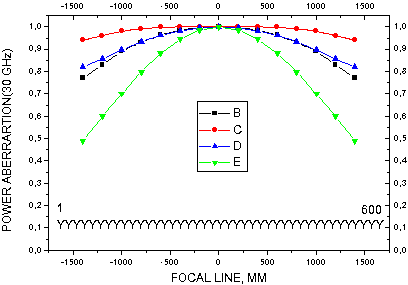
reception along the focal line or at plane. Our calculations show that
RATAN-600 aberrationless zone L along the focal line may exceed 3 meters
for the biggest Secondary mirror (12 m size) to study 20'-30' scales of
CMB in the range of 30 GHz at high elevation angles. Some ways also exist
to expand the available focal zone in cross direction by using more narrow
illumination angles and optimal turn of the plane from which the Secondary
mirror may be illuminated but this would decrease aperture efficiency almost
twice.
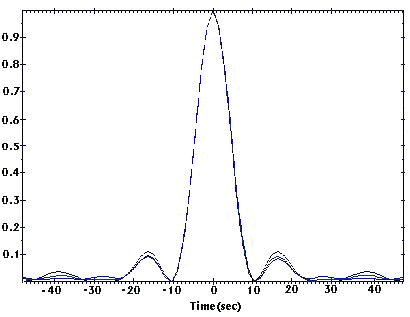
RATAN-600 beam patterns with undistorted beamshape in
the center and at edges of aberrationless focal zone in Radio-Schmidt mode
is shown in Fig.2.
5.MMIC ARRAY PROTOTYPE
The prototype of uncooled 8-element MMIC focal linear SUB-ARRAY in a range of 26-30 GHz is under fabrication for RATAN-600 at present. Multi-beam Integral Patch ARray (project "MIPAR") which is under development now can include up to 70-100 8-element SUB-ARRAYs. MIPAR is nonphased focal-plane array with independent inputs and beams. The input of each array element corresponds to a separate radiation pattern. The previous attempt to build 32-element focal phased array for RATAN-600 from ordinary hand-made radiometers (Pinchuk at al.,1993) has shown us the need to use new integral approaches and technologies.
In prototype of SUB-ARRAY rectangular patch radiators and MMIC receiver elements are fed by microstrip lines laying in the plane of radiating sheet. We use Rogers Corp. ceramic filled composite materials with loss tangent 0.0013 and constant 3.02 for the dielectric substrate. Microstrip radiators in the first prototype will receive signal of linear polarization but we plan to receive circular polarized waves with MIPAR as well. Input mutual radiator isolation is provided at -20 dB level. The front-end includes 3 GaAs MMIC LMA-422 of Litton SSD with NF=2.5 and gain G=22 dB in a receiving channel for direct RF amplification. Super low noise HP Schottky square low detectors complete VHF parts. Output mutual channel isolation is provided at -70 dB level. We put a microstrip band-pass filter before detector to limit channel bandwidth to 2 GHz at -3 dB level in an agreement with input radiator bandwidth. One loaded LMA-422 is used as a noise oscillator for a communal input channel calibration. Noise injection is produced through special radiators fed by a distributing microstrip line. A radiometric part of SUB-ARRAY is in the thermostat box. SUB-ARRAY is provided with radio transparent radome. Ultra-low noise high precision AD FET monolithic operational amplifiers are applied in the wideband multi-channel back-end.
We expect System temperature to be 270 K for the array directed to zenith and hope to realize 10-15 mK sensitivity per second in a channel in ordinary "Total power" receiving mode. To remove 1/F noise from a recording and decrease dG/G contribution into sensitivity we want to use a "frequent calibration" switched on each 100 msec during 10 msec with noise level of 10 K. PIN-diode modulator will be used for it. An amplitude and envelope of short noise calibration impulses are measured by quick enough A/D converter and used as a "pilot signal" for a real time two-pixel data treatment in DSP of a digital part. We hope to reach a factor 2 in sensitivity in this mode. Other way is to apply more perfect pilot-stabilized MMIC LNAs that gives a factor 2.5 in sensitivity (Weinreb, 1998). Fast switching or a correlation mode is needed to reach more high sensitivity with MMIC HEMT LNAs today (Weinreb, 1998).
6.ANTENNA MEASUREMENT APPLICATIONS
Another exciting possible field of applications for multi-pixel
MMIC reception at radio telescopes is millimeter wave antenna technologies
including holographic antenna measurement techniques. So multi-pixel (up
to 4000-8000 pixels) MMIC receiving systems may be used to get moment holographic
surface maps with a high resolution on strong cosmic or beacon satellite
sources that gives a chance to correct surface errors practically in real
time. It may give a powerful impulse to develop an active and adaptive
optics technique at radio telescopes including wave front correction but
requires at least one more order in MMIC cost reduction.
7.CONCLUSION
This seems possible to build 500-1000 beam MMIC focal array for the radio telescope in the nearest future. It looks as an exciting challenge for all those who develop MMIC technologies and apply them in Radio Astronomy today.
REFERENCES
1.Yu.Pariskij at al. "Dark Ages" of the Universe.
Proceed. of International School of Astrophysics "D. CHALONGE", 1997 in
press.
2.S.Weinreb and P.C.Chao. Full-Waveguide Band, 90
to 140 GHz, MMIC Amplifier Module. Proceedings of IEEE 1997 MTT-S Symposium,
Denver,1997.
3.V.Khaikin,E.Majorova,M.Chukhlebov. RATAN-600 as
Radio-Schmidt Telescope. In proceed. of XXVII Radio Astronomical Conf.,
V3, p.52, St.Petersburg, 1997.
4.N.Whyborn. Complete multi-feed systems for radio
astronomy. Proceedings of NRAO Workshop No.25,p.117, Tucson, 1994.
5.R.Padman. Optical fundamentals for array feeds.Proceedings
of NRAO Workshop No.25, p.3, Tucson, 1994.
6.S.Weinreb.MMIC Millimetre-wave focal plane arrays.
Proceed. NRAO Workshop No.25, p.189, Tucson, 1994.
7.G.A.Pinchuk, I.V.Berlizev,A.D.Dibizhev, E.K.Majorova,
D.V.Shannikov. The SET-UP of Linear Feed Array for the RATAN-600 Radio
Telescope. Bull.Spec.Astrophyz.Obs.,36,138,1993.
8.M.D.Parnes. Experience of the automated designing
of patch antenna arrays. Ship-building industry, issue 19, 1989.
9.S.Weinreb. VHF Pilot-Signal Stabilized Monolithic
Integral Circuit Millimeter-Wave Radiometers. Presented at the North
American URSI Meeting, Montreal, July 18,1998.