 1-4
0-8
1-4
0-8 < 2.0
<10.0
1.0
1.0
5.0
5.0
No
No
2.0
3.0
3.518.4
41.3
56.8
0.965
0.837
0.720
7.0
11.0
16.7
Yes
Yes
1.The longest aberrationless focal zone and widest radio telescope field
of view.
Absence of spherical aberration and coma in radio image in the wide
band 1-50 cm for an optimal focal way.
2.Possibility of long time cosmic source tracking or repeated observations
with an unmovable Main mirror.
3.Possibility to install a multi-beam feed array with the greatest
number of receiver elements along the focal line that may give
a significant (one-two orders) growth of integral radio telescope sensitivity in
background tasks [4].
4.Possibility to use one, two and three dimensional focal arrays.
In Table 1 some characteristics of antenna system in "Radio-Schmidt"
mode are presented for 150 m aperture size, optimal and real focal way
at 7.6 cm.
Calculations show that less than half an hour Sun tracking is
available with the real focal way at more than 8 cm wavelength and one
hour Sun tracking at 1 - 50 cm with optimized focal way.
| Relative source azimuth
|
Time of Sun tracking pattern
|
Maximal aperture phase error
|
Amplitude of the main lobe of beam pattern
|
Level of side lobes of beam pattern
|
Coma like aberration
|
Curvature radius of the focal way |
| 0
1-4
0-8 |
<1 | 0
< 2.0 <10.0 |
1.0
1.0 1.0 |
5.0
5.0 5.0 |
No
No No |
optimal |
| 0
2.0
3.0
3.5 |
<0.5 | 0
18.4 41.3 56.8 |
1.0
0.965 0.837 0.720 |
5.0
7.0 11.0 16.7 |
No
Yes Yes |
real |
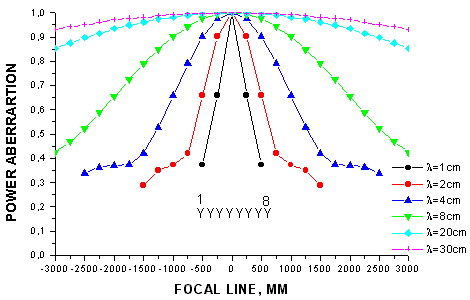
So it looks very attractive to apply multi-beem feed arrays in "Radio-Schmidt" mode[4].
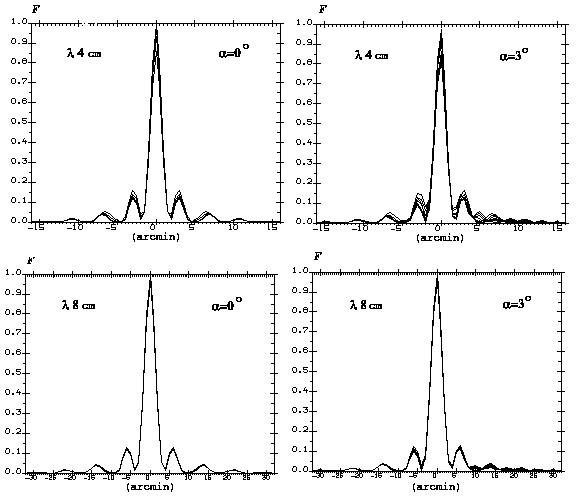
Sun tracking and repeated observations at longest wavelengths (more than 8 cm) are available at RATAN-600 in quazi-Schmidt mode with the unmovable Main mirror and reduced or "shortened" aperture (less than 100 m) even with the flat Periscope mirror. A first trial Sun tracking during an hour in "quazi-Schmidt" mode with an 80 m aperture is shown in Fig.2. RATAN-600 beam patterns for different elevation angles and azimuths in "Radio-Schmidt" mode (a real non optimal focal way) in are shown in Fig.3.
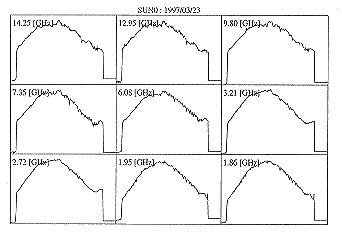
Fig. 2. The Sun in channels of the panoramic analyser of spectrum of the RATAN-600 observation cabin No 3 during trial one hour tracking in quazi-Schmidt mode with 80 m aperture.
1.V.Khaikin, E.Majorova, M.Chukhlebov. RATAN-600 as a "Radio-Schmidt" telescope. XXVII Radioastronomical Conference, v.3, 1997.
2.E.K.Majorova, V.B.Khaikin. Characteristics of RATAN-600 radio telescope as two-mirror aplanatic system. Radiophizika, 2000, 4, pp.1-16.
3.V.B.Khaikin,E.K.Majorova,I.G.Efimov, O.A.Victorov. Long time cosmic source tracking at RATAN-600 in "Radio-Schmidt" mode. Astronomy & Astrophysics Transactions, 2000,N3-4, pp.608-615.
4.V.Khaikin,E.Majorova, R.Shifman, M.Parnes, V.Dobrov,V.Volkov,V.Korolkov and S.Uman
Multi-element MMIC array technologies for a radio telescope. Astronomy & Astrophysics
Transactions, 2000, v.19, N3-4, pp.596-611.