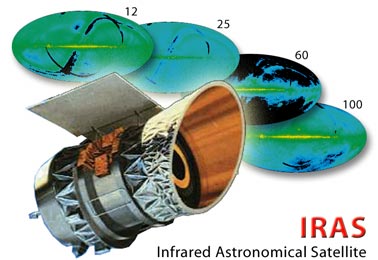
Infrared Astronomical Satellite (IRAS) Overview
The Infrared Astronomical Satellite (IRAS) mission was a collaborative effort by the United States (NASA), the Netherlands (NIVR), and the United Kingdom (SERC). IRAS contained a liquid helium-cooled 0.6 m Ritchey-Chretien telescope. It conducted an all-sky survey at wavelengths ranging from 8 to 120 microns in four broadband photometric channels centered at 12, 25, 60, and 100 microns. The focal plane contained an array of 62 rectangular infrared detectors. The angular resolution varied between about 0.5' at 12 microns to about 2' at 100 microns. Some 250,000 point sources were detected down to a limiting flux density, away from confused regions of the sky, of about 0.5 Jy at 12, 25, and 60 microns and about 1.5 Jy at 100 microns. A catalog of small (< 8') extended sources gives the characteristics of some 20,000 objects down to flux density levels about a factor of three brighter than the point source detection limits. An atlas of images covering the entire sky gives the absolute surface brightness at each of the four survey wavelengths. The positional accuracy of sources detected by IRAS depends on their size, brightness and spectral energy distribution but is usually better than 20". For the all-sky survey the satellite scanned at 3.85' per second along arcs of constant Solar elongation close to 90°. IRAS also made pointed observations of selected objects with integration times lasting up to 12 minutes, providing up to a factor of 10 increase in sensitivity relative to that of the survey. In addition to the main survey instrument, two other instruments - A Low Resolution Spectrometer (LRS) and a Chopped Photometric Channel (CPC) - were colocated with the photometric detector array in the focal plane. The LRS provided 8-22 micron spectra of approximately 5000 survey sources brighter than 10 Jy at 12 and 25 microns. The CPC made 50 and 100 micron maps by scanning in raster fashion with a circular 1.2' diameter aperture, however the detectors behaved anomalously and yielded data of lower quality than expected. Following a 10 month long mission, IRAS exhausted its cryogen and ceased operations on November 21, 1983. |