
· Project Overview
· Instrument
· Technology
» Science
· Collaboration
· Talks and Papers
Postscript of above figure
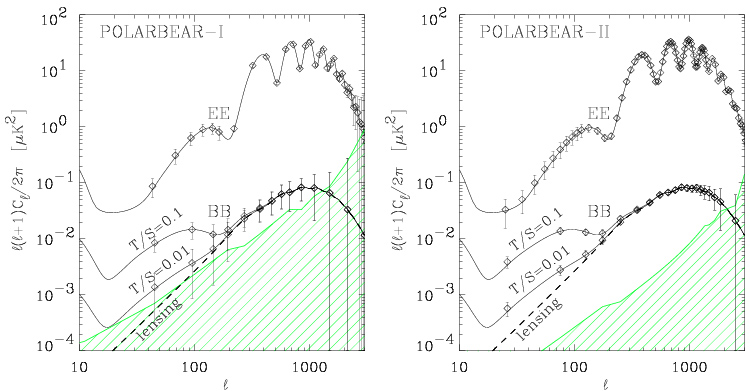
Simulated results from POLARBEAR-I (left) and POLARBEAR-II (right). In both panels, the lines from top to bottom on the left are: The E-mode spectrum, the B-mode spectrum for r = 0.1, the B-mode spectrum for r = 0.01, and the B-mode spectrum for r = 0 (dashed). All the B-mode spectra include the gravitationally lensed B-mode spectrum. The top three lines show the error bars that can be achieved with POLARBEAR. The shaded region shows the upper limits that could be set assuming the sky had no polarized signal, which gives a generic view of the sensitivity. The E-mode spectrum is well resolved deep into the damping tail at high l. The r = 0.1 and r = 0.01 spectra can be readily detected by POLARBEAR without subtracting the lensed spectrum. POLARBEAR will dig deeper than r = 0.01, but subtraction of the lensing signal is required, setting a limit on the lowest r that can be probed.
Polarbear-I Experimental specifications
| Freq [GHz] | Beam [arcmin] | # Detectors (2 per pixel) | NEQ/NEU [micro-k sqrt(sec)] | Area [sq. deg] | Noise Q/U [micro-K] | Noise (30' pix) Q/U [micro-K] | r=T/S (limit) |
| 90 | 6.7 | 104 | 310 | 500 | 2.3 | 0.51 | 0.05 |
| 150 | 4 | 160 | 345 | 500 | 3.5 | 0.46 | |
| 220 | 2.7 | 96 | 640 | 500 | 12.3 | 1.1 |
Polarbear-II Experimental specifications
| Freq [GHz] | Beam [arcmin] | # Detectors (2 per pixel) | NEQ/NEU [micro-k sqrt(sec)] | Area [sq. deg] | Noise Q/U [micro-K] | Noise (30' pix) Q/U [micro-K] | r=T/S (limit) |
| 90 | 6.7 | 400 | 310 | 1000 | 1.7 | 0.37 | 0.015 |
| 150 | 4 | 600 | 345 | 1000 | 2.5 | 0.34 | |
| 220 | 2.7 | 200 | 640 | 1000 | 12.0 | 1.1 |
Experimental specifications for POLARBEAR-I and POLARBEAR-II. Each campaign will last for 18 months with a 30% duty cycle. NEQ and NEU are noise equivalent temperatures for the Q and U stokes parameters. Each pixel has requires two bolometers to achieve quoted NEQ/NEU. Area is the total area of the CMB scan, which includes four patches. Noise for a 30’ pixel gives the noise on the scale of the inflationary signal. r = T/S is the limit in tensor to scalar ratio for inflationary signal search, which in turn gives the limit on the energy of inflation.