
· Project Overview
· Instrument
· Technology
· Bolometers
» Multiplexing
· Science
· Collaboration
· Talks and Papers
|
Large arrays of bolometric detectors require sophisticated readout schemes.
To reduce thermal loading onto the coldest stages of the experiment and to
reduce the complexity of instrumenting large arrays, the readout of these arrays
is multiplexed. The readout multiplexing scheme that has been developed and
demonstrated at Berkeley is frequency-domain multiplexing. Each sensor
is biased with a sinusoidal voltage at a unique frequency. The sensor signals
are thus separated in frequency space and can by summed before being readout
by SQUID electronics (superconducting quantum interference device).
Each sensor is placed in series with a tuned filter consisting of an
inductor and a capacitor with values chosen to give center frequencies
from 300 kHz to 1 MHz.
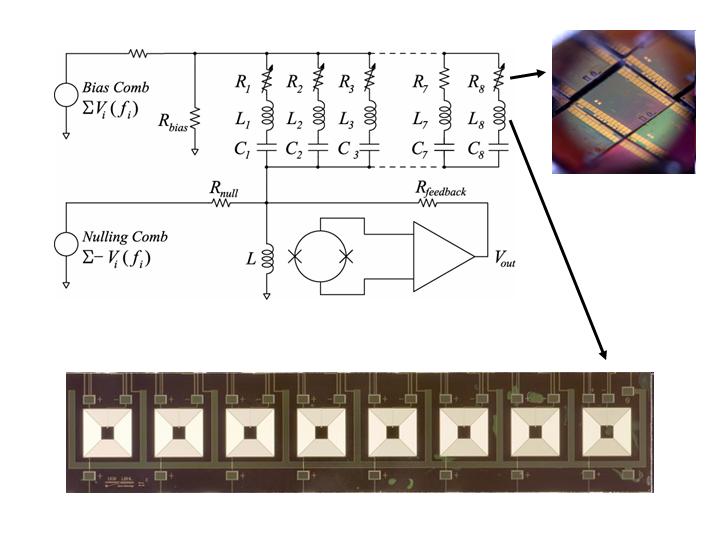
Pictured above is a schematic outlining the demonstration of an eight-channel
readout multiplexer. Also shown is a picture of the inductor chip.
The chips were manufactured at TRW-Northrop Grumman and each chip contains eight inductors.
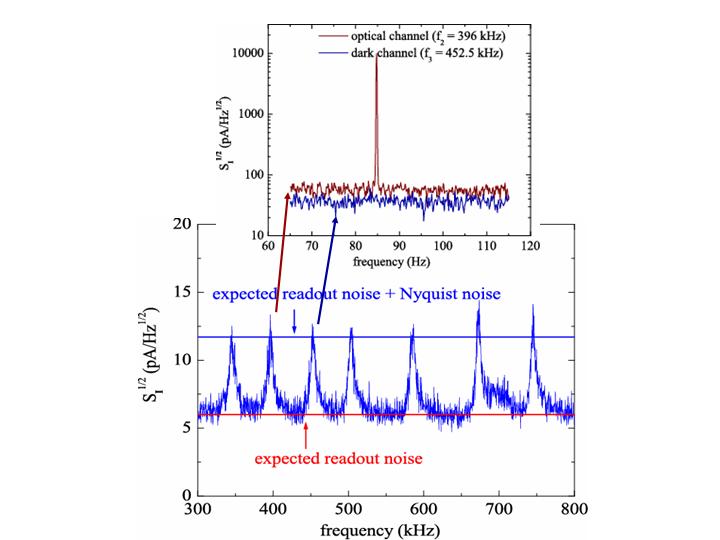
Pictured below is a spectrum across the readout multiplexer bandwidth
showing Nyquist noise from the multiplexed sensors well above the
expected readout noise. The sensor biased at 396 kHz sees an optical
signal from a cooled LED and the adjacent sensor is monitored for
crosstalk. The crosstalk is well below design requirements.
|