


Green has produced a revised catalogue of 182 Galactic SNRs (Green,
in press a), and used this to constrain the distribution of SNRs with Galactocentric
radius (Green, in press b). By comparing the observed Galactic longitude distribution
of high surface brightness SNRs with that expected from simple models -- which
avoids some of the problems with selection effects and the lack of distances
-- a Gaussian scale length of  kpc in Galactocentric radius is
obtained for SNRs, which is quite different from some other recently published
results. Green & Joncas (1994) present observations of the Galactic plane near
kpc in Galactocentric radius is
obtained for SNRs, which is quite different from some other recently published
results. Green & Joncas (1994) present observations of the Galactic plane near
 , which include evidence for a possible new SNR G104.7+2.8.
Pooley and Green detected radio emission from SN1993J with the Ryle Telescope
at 15.25GHz on April 4, which was the first detection reported (by IAU
Circular) of radio emission from this nearby SN (Pooley & Green 1993a,b; Green
& Pooley 1993). The emission was detected only 8d after the supernova
explosion, which is the earliest that radio emission has been detected from a
radio SN. This emission rose at an approximately constant rate for the next
30d, peaking about 75d after the explosion. Subsequently the emission
showed a general decline, with variations on a time-scale of weeks. The general
form of evolution is similar to that expected from `mini-shell' models of radio
supernovae, although it is impossible to fit the long, steady rise in emission
with the available models (Pooley & Green 1993c; Green & Pooley in press). This
implies either non-spherical mass loss, or a density gradient different from
the  expected from a constant-velocity wind.
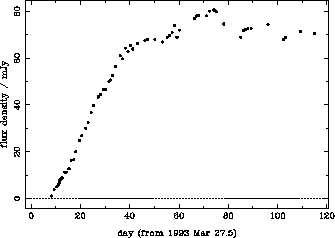
Figure 9:
15.25GHz flux of SN1993J, as a function of time
from optically inferred explosion date.