


Next: Observation log for June-July Up: thesis Previous: Summary Contents
 in the figure is within the
image plane of the telescope. The contribution to the optical flux at
this point can be determined by first selecting a plane
in the figure is within the
image plane of the telescope. The contribution to the optical flux at
this point can be determined by first selecting a plane  which is
perpendicular to the line of sight from (joining the point and
the centre of the lens in Figure A.1). The
integral of the complex wavefunction across the plane determines
the contribution to the wavefunction amplitude at point . The
photon flux is proportional to the square of this amplitude.
which is
perpendicular to the line of sight from (joining the point and
the centre of the lens in Figure A.1). The
integral of the complex wavefunction across the plane determines
the contribution to the wavefunction amplitude at point . The
photon flux is proportional to the square of this amplitude.
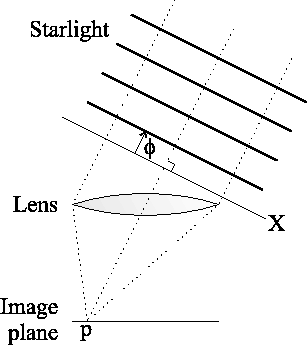 |
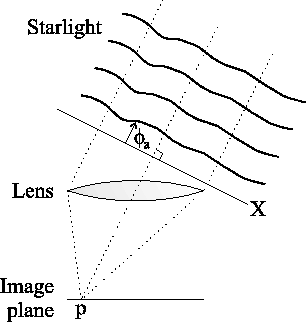
Figure A.2 shows the same situation as
Figure A.1, but the incoming wavefronts have been
perturbed by the atmosphere. The phase fluctuations will affect the
integral of the wavefunction over plane altering the measured
intensity at point .
 |
For the case of a single wind-blown Taylor screen, the phase
perturbations introduced by the atmosphere will be translated
laterally across the telescope aperture by the wind with no change in
the structure of these perturbations. The modulus of the integral of
the wavefunction over the plane is not directly affected by the
lateral motion of the phase fluctuations, but the motion of the screen
introduces new phase perturbations at the upwind side of the aperture
and removes phase perturbations at the downwind side. This can be seen
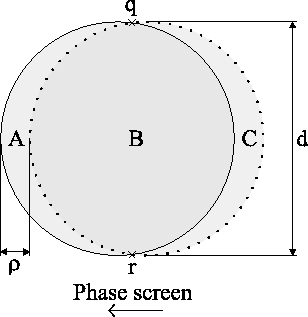
clearly if the outline of the telescope aperture is projected along
the line of sight from onto the Taylor screen, as shown by the
solid circle in Figure A.3. After time has elapsed
and the wind-blown Taylor screen has moved a distance  , the
outline of telescope aperture will be projected onto the dotted
circle. Area
, the
outline of telescope aperture will be projected onto the dotted
circle. Area  is common to both timepoints and will contribute
equally to the amplitude of the wavefunction at point in the image
plane, but the contribution from area
is common to both timepoints and will contribute
equally to the amplitude of the wavefunction at point in the image
plane, but the contribution from area  will be lost, and a new
contribution from area
will be lost, and a new
contribution from area  will be included at the later timepoint. In
reality, the atmospheric phase in areas and will remain
correlated to that in area over a region extending approximately
will be included at the later timepoint. In
reality, the atmospheric phase in areas and will remain
correlated to that in area over a region extending approximately
 from the boundary of area , but for the particular case of
large diameter apertures this only has a small effect on our
calculations and will be neglected in this simple approximation.
from the boundary of area , but for the particular case of
large diameter apertures this only has a small effect on our
calculations and will be neglected in this simple approximation.
 |
We can write the contributions  ,
,  and
and  to the wavefunction at point from areas , and
respectively as:
to the wavefunction at point from areas , and
respectively as:
where  ,
,  and
and  describe the amplitudes
and
describe the amplitudes
and  ,
,  and
and  the phases of these
contributions. If the linear dimensions of areas , and in
Figure A.3 are much larger than , then the
phases , and will not be correlated
with each other, as the structure function of
Equation 1.3 indicates that the typical phase
variation between points separated by distances much greater
will be many cycles in magnitude.
the phases of these
contributions. If the linear dimensions of areas , and in
Figure A.3 are much larger than , then the
phases , and will not be correlated
with each other, as the structure function of
Equation 1.3 indicates that the typical phase
variation between points separated by distances much greater
will be many cycles in magnitude.
If the linear dimensions of areas , and are much larger
than then the ensemble average amplitudes
 ,
,
 and
and
 will be
proportional to the square root of the areas of , and
respectively. This can most clearly be seen if we imagine utilising a
telescope whose aperture has the same size and shape as one of these
three regions. The atmospheric seeing will generate an image with a
FWHM of approximately
will be
proportional to the square root of the areas of , and
respectively. This can most clearly be seen if we imagine utilising a
telescope whose aperture has the same size and shape as one of these
three regions. The atmospheric seeing will generate an image with a
FWHM of approximately  regardless of the aperture size
and shape (as long as the aperture is much larger than ), with
an average intensity proportional to the area of the aperture.
regardless of the aperture size
and shape (as long as the aperture is much larger than ), with
an average intensity proportional to the area of the aperture.
As the phases , and are not
correlated with each other, if the light from more than one of the
these regions is combined then the ensemble averages of the relevant
amplitudes must be added in quadrature to give the total amplitude. It
is useful to consider three ensemble average intensities
 ,
,
 and
and
 which describe the contributions from the areas , and as
follows:
which describe the contributions from the areas , and as
follows:
 |
 |
 |
(A.4) |
 |
|
 |
(A.5) |
 |
|
 |
(A.6) |
, and
are not correlated (not coherent), the ensemble average
intensities
,
and
can be summed linearly. As the areas of
and are equal, the corresponding ensemble average intensities will
be equal:
 |
(A.7) |
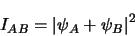
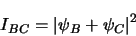
We are interested in the intensity  produced at the first
timepoint when light from areas and is combined:
produced at the first
timepoint when light from areas and is combined:
 |
(A.8) |
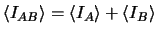
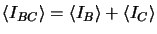
 from areas and , corresponding to a
time when the Taylor screen has moved by a distance in
Figure A.3:
from areas and , corresponding to a
time when the Taylor screen has moved by a distance in
Figure A.3:
 |
(A.9) |
 |
(A.10) | ||
 |
(A.11) |
, the combined
intensities
 and
and
 will be independent of the offset .
The value of
is directly dependent on
. For non-zero values of
, the
fluctuations in the instantaneous intensities and
will be correlated, as both intensities include a contribution from
. Conversely, if the value of
were
zero then the contribution would be zero, and fluctuations
in and would be completely uncorrelated. We are
interested in determining the size of the contribution
for which the correlation between fluctuations in
and has dropped by a factor of  . As the wavefront
components , and are uncorrelated
Rayleigh distributions, this will be true when the ensemble average
intensity
from area contributes
. As the wavefront
components , and are uncorrelated
Rayleigh distributions, this will be true when the ensemble average
intensity
from area contributes
 of the total intensity:
The intensity
will obey
Equation A.12 when areas and are related as
follows:
 |
(A.13) |
If the telescope aperture is described by a function
 such as the example case in
Equation 1.7, then area of overlap
between two offset apertures comes directly from the autocorrelation of
this function
such as the example case in
Equation 1.7, then area of overlap
between two offset apertures comes directly from the autocorrelation of
this function
 :
:
 |
(A.14) |
.
For the simple case presented in Figure A.3 of a
filled circular aperture of diameter  , the area of overlap can
be calculated geometrically. The line joining
, the area of overlap can
be calculated geometrically. The line joining  and
and  in
Figure A.3 is a chord to both the dotted and filled
circles. is constructed from two symmetric regions either side of
this chord, each having an area:
in
Figure A.3 is a chord to both the dotted and filled
circles. is constructed from two symmetric regions either side of
this chord, each having an area:
is reduced by a factor of
was evaluated numerically as
 for a telescope of
diameter , giving a coherence
timescale:
for a telescope of
diameter , giving a coherence
timescale:
 .
Bob Tubbs
2003-11-14
.
Bob Tubbs
2003-11-14



