


Next: Model descriptions Up: Simple models of the Previous: Simple models of the Contents
 --
--
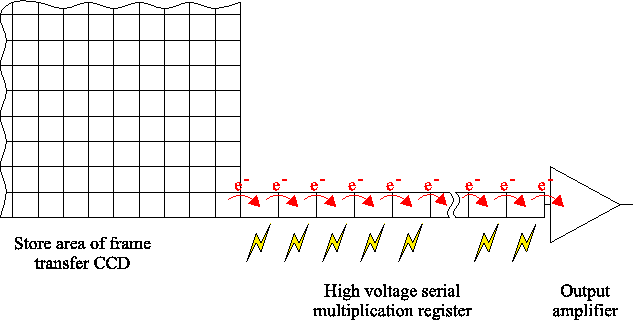
 ). The large
electric fields which are established within the semiconductor
material accelerate charge-carrier electrons to sufficiently high
velocities that additional carriers can be generated by impact
ionisation, as described in Jerram et al. (2001); Burt & Bell (1998). This generates a
small level of charge multiplication (signal gain) in each stage of
the high-voltage multiplication register. The large number of gain
stages in the register can lead to a substantial overall gain in
signal level. The output of the multiplication register is read out
using a conventional CCD amplifier. Measurements in the laboratory did
not show any signs of non-linearity in the multiplication register
when the CCDs were operated at signal levels well below saturation
(Mackay et al. , 2001).
). The large
electric fields which are established within the semiconductor
material accelerate charge-carrier electrons to sufficiently high
velocities that additional carriers can be generated by impact
ionisation, as described in Jerram et al. (2001); Burt & Bell (1998). This generates a
small level of charge multiplication (signal gain) in each stage of
the high-voltage multiplication register. The large number of gain
stages in the register can lead to a substantial overall gain in
signal level. The output of the multiplication register is read out
using a conventional CCD amplifier. Measurements in the laboratory did
not show any signs of non-linearity in the multiplication register
when the CCDs were operated at signal levels well below saturation
(Mackay et al. , 2001).
 |
Bob Tubbs 2003-11-14