


Next: Results from numerical simulations Up: Simple models of the Previous: Signal-to-noise performance Contents
For the case of high multiplication-register gain, the large number of electrons involved in the latter stages of the register make Monte Carlo simulations rather cumbersome. Fortunately the probability distribution for the number of output electrons from my two models of the multiplication register can be calculated directly in a rapid and relatively straightforward manner.
We will start by discussing a single gain stage described by one of
the models from Chapter 4.2.3. As the models are
linear, taking the probability distribution describing the output when
only one electron is input to the gain stage, and convolving this
distribution with itself results in the probability distribution for
the output electrons when two electrons are input. For model 1 we must
convolve Equation 4.2 with itself:
 is the probability distribution for
the total number of output electrons given two input electrons,
is the probability distribution for
the total number of output electrons given two input electrons,
 is the distribution for one input electron
taken from Equation 4.2 and
is the distribution for one input electron
taken from Equation 4.2 and  represents convolution of the probability distributions.
As
and
are
only defined for discrete  , this convolution can be described in
terms of the discrete Fourier transform of
:
, this convolution can be described in
terms of the discrete Fourier transform of
:
![\begin{displaymath}
P_{2e} \left (n \right )=\mbox{DFT} \left [ \mbox{DFT} \left [ P_{1e}\left (n \right )
\right ]^{2} \right ]
\end{displaymath}](img505.png) |
(4.23) |
![$\mbox{DFT} \left [ \ldots \right ]$](img506.png) indicates a discrete
Fourier transform, and
indicates a discrete
Fourier transform, and
![$\mbox{DFT} \left [ \ldots \right ]^2$](img507.png) indicates that the individual Fourier components are
squared. Numerically the discrete Fourier transforms can be performed
using a Fast Fourier Transform algorithm. To limit the calculation
time the probability distribution must be truncated at large . As
long as the truncation occurs at a sufficiently large value of
(with
indicates that the individual Fourier components are
squared. Numerically the discrete Fourier transforms can be performed
using a Fast Fourier Transform algorithm. To limit the calculation
time the probability distribution must be truncated at large . As
long as the truncation occurs at a sufficiently large value of
(with
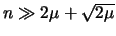 ) there is little loss of accuracy.
For  input electrons entering the gain stage the probability
distribution for , the number of output electrons, is given by:
input electrons entering the gain stage the probability
distribution for , the number of output electrons, is given by:
for one input electron, this equation fully
describes the operation of the gain stage for any number of input
electrons.
The model can be extended by adding another gain stage, situated immediately before the one we have just described. If one electron enters the new, additional gain stage, the probability distribution for the output electrons from the new stage can be calculated as before. Each possible outcome of this stage is dealt with separately and fed into the model for the next gain stage (based on Equation 4.24). The outcomes are weighted by the appropriate probabilities and summed to give the probability distribution for the total number of output electrons from the combined two-gain-stage system for one input electron.
The probability distribution for one electron entering the
two-gain-stage system can be convolved with itself to give the
probability distributions for input electrons, in the same way as
for Equations 4.22 to
4.24.
The process can be repeated to convert a two-gain-stage system into a three-gain-stage system, and so on for an arbitrary number of gain stages. To minimise the computation time, it is best to work entirely in the discrete Fourier domain, and only return to the probability domain at the end of the calculations.
A multiplication register where each gain stage was defined by model 2 was also simulated using the same approach. The same convolution procedure can be applied to any linear model of one individual gain stage in order to provide a model for a multi-stage multiplication register.

![\begin{displaymath}
P\left (m,n\right ) =\mbox{DFT} \left [ \mbox{DFT} \left [ P_{1e}\left
(n \right ) \right ]^{m} \right ]
\end{displaymath}](img509.png)