


Next: Conclusions Up: Charge transfer efficiency problems Previous: Charge transfer efficiency problems Contents
Short exposure images were taken of a camera ``test card'' transparency using standard slide-copying optics, with a CCD65 detector in the camera. The voltage settings on the camera were such that the charge transfer efficiency deviated significantly from unity at low signal levels. At high signal levels the images of the test card showed a high degree of fine structure, ideal for charge transfer efficiency measurements.
Datasets of  images each were taken operating the CCD65 at high
multiplication register gain with exposure times of
images each were taken operating the CCD65 at high
multiplication register gain with exposure times of 
 and
and

 . In the test card images these light levels corresponded to
 --
-- photons per pixel per frame and
  --
-- photons per
pixel per frame respectively. Ten exposures of were also
taken with no multiplication register gain to provide an accurate
representation of the test card at high signal level. There was no
evidence for charge transfer efficiency problems in these long exposure
images.
photons per
pixel per frame respectively. Ten exposures of were also
taken with no multiplication register gain to provide an accurate
representation of the test card at high signal level. There was no
evidence for charge transfer efficiency problems in these long exposure
images.
The raw images did not show any visual evidence for poor charge
transfer efficiency, but the signal level was too low in the
individual exposures to make an accurate
assessment. Software was written by the author to combine the short
exposures and deconvolve the resulting images in order to make a
quantitive assessment of the charge transfer efficiency.
The exposures were co-added to increase the signal-to-noise,
as were the and exposures. The summed images from
the and exposures were then deconvolved using the
summed image from the long exposures in order to give a ``PSF'' which
described the charge transfer efficiency problems at low light
levels. The fraction of the signal residing a given number of pixels
from the origin of this PSF corresponds to the fraction of electrons
which have been displaced by this distance due to charge transfer
efficiency problems. In order to control the noise in the
deconvolution process, a 2-D version of the Nahman-Guillaume one
parameter filter was used (Nahman & Guillaume, 1981). The filter parameter was
adjusted until there was good dynamic range between the central peak
of the PSF and the noise floor in the wings. In order to confirm that
the filter was not adversely affecting the shape of the PSF, different
long exposure images were deconvolved in the same way, providing a
strongly peaked response at the origin which dropped to the noise
floor within two pixels of the origin.
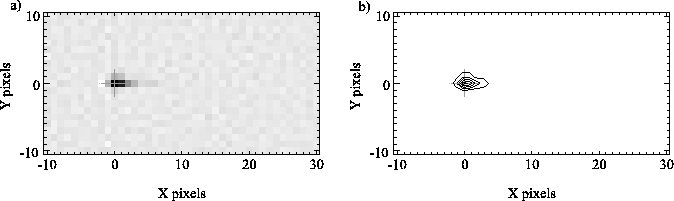
Figure 4.10 shows the result of deconvolving a section of the
summed image from the exposures. The PSF shows a strong peak
at the origin corresponding to those electrons which were transferred
with good charge transfer efficiency. Weak tails extend both to the
right and upwards, indicating that some of the photo-electrons are
experiencing much poorer charge transfer efficiency for either
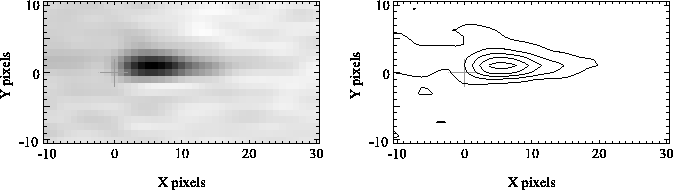
horizontal or vertical transfers. With the shorter exposures (having
fewer photons per pixel), the strong peak at the origin disappears,
and the tails to the right and in the upwards direction are broadened
and strongly enhanced to form a single peak offset from the origin, as
shown by Figure 4.11.
 |
 |
A PSF was calculated in this way for different regions of the test
card image using the exposures. The horizontal offset and
vertical offset of the peak in the PSF was found to depend linearly
on the horizontal position and vertical position respectively in the
image. This is consistent with charge transfer efficiency problems in
the image and store areas of the CCD, as electrons which are generated
further from the readout register must undergo a larger number of
transfers.
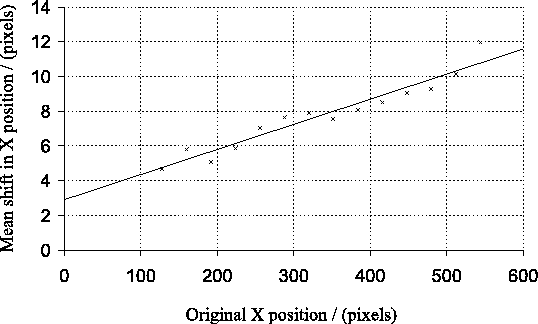
Figure 4.12 shows a plot of the horizontal offset in the PSF
peak against the horizontal (`` '') position of the region used for
the calculations. The data points are fit by a line which crosses the
-axis at an value of
'') position of the region used for
the calculations. The data points are fit by a line which crosses the
-axis at an value of  . This implies that a significant
fraction of the charge transfer efficiency loss is occurring after the
signal has left the image and store areas of the CCD, and is
presumably occurring in the multiplication register. The bulk of the
charge transfer efficiency losses do seem to occur in horizontal
(serial) transfers in the store area of the CCD, however. The gradient
of the line in Figure 4.12 indicates that electrons are being
``left behind'' in
. This implies that a significant
fraction of the charge transfer efficiency loss is occurring after the
signal has left the image and store areas of the CCD, and is
presumably occurring in the multiplication register. The bulk of the
charge transfer efficiency losses do seem to occur in horizontal
(serial) transfers in the store area of the CCD, however. The gradient
of the line in Figure 4.12 indicates that electrons are being
``left behind'' in  of the serial transfers in the store area
of the CCD for these measurements.
of the serial transfers in the store area
of the CCD for these measurements.
 |
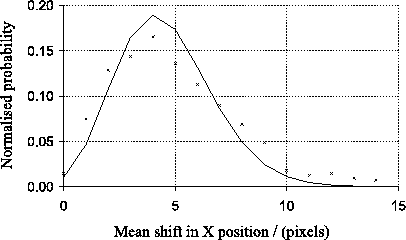
A cross section through the PSF calculated for a region centred on
 pixels is shown in Figure 4.13. The curve is
similar in shape to the binomial distribution which would be expected
if it was the result of
pixels is shown in Figure 4.13. The curve is
similar in shape to the binomial distribution which would be expected
if it was the result of  transfers attempts, each having a
chance of failing to transfer the electron.
transfers attempts, each having a
chance of failing to transfer the electron.
 |
The charge transfer efficiency was found to be strongly dependent on the (variable) operating voltages and environmental conditions of the camera. It was possible to get very good charge transfer efficiency in the laboratory with the CCD87 by selecting appropriate operating conditions. The operating voltages used during observations at the NOT are not precisely known, and for this reason it will not be possible to predict the charge transfer efficiency which was present for observations at the NOT.
The experimental measurements and calculations of charge transfer efficiency at low signal level are currently relatively time consuming, and require an image with suitably fine structure to be projected on to the CCD in a stable experimental setup. It would be extremely beneficial if an automated approach to this analysis could be developed which could be performed when the camera was at an astronomical telescope, so that the charge transfer efficiency could be maximised before astronomical observations began.

