cjo25
Summary and figures of the currently available experimental data on CMB temperature anisotropies. A couple of packages for download, including a C version of the WMAP likelihood code.
NEWS
previous news
- 10.07.03: I am now in Switzerland. News and features on this page.
- 01.07.03: New 'Talks and posters' page here with abstracts and downloads of slides and posters in PDF format.
- 01.07.03: I have come back from Wales and I have put the slides of my seminar here. I am on my way to Switzeland to write up and any other plans can be found here.
- 28.05.03: Less cluttered navigation. Publications now available here. Also, I have added an online research proposal here.
- 16.05.03: Another update, another design :). I have now written my WMAP page with a C version of the likelihood code for download and some recent results.
List of publications with abstracts and links.
List of talks an posters with abstracts and downloads.
|
|
WELCOME
to Carolina's web page
Where I come from (Aubonne and Verbier)
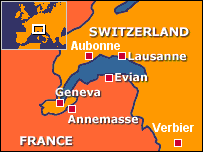
this image was taken from here and modified.
News from the "bang bodies": New observations of distant supernovae released!
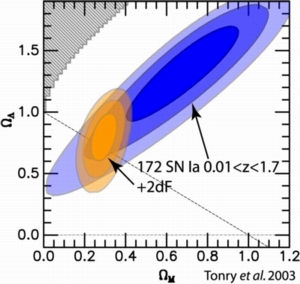
Image taken from Tonry & al.
Congratulations to the High-Z Supernova search!
These measurments are independent of structure formation. Their importance in breaking the cosmic parameter space degeneracies is crucial! The new data agree with the 'Standard' Λ-CDM model.
Brief facts:
- distant stars indeed!:
The new results include start in a redshift interval z=0.3-1.2 at a mean redshift of 0.5.
- Hubble parameter and age of the universe:
The equation of state parameter of the dark energy is w = -1, then H0 t0 = 0.96±0.04
- Little matter:
Considering a flat universe, they also find Ωm = 0.28 ± 0.05.
News from the CMB: Wilkinson Microwave Anisotropy Probe (local page here)
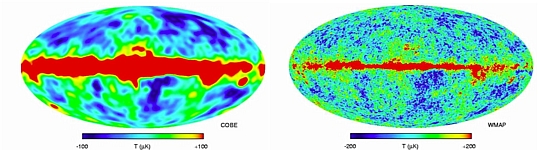
Congratulations to the WMAP team!
The Cosmic Microwave Background (CMB) is a relic radiation from the very early universe. It was emitted when the universe was only about 380,000 years of age, according to the WMAP observations.
Other major breakthroughs from the WMAP experiment are:
- The first stars started shining about 200 million years after the Big Bang.
The CMB photons reach us almost untouched since they were emitted. However, as the first stars started shining, reionizing the universe, the newly released charged particles interacted with the CMB photons. The signature of this event has been measured for the first time by the WMAP experiment.
- The universe is 13.7 billion years old
Careful, though: this is the case if the theoretical framework and the resulting scenario of structure formation in the universe is valid. But the more experimental data become available, the more compelling the evidence that this framework represents a successful (and sufficient) description of the universe.
- The universe is flat, and we don't know what it's made of.
Oh yes, there are a few baryons (4%), photons (less) and neutrinos (less again). But most of it is different from what we know. Cold Dark Matter (23%) is some exotic collisionless stuff that clusters but doesn't shine. Dark Energy (73%) is even more mysterious! Peebles and Ratra offer an interesting review of Dark energy here.
- Inflation, inflation...
Not only does it predict a flat Universe, but it should leave a distinct signature in the polarization of the CMB. That signal was detected by WMAP. Other main conclusions from the scenarii the WMAP observations favour are a value of the Hubble parameter H0 of about 70 km/sec/Mpc, and a very lonely future as the universe expands forever... (sigh)
|
|
