
 postscript
2 Model...
postscript
2 Model...
 Abstract...
 4 Effect on the ...
In this section, we model the formation of a very rich Abell cluster. The characteristics (see table 1) are chosen to be similar to those of the clusters described in Quilis et al. (1995) and Panek (1992) so that our results can be compared.
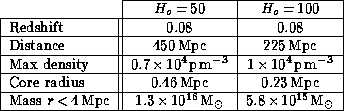
Table 1: Cluster characteristics.
The cluster is placed at a redshift  , with a core radius
 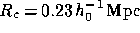 (
( is defined as the radius at which the cluster
energy falls to one-half its maximum value). The maximal baryonic density
is defined as the radius at which the cluster
energy falls to one-half its maximum value). The maximal baryonic density
 encounter by an observed photon is taken to be
 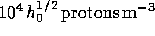 and the baryon to dark-matter mass ratio is assumed
to be 0.1. The
and the baryon to dark-matter mass ratio is assumed
to be 0.1. The  -dependencies for
  and
and  ensure that the
observed cluster characteristics (i.e. angular size and X-ray luminosity) are
independent of the Hubble parameter. Throughout this paper we assume
ensure that the
observed cluster characteristics (i.e. angular size and X-ray luminosity) are
independent of the Hubble parameter. Throughout this paper we assume
 .
.
Figure 3 shows the fluid density and the fluid velocity as a function of proper time as experienced by a photon which travels straight through the centre of the cluster. From the figure we see clearly that the fluid distributions are continuous.
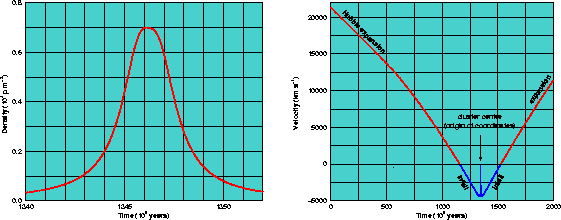
Figure 3: Plot of the fluid density (left) and fluid
velocity (right) as experienced by the photon while it is travelling through
the Universe and the collapsing cluster. The horizontal axis marks the time
prior to the present epoch in millions of years. We assume  .
.
We next consider (fig 4) the density profile of the cluster at
the time 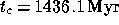 ago, when the photon experienced the maximum
density
ago, when the photon experienced the maximum
density  . In order to check that the
obtained density distribution is of realistic shape, we fit our profile to the
equilibrium spherical King model (King (1966)):
. In order to check that the
obtained density distribution is of realistic shape, we fit our profile to the
equilibrium spherical King model (King (1966)):
where  is the central density of the cluster,
  represents some
core radius and
represents some
core radius and  is the conventional power-law index for such models.
The results of a simple least-squares fit are
is the conventional power-law index for such models.
The results of a simple least-squares fit are  ,
,  and
and
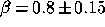 . The result of this fit is very encouraging since it shows
that our model leads to a radial density profile that matches quite closely
those of observed clusters.
. The result of this fit is very encouraging since it shows
that our model leads to a radial density profile that matches quite closely
those of observed clusters.
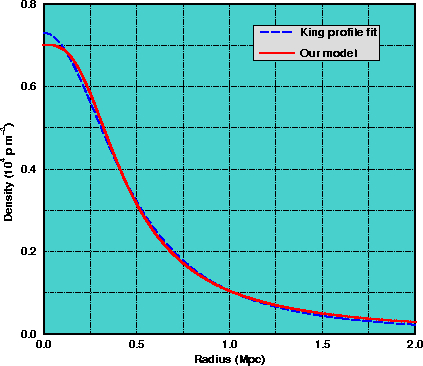
Figure 4: Plot of the density when the photon is
at the centre of the cluster. The obtained profile is realistic since
it can be fitted by a spherical King model.
