


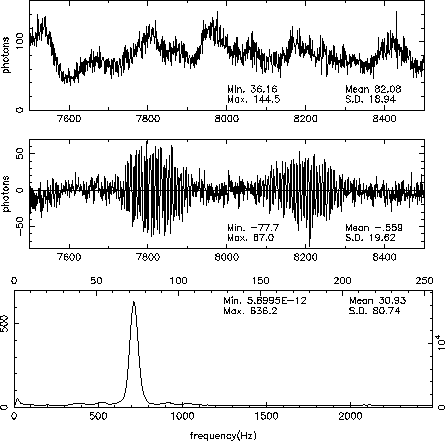
Figure 11:
54 milliarcsecond interference fringes from Capella using COAST;
 ,
,  .
a) sum of detector outputs showing stellar scintillation. Time unit
= 0.2ms.
b) difference of detector outputs showing result of sweeps in path
delay of twice the coherence length of the fringe envelope.
c) power spectrum of the fringes from a 10s run, used to determine
fringe visibility.
.
a) sum of detector outputs showing stellar scintillation. Time unit
= 0.2ms.
b) difference of detector outputs showing result of sweeps in path
delay of twice the coherence length of the fringe envelope.
c) power spectrum of the fringes from a 10s run, used to determine
fringe visibility.
The main constructional phase has now been completed. COAST consists,
as planned, of four 40cm afocal Cassegrain telescopes whose output
beams are fed to the thermally-stable optics building. This houses the
continuously-variable optical path delays needed to correct for the
Earth's rotation, the combining optics for the four beams, and
photon-counting detectors for the interference fringes. It also
contains the CCD camera which provides both acquisition information and
fast tip-tilt correction signals for the piezo-driven mirrors on all
four telescopes. The principal aspects of COAST have been reviewed
(Baldwin et al. 1994a), and a further paper (Baldwin et al. 1994b) describes its
operation and the results obtained on astronomical sources. The overall
mechanical and optical stability of COAST is very good. At all times the
differential optical path fluctuations internal to the array are much smaller
than those imposed by the atmosphere above the telescopes (Haniff et al. 1994)
and are as small as  under good conditions. The interferometer
baselines are known to a precision of about
under good conditions. The interferometer
baselines are known to a precision of about  and appear to be stable
from night to night to about
and appear to be stable
from night to night to about  . This allows interference fringes on a
star to be tracked for several hours without intervention by the observer.
Fringes of high quality can be acquired regularly under good atmospheric
conditions (Fig 11).
Current instrumental activity is centered on commissioning of the final
telescope and path-delay trolleys into the array, and of the NICMOS3
camera for the near infrared. Analytical effort concentrates on calibration
of the stellar fringe visibilities and closure-phases, preparatory to
obtaining the first images with COAST.
. This allows interference fringes on a
star to be tracked for several hours without intervention by the observer.
Fringes of high quality can be acquired regularly under good atmospheric
conditions (Fig 11).
Current instrumental activity is centered on commissioning of the final
telescope and path-delay trolleys into the array, and of the NICMOS3
camera for the near infrared. Analytical effort concentrates on calibration
of the stellar fringe visibilities and closure-phases, preparatory to
obtaining the first images with COAST.
The techniques developed in COAST for precisely superimposing pupils from each of the telescopes have direct application in other areas of adaptive optics. We have developed a fast Wave Front Sensor for the MARTINI (Durham) system based on a low-noise CCD chip, which is to be used on the WHT in early 1995. We have also designed and are now building a Wave Front Sensor for characterization of atmospheric seeing on millisecond timescales at the WHT as part of the JOSE Adaptive Optics programme.