


This has been a period of intense activity in our cosmic microwave background (CMB) research. We have research projects devoted to studying both primary CMB anisotropies at intermediate and large angular scales, and small-scale secondary anisotropies.
 scale
scale
The ultimate objective of primordial CMB observations is the mapping of the
surface of last scattering at a redshift  . One form of
anisotropy expected is Doppler peaks on scales
. One form of
anisotropy expected is Doppler peaks on scales  . The Cosmic
Anisotropy Telescope (CAT), a three-element interferometer of novel design, has
been built to study this regime, and in the period of this report has moved
from the construction phase to producing significant scientific results. After
a period of commissioning it began astronomical observations in the summer of
1993. For about 60% of the time the atmospheric conditions at Lord's Bridge
allow unhindered operation, with residual tropospheric emission below the
instrumental noise level even in integrations of several hundred hours (Robson
et al. 1994).
. The Cosmic
Anisotropy Telescope (CAT), a three-element interferometer of novel design, has
been built to study this regime, and in the period of this report has moved
from the construction phase to producing significant scientific results. After
a period of commissioning it began astronomical observations in the summer of
1993. For about 60% of the time the atmospheric conditions at Lord's Bridge
allow unhindered operation, with residual tropospheric emission below the
instrumental noise level even in integrations of several hundred hours (Robson
et al. 1994).
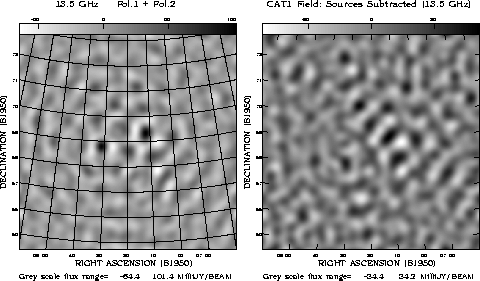
Figure 1:
CAT maps at 13.5 GHz of the field 0820+69 (``CAT1'').
a) The ``raw'' map.
b) Thirty-one foreground radio sources detected by the RT, with a total
flux density of 480 mJy, have been subtracted. There is significant structure
remaining near the centre of the map: this is a combination of fluctuations
in the CMB and the Galaxy.
In the first field chosen for a deep survey, we have now achieved a sensitivity
at 13.5GHz of  , roughly equivalent to
  . After
subtraction of foreground radio sources, using information from the Ryle
Telescope maps, there is a clear detection of an astronomical signal with an
rms of about 18mJy (O'Sullivan et al. in press; Fig 1). Data at other
frequencies are required to distinguish between galactic and CMB components of
this signal; observations are progressing at 14.5, 15.5 and 16.5GHz, and a
preliminary result (Figure 2) shows that some of the same features
are detected at 16.5GHz as at 13.5GHz. We have also begun integrating on a
second deep field, and have observed the Gamma Ursae Minoris region where the
MAX balloon experiment has reported a possible detection of CMB fluctuations.
The CAT limit from this field rules out galactic free--free emission as the
source of the MAX signal.
. After
subtraction of foreground radio sources, using information from the Ryle
Telescope maps, there is a clear detection of an astronomical signal with an
rms of about 18mJy (O'Sullivan et al. in press; Fig 1). Data at other
frequencies are required to distinguish between galactic and CMB components of
this signal; observations are progressing at 14.5, 15.5 and 16.5GHz, and a
preliminary result (Figure 2) shows that some of the same features
are detected at 16.5GHz as at 13.5GHz. We have also begun integrating on a
second deep field, and have observed the Gamma Ursae Minoris region where the
MAX balloon experiment has reported a possible detection of CMB fluctuations.
The CAT limit from this field rules out galactic free--free emission as the
source of the MAX signal.
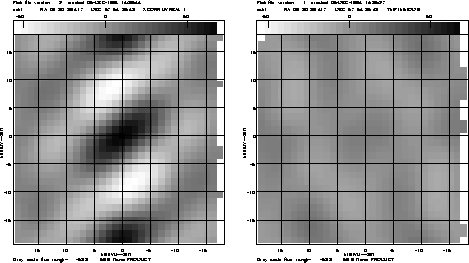
Figure 2:
Two-dimensional cross-correlation functions for the
source-subtracted CAT1 maps at 13.5 and 16.5 GHz.
a) Correlation of the two maps, each made by summing the two polarizations
( ie., signal plus noise).
b) Correlation of the subtracted-polarization maps, ie., just noise.
This shows clearly the
presence of common structures at the two frequencies.
 scale
scale
On scales larger than the horizon scale at recombination (degrees upwards), one
is directly measuring the initial spectrum of fluctuations.
Analysis of the data from
the Tenerife experiment (Hancock et al. 1994) resulted in the first clear
observations of individual primordial CMB structures and confirmed the
statistical excess reported from the NASA COBE satellite. The Tenerife
experiments, designed and built at Jodrell Bank and operated by the IAC,
consist of dual-beam radiometers with a secondary wagging mirror, which
produces a triple beam pattern on the sky. This configuration allows high
sensitivity CMB observations on scales  to be made at
frequencies of 10, 15 and 33GHz from the high-altitude site in
Tenerife.
to be made at
frequencies of 10, 15 and 33GHz from the high-altitude site in
Tenerife.
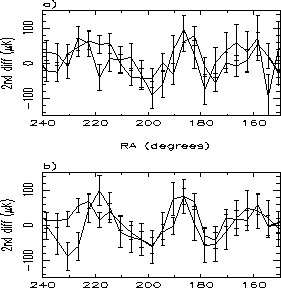
Figure 3:
a) Common structure is present in the independent Tenerife
15GHz (light line) and 33GHz (bold line)
scans. The structure has the properties expected for primordial CMB
fluctuations. The vertical axis represents the second differenced
anntena temperature measurements. b) A comparison of the COBE DMR
two-year data (light line) with the Tenerife 15+33GHz data
(bold line) supports the cosmological origin of the well-defined
features seen in the Tenerife data scan. The vertical
axis is the second differenced thermodynamic temperature.
Deep integrations of a strip of sky at high galactic latitude have been
conducted at all three frequencies. The Tenerife observations currently
provide the highest sensitivity to CMB features on scales greater than the
horizon size at recombination (see Lasenby & Hancock 1994 for a recent
review), achieving an r.m.s. noise of  . The
signal-to-noise ratio of
. The
signal-to-noise ratio of  in the final Tenerife scan (Hancock et al.
in press; Fig 3) allows one to trace out features on the surface of
last scattering, thereby mapping the seed structures present at recombination.
This contrasts with the COBE first-year maps, where no single feature had a
signal to noise of greater than unity.
in the final Tenerife scan (Hancock et al.
in press; Fig 3) allows one to trace out features on the surface of
last scattering, thereby mapping the seed structures present at recombination.
This contrasts with the COBE first-year maps, where no single feature had a
signal to noise of greater than unity.
The recent release of the COBE two-year data has improved this situation,
facilitating a direct comparison of features between the independent COBE and
Tenerife data sets. Hancock and Lasenby, with Lineweaver and Smoot from the
NASA COBE group, and others (Lineweaver et al. submitted), find that there is evidence
for common structure with the properties expected for CMB anisotropy. Using the
amplitudes as measured at  by Tenerife and
  by COBE it is
possible to estimate the slope
by COBE it is
possible to estimate the slope  of the intrinsic fluctuation power spectrum
and hence to directly probe the inflationary theory, which predicts
of the intrinsic fluctuation power spectrum
and hence to directly probe the inflationary theory, which predicts  .
First results show that
.
First results show that  at 95 % confidence.
The Sunyaev--Zel'dovich (S--Z) effect arises from the scattering of
CMB photons to higher energies by the hot intracluster medium in
clusters of galaxies. When combined with X-ray data it can be used to
provide an estimate of the Hubble constant free from the usual
distance-ladder arguments. It also provides new information about the
physics of the cluster gas.
We have been
using the unique capabilities of the Ryle Telescope to make images of
the S--Z effect in moderate- to high-redshift ( )
clusters.
)
clusters.
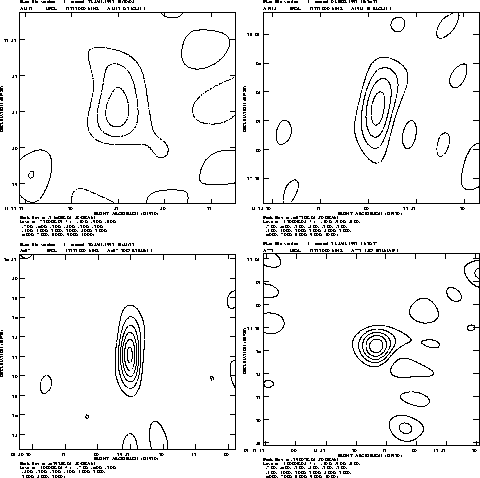
Figure 4:
Some of the S--Z images produced by the Ryle Telescope. The
resolutions vary depending on the declination of the cluster. a) A1413. The
beam is  arcsec. b) A1914;
  arcsec. c) A697;
 arcsec. d) A773;
  arcsec.
Much attention has recently been focussed on the thorny question of
the distance scale. We have used our image of the S--Z effect in
Abell 2218 together with the ROSAT PSPC image and the X-ray spectrum
determined by GINGA to estimate a value of  of
of 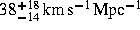 (Jones, in press). This error range,
although wide compared to the errors quoted by distance-ladder
methods, does include realistic estimates of the systematic errors
involved, and is very difficult to reconcile with a value as high
as
(Jones, in press). This error range,
although wide compared to the errors quoted by distance-ladder
methods, does include realistic estimates of the systematic errors
involved, and is very difficult to reconcile with a value as high
as 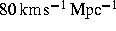 . Together with Edge (IoA) we
have constructed an X-ray-selected sample of clusters which is free
from orientation bias in order to reduce further the systematic
errors, which we have begun systematically to survey. Detection of new
S--Z decrements is now routine ( eg. Grainge et al. 1993;
Saunders, in press) -- we have images of the S--Z effect in seven
clusters: Abell 665, A697, A773, A1413, A1914, A2218 and 0016+16. Some of
the necessary X-ray data for these clusters already exist, for example
as ROSAT pointed observations or ASCA PV phase data, and in
collaboration with Miyoshi (Kyoto) we have obtained ASCA observations
of two more of our sample.
. Together with Edge (IoA) we
have constructed an X-ray-selected sample of clusters which is free
from orientation bias in order to reduce further the systematic
errors, which we have begun systematically to survey. Detection of new
S--Z decrements is now routine ( eg. Grainge et al. 1993;
Saunders, in press) -- we have images of the S--Z effect in seven
clusters: Abell 665, A697, A773, A1413, A1914, A2218 and 0016+16. Some of
the necessary X-ray data for these clusters already exist, for example
as ROSAT pointed observations or ASCA PV phase data, and in
collaboration with Miyoshi (Kyoto) we have obtained ASCA observations
of two more of our sample.
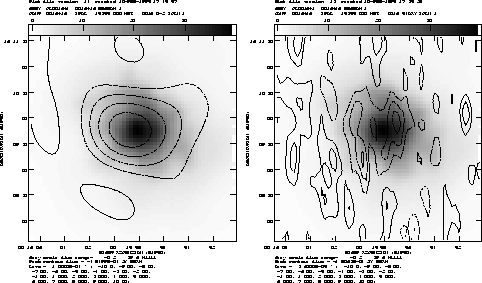
Figure 5:
Ryle Telescope (contours) and ROSAT PSPC (greyscale)
observations of the distant cluster 0016+16.
In a) the resolution of the RT image is  arcsec;
in b) it is
arcsec;
in b) it is  arcsec, and shows distinct
substructure not present in the X-ray image (whose resolution is
arcsec, and shows distinct
substructure not present in the X-ray image (whose resolution is  arcsec).
S--Z images can provide valuable insights into the properties of
individual clusters. Fig. 5 shows two Ryle Telescope images
of the distant ( ) cluster 0016+16, superposed on the ROSAT
PSPC X-ray image. At low resolution, the S--Z image follows the X-ray
emission quite closely, but at higher resolution the S--Z image shows
structure, which may be due to temperature substructure within the
cluster. With a combination of S--Z, optical and X-ray data, a picture
is emerging that this high
) cluster 0016+16, superposed on the ROSAT
PSPC X-ray image. At low resolution, the S--Z image follows the X-ray
emission quite closely, but at higher resolution the S--Z image shows
structure, which may be due to temperature substructure within the
cluster. With a combination of S--Z, optical and X-ray data, a picture
is emerging that this high  cluster is in the last stages of a
merger between two ``proto'' clusters, whose nuclei are still
distinct.
cluster is in the last stages of a
merger between two ``proto'' clusters, whose nuclei are still
distinct.