


Our study of the physics of powerful extragalactic radio sources is concentrated mainly on source asymmetries and jet structure. Our low frequency surveys are proving a fruitful hunting ground for interesting objects, particularly those at high redshifts. During the period covered by this report, it has become clear that millimetre-wave spectral-line and continuum observations can potentially tell us a great deal about the contribution of star formation activity to the luminosities of distant radiogalaxies and QSOs, and we have several programs in this area.
Multi-frequency VLA observations and modelling work have provided new insight into the origin of the spectral index asymmetries observed in the two lobes of radio galaxies. Bridle et al. (1994) find that 7 out of 8 quasars they studied show a flatter spectrum on the jet side, which is not confined to the hotspots. Their observations indicate that both orientation-dependent and environmental factors play well-defined parts, though the relevant mechanisms are not obvious. Blundell & Alexander (1994) show that it is possible to obtain a very significant spectral index asymmetry from projection effects alone, provided that the magnetic flux density within the source decreases as it evolves.
We are investigating the physics of jets in both FRI and FRII sources
using high-resolution high-sensitivity VLA observations. We have found evidence
that the jets can be described by a two-component model involving a highly
relativistic core and a less relativistic sheath (Fig.6). We are now
extending our work to a larger sample of FRI s. Building on the excellent
observations of Black (1993) we have obtained VLA time for detailed imaging of
a complete sample of 3C sources out to  . The detection rate of jets in
this sample is high --
. The detection rate of jets in
this sample is high --  -- and will allow use to determine the
luminosity function of the jets themselves. When compared to theoretical models
and simulations, these data will provide important information on jet physics
and the efficiency of the AGN.
-- and will allow use to determine the
luminosity function of the jets themselves. When compared to theoretical models
and simulations, these data will provide important information on jet physics
and the efficiency of the AGN.
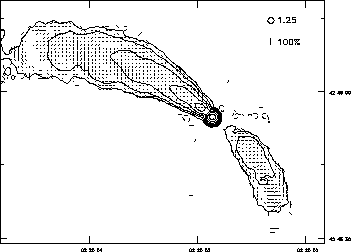
Figure 6:
The 8.4GHz VLA map of the radio jet in 3C66B
with a resolution of 1.25-arcsec (750pc at
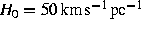 ),
showing vectors indicating the
direction of the B-field superimposed on the contours of total intensity. The
jets appear to have two distinct components: an outer sheath in which the
field lines are parallel to the length of the jet, and an inner region in which
the field is parallel to the jet very close to the core (visible in the jet but
not the counterjet here) and then becomes perpendicular after a few kpc.
),
showing vectors indicating the
direction of the B-field superimposed on the contours of total intensity. The
jets appear to have two distinct components: an outer sheath in which the
field lines are parallel to the length of the jet, and an inner region in which
the field is parallel to the jet very close to the core (visible in the jet but
not the counterjet here) and then becomes perpendicular after a few kpc.
Rottgering et al. (1994b) have mapped the rich cluster of galaxies Abell 2256 with the VLA. The very striking radio structure of the sources can be explained in terms of an infalling subcluster which has been inferred from the ROSAT data.
Two further areas of the 7C 151-MHz survey have been published. The first
(Lacy et al. , in press) covers the North Ecliptic Pole ( square
degrees), and has resulted in a catalogue of 400 sources complete to a peak
flux density limit of
square
degrees), and has resulted in a catalogue of 400 sources complete to a peak
flux density limit of 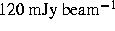 . The Cambridge APM has been used
to search for identifications on the Palomar Sky Survey. The NEP survey has
been used in conjunction with several other surveys to investigate a number
of questions relating to the cosmological evolution of radio sources. The
second area (Visser et al. , in press) was analysed to complement the survey
being carried out by Westerbork (WENSS) at 330MHz. It covers an area of
418 square degrees centered on RA
. The Cambridge APM has been used
to search for identifications on the Palomar Sky Survey. The NEP survey has
been used in conjunction with several other surveys to investigate a number
of questions relating to the cosmological evolution of radio sources. The
second area (Visser et al. , in press) was analysed to complement the survey
being carried out by Westerbork (WENSS) at 330MHz. It covers an area of
418 square degrees centered on RA  , Dec
, Dec  , and includes
2702 sources which have a signal-to-noise ratio
, and includes
2702 sources which have a signal-to-noise ratio  .
.
A revised machine-readable source list for the Rees 38-MHz (8C) survey has
been produced with improved source positions and no redundancy (Hales et al. ,
in press). One of the primary uses of these low-frequency surveys has been to
select sources with extreme spectra. In particular, by concentrating on
samples of radio sources with ultra-steep radio spectra ( , where
 ) many very distant radio galaxies have been found.
Most notable amongst these is 8C1435+635 (Lacy et al. 1994) which, with
) many very distant radio galaxies have been found.
Most notable amongst these is 8C1435+635 (Lacy et al. 1994) which, with  , is the first galaxy known with a redshift greater than
4. The radio source is exceptional in that all the components have very
steep high frequency spectra with spectral indices in the range 1.4 -- 1.8.
It shows the alignment effect between the radio and optical structures seen
in other high-redshift radio galaxies.
, is the first galaxy known with a redshift greater than
4. The radio source is exceptional in that all the components have very
steep high frequency spectra with spectral indices in the range 1.4 -- 1.8.
It shows the alignment effect between the radio and optical structures seen
in other high-redshift radio galaxies.
Building on the survey results from the CLFST, we have now found 15 7C distant
giant radio sources with (optical) spectroscopic redshifts up to  . Their
comoving density follows that of the source population as a whole, rather than
falling dramatically with
. Their
comoving density follows that of the source population as a whole, rather than
falling dramatically with  as previously supposed. The distant giants,
however, have a wider range of central engine power than those nearby, implying
that the distant giants
(Cotter et al. , submitted), and rule out the possibility that the confining
environments at
as previously supposed. The distant giants,
however, have a wider range of central engine power than those nearby, implying
that the distant giants
(Cotter et al. , submitted), and rule out the possibility that the confining
environments at  were more centrally condensed than at
the present epoch.
were more centrally condensed than at
the present epoch.
Rottgering et al. (1994a) have been studying a large sample of
ultra-steep-spectrum
radio sources, and present VLA images of 605 such objects. In
follow-up optical studies a large number of radio galaxies with  has
been found (Rottgering, Miley & Chambers, submitted; Rottgering, West,
Miley & Chambers, submitted). Several of these objects are very interesting
and have been the object of individual study. One such object, 0943-242
(
has
been found (Rottgering, Miley & Chambers, submitted; Rottgering, West,
Miley & Chambers, submitted). Several of these objects are very interesting
and have been the object of individual study. One such object, 0943-242
( ) (van Ojik et al. , in press) has been found to have CO in emission,
implying that large amounts of molecular gas are present; it seems likely
that this is a star-forming galaxy perhaps in the process of producing
the bulk of its stellar population.
The galaxy 0211-122 (
) (van Ojik et al. , in press) has been found to have CO in emission,
implying that large amounts of molecular gas are present; it seems likely
that this is a star-forming galaxy perhaps in the process of producing
the bulk of its stellar population.
The galaxy 0211-122 ( ) (van Ojik et al. , 1994)
has a very peculiar emission line spectrum, indicating that the
line-emitting gas is overabundant in nitrogen; they argue that it is
undergoing a massive starburst in the central region, possibly as a result
of the passage of the radio jet.
) (van Ojik et al. , 1994)
has a very peculiar emission line spectrum, indicating that the
line-emitting gas is overabundant in nitrogen; they argue that it is
undergoing a massive starburst in the central region, possibly as a result
of the passage of the radio jet.
As noted above, CLFST observations have proved a very effective way of selecting sources for further study. Monitoring of flux density variations at 151 MHz in a sample of 1000 sources has been carried out now for 10 years. About 60 variable sources have now been found. The study of the properties of these low frequency variable sources (Riley & Warner, 1994) indicates that the majority of them belong to the compact steep spectrum class and are unidentified on the Palomar Sky Survey. It seems likely that these are at redshifts greater than 1. It is therefore possible that the presence of low-frequency variability is another good indicator that a source is at a high redshift.
Two of the CLFST fields which have been monitored for low frequency variability, have also been observed at 408MHz with the DRAO Synthesis Telescope. Two sets of data, one year apart, were obtained for each field, to investigate the correlation between 408MHz variability and that at 151MHz. Source lists from the averaged 408MHz images and from second-epoch images at 1420MHz are presented by Green & Riley (in press).
The CLFST has been also been used, since the summer of 1993, to search for radio counterparts of Gamma Ray Bursters (GRBs) and more than 100 special observations have been made. A search through the CLFST archives revealed that the fields of some well-localised GRBs had been observed only days after the burst, and these fields have been re-observed on timescales of up to a year to search for variability in any radio sources. Koranyi et al. (1994) report observations of the field of the GRB920711, for which no evidence for variability was found within the noise limits. In addition to the conventional mapping of the GRB fields, a new observing mode has been developed where the telescope is effectively split into 7 sub-telescopes, so covering a wider field of view, to look for prompt radio `spikes' from GRBs. Harrison et al. (submitted) report the preliminary results of both the new and conventional observations for the GRB940301.
A deep 408 and 1407 MHz survey of a  -diameter region in Hercules,
carried out with the One-Mile Telescope, has now been completed (Benn 1995).
This survey brings to 3220 the number of 408-MHz sources catalogued by the
published 5C surveys.
-diameter region in Hercules,
carried out with the One-Mile Telescope, has now been completed (Benn 1995).
This survey brings to 3220 the number of 408-MHz sources catalogued by the
published 5C surveys.
It has recently become apparent that observations at millimetre wavelengths
can reveal processes associated with the formation of galaxies at early epochs.
The  line of singly-ionised carbon,
  , is usually the most
luminous line in the far-IR spectrum of starburst galaxies, perhaps
contributing as much as 1% of the total luminosity. At redshifts greater
than 4, this line is redshifted into the submillimetre waveband, where it
could in principle be detected using the JCMT, although the expected large
velocity width makes this a very difficult observation. We have searched for
this line in luminous high-redshift QSO's but have so far failed to detect it.
We have, however, also searched for continuum radiation (as a way of
selecting candidates with massive underlying galaxies) and found emission
from several objects. Of particular interest is the detection of continuum
radiation, at
, is usually the most
luminous line in the far-IR spectrum of starburst galaxies, perhaps
contributing as much as 1% of the total luminosity. At redshifts greater
than 4, this line is redshifted into the submillimetre waveband, where it
could in principle be detected using the JCMT, although the expected large
velocity width makes this a very difficult observation. We have searched for
this line in luminous high-redshift QSO's but have so far failed to detect it.
We have, however, also searched for continuum radiation (as a way of
selecting candidates with massive underlying galaxies) and found emission
from several objects. Of particular interest is the detection of continuum
radiation, at  ,
,  , and
, and  , from the high-redshift
(
, from the high-redshift
( ) QSO BR1202 (Isaak, McMahon, Hills, & Withington, 1994). The
continuum spectrum is consistent with a large mass of dust at a temperature
of about 50K. Although it is not known whether the dust is being heated by
starburst activity or the AGN, it is clear that the object contains a
large amount of stellar-processed material, distributed over a substantial
volume, so that a period of intense star-formation must already have taken
place.
) QSO BR1202 (Isaak, McMahon, Hills, & Withington, 1994). The
continuum spectrum is consistent with a large mass of dust at a temperature
of about 50K. Although it is not known whether the dust is being heated by
starburst activity or the AGN, it is clear that the object contains a
large amount of stellar-processed material, distributed over a substantial
volume, so that a period of intense star-formation must already have taken
place.