


We have continued our detailed millimetre-wave and infrared study of the
high-mass star-forming region M17. Hobson et al. (1993, 1994) have used the JCMT
to map emission from  and dust. The optically-thin molecular-line
emission clearly shows clumping over a range of size scales, while the dust
emission additionally reveals several massive (several hundred solar mass)
condensations which appear to be associated with known
and dust. The optically-thin molecular-line
emission clearly shows clumping over a range of size scales, while the dust
emission additionally reveals several massive (several hundred solar mass)
condensations which appear to be associated with known  water masers.
These cold `Class 0' sources have no mid- or near-infrared counterparts, and
appear to be optically thick even at wavelengths of a few tenths of a
millimetre. Hobson & Ward-Thompson (1994) have also used Maximum Entropy
restoration of the IRAS survey to examine the hot dust in this source.
water masers.
These cold `Class 0' sources have no mid- or near-infrared counterparts, and
appear to be optically thick even at wavelengths of a few tenths of a
millimetre. Hobson & Ward-Thompson (1994) have also used Maximum Entropy
restoration of the IRAS survey to examine the hot dust in this source.
Hobson & Padman (1994) have examined various techniques for determining the
distribution of dust mass with temperature from the full broadband spectrum,
and have applied this technique to M17. Although the problem is very badly
conditioned, it is nonetheless clear that most of the gas mass in this source
is at a relatively low temperature -- between 20 and 50K -- while most of
the emission at wavelengths shortward of  comes from a small amount
of much hotter dust.
comes from a small amount
of much hotter dust.
The disks around the protostars in L1551 and HLTau have been observed with the JCMT--CSO submillimetre interferometer (Lay et al. 1995). The disks are optically thick, and when modelled by elliptical gaussians are found both to have semi-minor radius 50AU and semi-major (disc) radii of 60AU for HLTau and 80AU for L1551. The high brightness temperature indicates substantial column density and mass, further strengthening the accretion disc interpretation.
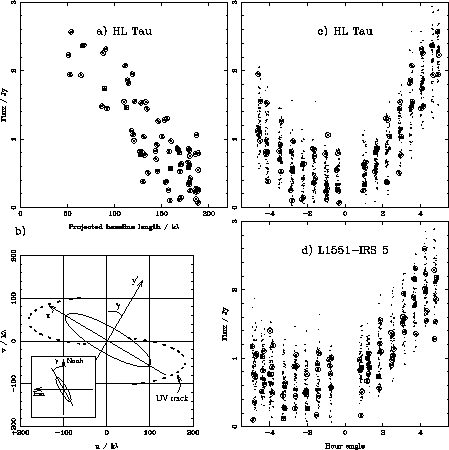
Figure 7:
First results from the JCMT--CSO Submillimetre
Interferometer:
a) The visibility flux of HLTau at  detected with the
interferometer as a function of the projected baseline length,
clearly showing that the emission has been resolved.
b) The gaussian model used to fit the data, show in the
detected with the
interferometer as a function of the projected baseline length,
clearly showing that the emission has been resolved.
b) The gaussian model used to fit the data, show in the  plane
with a track of the interferometer baseline for the observations
of HLTau. The inset shows the same model as it appears on the sky.
c) & d) Visibility fluxes as a function of hour angle for HLTau and
L1551-IRS5, respectively. The actual data are shown by the circled
points and the best-fit model in each case is the series of squares
that form a dashed line. The small dots represent simulated data.
plane
with a track of the interferometer baseline for the observations
of HLTau. The inset shows the same model as it appears on the sky.
c) & d) Visibility fluxes as a function of hour angle for HLTau and
L1551-IRS5, respectively. The actual data are shown by the circled
points and the best-fit model in each case is the series of squares
that form a dashed line. The small dots represent simulated data.
Ladd et al. (1995) and Fuller et al. (submitted) have also observed
L1551, in optically-thin dust and  respectively, using the JCMT.
Both maps show evidence for a hot `cross-shaped' feature
which is contained within the envelope and appears to form some sort of hot
shell around the base of the bipolar optical and molecular outflow.
respectively, using the JCMT.
Both maps show evidence for a hot `cross-shaped' feature
which is contained within the envelope and appears to form some sort of hot
shell around the base of the bipolar optical and molecular outflow.
Ward-Thompson et al. (1994) have reported the results of their JCMT dust and
 survey of `Myers starless cores'. These
  cores
without associated IRAS point sources differ in several ways from their
IRAS-identified counterparts; the continuum clumps found in about half
of the sample are all less centrally peaked and more diffuse than the
equivalent clumps in cores with IRAS sources.
cores
without associated IRAS point sources differ in several ways from their
IRAS-identified counterparts; the continuum clumps found in about half
of the sample are all less centrally peaked and more diffuse than the
equivalent clumps in cores with IRAS sources.
Our work on star-forming galaxies has concentrated on the central
problem of attempting to determine the principal mechanisms responsible
for regulating and organizing star formation on the galactic scale.
Observationally we have employed multi-frequency radio observations
to constrain the star-formation history of a galaxy in the recent past
and have found quantitative evidence for propagating star formation
in NGC1569 (Wilding et al. 1993). Fitt & Alexander (1993) have also
investigated the distribution of magnetic-field strengths as a function
of luminosity in late-type galaxies. The mechanism by which galaxy interactions
trigger star formation has been investigated by a high-resolution HI and
 CO study of the Leo Triplet which identified the dynamical model
by which the gas was stripped in NGC3627, and nuclear star formation
triggered in NGC3627 and NGC3628 (Zhang et al. 1993; Wilding et al. 1993).
The identification of propagating star formation on galactic scales as being
an important controlling mechanism has led Sleath & Alexander (submitted) to
develop a new model of star formation in which clouds are intrinsically
stable and star formation is triggered in them by some outside factor.
They use an N-body code which follows the evolution of the cloud
population in a realistic potential and propagate star formation via
supernova shocks. With this model they are able not
only to reproduce the appearance of late-type galaxies, but also to predict
the star formation rate in our own Galaxy and a Schmidt-law
type behaviour in excellent agreement with the best current observational
estimates.
CO study of the Leo Triplet which identified the dynamical model
by which the gas was stripped in NGC3627, and nuclear star formation
triggered in NGC3627 and NGC3628 (Zhang et al. 1993; Wilding et al. 1993).
The identification of propagating star formation on galactic scales as being
an important controlling mechanism has led Sleath & Alexander (submitted) to
develop a new model of star formation in which clouds are intrinsically
stable and star formation is triggered in them by some outside factor.
They use an N-body code which follows the evolution of the cloud
population in a realistic potential and propagate star formation via
supernova shocks. With this model they are able not
only to reproduce the appearance of late-type galaxies, but also to predict
the star formation rate in our own Galaxy and a Schmidt-law
type behaviour in excellent agreement with the best current observational
estimates.
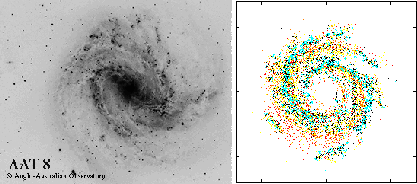
Figure 8: The image on the left is M83 as seen by the
Anglo-Australian Telescope whilst the image on the right is a typical output
from the propagating star formation model, using input parameters based on
observational quantities from our own galaxy. Clearly, realistic galactic
structures are easily reproduced by this new model.