


The core of our work in this area is the provision of common-user instruments for the JCMT. This work is underpinned by in-house research into fundamental aspects of mm-wave systems (mixers, quasioptics, low-noise amplifiers etc), and by our development of ``demonstration systems''. These instruments serve many purposes -- as well as acting as test beds for new technology, they provide hands-on experience for Ph.D. students (both in building and using them), the `first-cut' data serves as a basis for astronomical Ph.D. theses and above all they can be built relatively quickly and easily modified in the light of experience. Moreover, these instruments present the opportunity for testing new observational techniques which may be more difficult to explore with dedicated common-user equipment. None of these goals can easily be accomodated purely within the common-user framework.
Some of our developments in this area have been described elsewhere in this report. For example, the development of a water-vapour radiometer system suitable for atmospheric phase correction has been described in section 2.6 above, while continued development of algorithms and software for antenna surface measurement is described in section 2.8. Most of the rest of our effort over the report period has been directed at completion of two instruments -- the common-user ``RxW'', a dual-band dual-polarization heterodyne instrument for the 450--500GHz and 650--700GHz bands, and the MRAO Array receiver system (MARS), a demonstration heterodyne array for the 230GHz band.
At the time of writing, Receiver W is undergoing final testing at MRAO before shipment to Hawaii. This receiver implements many new features not previously available in JCMT instruments, including full closed-cycle cooling, single-sideband filtering and operation in two frequency bands, and will provide nearly an order-of-magnitude improvement in speed over the existing JCMT system in the 450--500GHz band, as well as making the 650--700GHz band available for the first time. We expect this receiver to be commissioned towards the end of the current semester, but anticipate that some work to improve its performance, especially through the installation of still more sensitive mixers, will continue until at least the middle of next year.
This is by far the most complex instrument yet constructed at MRAO, and has consumed a large amount of effort. Fortunately, much of the experience and know-how gained through this will now propagate into other projects, including in particular the B-band array front-end, on which expenditure has now been approved by the JCMT Board, starting this year.
The MRAO array receiver system (MARS) is designed to provide efficient mapping of spectral-line objects of large angular extent, such as cloud complexes and molecular outflows in our own Galaxy. Funding for the basic components of the system -- optics, cryogenics, electronics etc -- has already been provided through the rolling grant, and construction is nearly complete, with commissioning at JCMT expected to take place in the first half of 1998.
Although MARS will only have 8 mixers functioning at any one time, it was designed to accomodate up to 24 elements at 230GHz, or in excess of 50 at 345GHz. It is thus truly a demonstration ``large-format array''. Getting to this point has required solution of many technically difficult problems, in cryogenics, optics and mixers, and these solutions are already feeding through into designs for future common-user and demonstration systems.
Mixers
The final element in the MARS development was the successful demonstration of a tunerless, arrayable mixer, with a noise temperature comparable to the best available anywhere at this frequency (Yassin et al., 1997). The finline mixer marries easily-replicated planar technology for the devices with the advantages of a well-understood metallic horn, and is remarkably easy to manufacture, consisting essentially just of a diagonal horn and waveguide section.
Our test mixer was designed and built at MRAO, and populated with SIS devices fabricated by our collaborators at the University of Köln. This particular design has several advantages: it is intrinsically wideband (performance is essentially flat from 215 to 270GHz); no tuners are needed (either fixed or adjustable); and it is all in-line, so that large fully 2-dimensional arrays are readily achievable. It turns out that it is also very easy to provide for suppression of the Josephson super-current through the use of in-line mini-coils wrapped around the junction, as shown in figure 12.
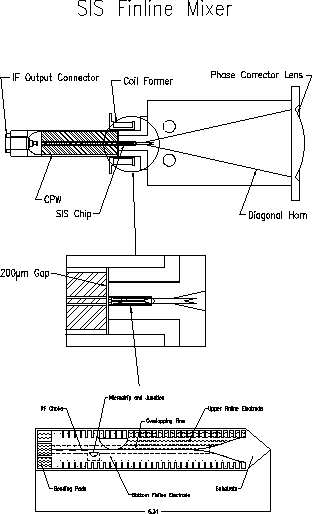
Figure 12:
Details of new finline mixer for MARS. Top: overall layout of mixer block,
showing the coil surrounding the quartz substrate. Centre: magnified view
of the horn throat, waveguide, device and coplanar waveguide bias board.
Bottom: details of metallization on quartz substrate.
Work is now underway to characterize the performance of these devices at higher frequencies. At the same time, we are conducting a rigorous theoretical investigation of the factors which affect both these and more conventional probe-coupled mixers (Yassin & Withington, 1996a and 1996b; Yassin et al., in press).
Quasioptics
We also continue to work on aspects of quasi-optics, particularly as they affect the coupling between the mixer feed-horn and both the Local Oscillator feedhorn and the aperture fields of the telescope (Murphy et al., in press; Withington & Murphy 1995). Withington and Murphy (1997) have examined the propagation of the coherence function in the gaussian-beam formalism, and have also looked at the factors determining the choice of beam-waist radius (which is normally a free parameter).
Withington, Yassin and collaborators have also been examining the application of corrugated horn-reflector antennas, as used in CAT, to millimetre-wave instruments. These antennas have excellent coupling efficiency, but are difficult to manufacture at mm, and particularly submm, wavelengths. Techniques have been developed for direct machining of the corrugated horns for frequencies up to 700GHz (Withington et al., 1996), and experiments are underway to determine their suitability for application to linear arrays.