


The combination of the JCMT and the CSO is still the only system in the world capable of making interferometric observations at submillimetre wavelengths. During the period covered in this report, the operation of the interferometer at frequencies around 345GHz has been made much more routine, partly through a number of hardware modifications, but more importantly by improvements to the software: the procedures for controlling the two antennas and their receiver systems are now much more unified and automated.
The major new developments have been to extend the operation to still higher frequencies, with good results being achieved at 460GHz, and to install a system to correct for atmospheric phase variations. The phase variations are caused by fluctuations in the amounts of water vapour along the paths from the source to the telescopes. We have built two radiometers operating near the 183 GHz emission line of water vapour and mounted one on each telesope. These can determine the amounts of water along each path with the necessary high precision on time-scales as short as 1 second. This new system was tested in November 1996 and produced very encouraging results despite very poor weather conditions. Figure 11 illustrates the phase measured by the interferometer, the scaled difference in the water vapour readings, and the corrected phase. With this system in operation it will be possible to use longer coherent integration times and thus extend the use of the interferometer to fainter sources.
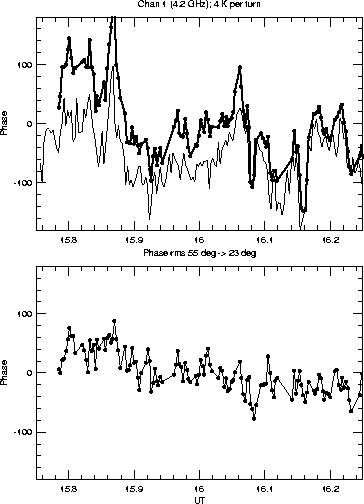
Figure 11: Top: Phase measured using the JCMT-CSO interferometer observing
3C273 at 345GHz (upper line) and estimated from the differences in the
water vapour measured by radiometers on the two antennae (lower line).
Bottom: Residual phase (difference of the two curves above) showing
remaining fluctuations, which are a roughly consistent with noise,
plus a slow drift which is probably due to thermal effects in the
instrument.