


The Cosmic Microwave Background (CMB) work at MRAO over the past two years has covered three main observational areas: intermediate angular scale mapping of the CMB with the Cosmic Anisotropy Telescope (CAT), together with the Ryle Telescope (RT) for source removal; collaboration in the analysis of data from the Tenerife experiments; and observations of secondary anisotropies using the Ryle Telescope. In addition, work has been carried out on how the CMB results can be used to constrain cosmological theories, and on new analysis and reconstruction methods suitable for the new generation of CMB experiments (both interferometer and satellite).
 scale
scale
Primordial anisotropies on scales from about 10 arcminutes to  can
provide detailed information on the physics of the recombination era and on the
values of key cosmological parameters. The information can be derived by
comparing the form of the CMB power spectrum on these scales with the
predictions of cosmological models. The inflation model, with adiabatic
perturbations and cold dark matter, predicts a series of peaks in the power
spectrum on these scales, known as the Doppler peaks (see figure
1), and detection of these peaks, and the tracing of their
detailed form, is one of the main objectives of CMB astronomy.
can
provide detailed information on the physics of the recombination era and on the
values of key cosmological parameters. The information can be derived by
comparing the form of the CMB power spectrum on these scales with the
predictions of cosmological models. The inflation model, with adiabatic
perturbations and cold dark matter, predicts a series of peaks in the power
spectrum on these scales, known as the Doppler peaks (see figure
1), and detection of these peaks, and the tracing of their
detailed form, is one of the main objectives of CMB astronomy.
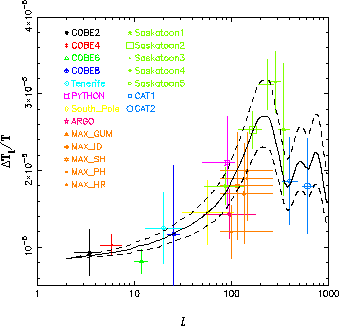
Figure 1:
Recent CMB anisotropy results on large and
intermediate angular scales are used to delimit the spectral index
 of the primordial fluctuations. The solid curve is for
  and the
outlying dashed curves are for
and the
outlying dashed curves are for  and
and  . The CAT data points are
the two nearest the right-hand side. (Taken from Hancock et al., 1997a.)
. The CAT data points are
the two nearest the right-hand side. (Taken from Hancock et al., 1997a.)
The CAT observations we have been carrying out are making a major contribution
to this process, since their angular scale is ideally suited to constraining
the position of the first Doppler peak in theories in which the density
parameter of the universe,  , is close to 1. At the time of the last
report, analysis of CAT data was only complete at one frequency, but we have
now published results from three frequencies (13.5, 15.5 and 16.5 GHz) for our
first field, CAT1 (Scott et al. 1996). This has given a definitive
detection of CMB anisotropy on the
, is close to 1. At the time of the last
report, analysis of CAT data was only complete at one frequency, but we have
now published results from three frequencies (13.5, 15.5 and 16.5 GHz) for our
first field, CAT1 (Scott et al. 1996). This has given a definitive
detection of CMB anisotropy on the  to
to  scale, at a
level compatible with the predictions of an inflationary cold dark matter model
with standard parameters. The effects of discrete radio sources are removed
using observations made with the Ryle Telescope, and the multifrequency
information enables us to remove the effects of the Galaxy. These CAT results
have made a particular impact in theoretical studies in conjunction with the
Saskatoon observations (see Fig. 1), which are on slightly larger angular
scales, and combined with the CAT points appear to trace out a peak in the
power spectrum. Some preliminary consequences of this for cosmology are
discussed below (Section 1.1.4).
scale, at a
level compatible with the predictions of an inflationary cold dark matter model
with standard parameters. The effects of discrete radio sources are removed
using observations made with the Ryle Telescope, and the multifrequency
information enables us to remove the effects of the Galaxy. These CAT results
have made a particular impact in theoretical studies in conjunction with the
Saskatoon observations (see Fig. 1), which are on slightly larger angular
scales, and combined with the CAT points appear to trace out a peak in the
power spectrum. Some preliminary consequences of this for cosmology are
discussed below (Section 1.1.4).
In addition to helping to constrain the CMB power spectrum, the CAT results have given the first image of the primordial CMB fluctuations on intermediate angular scales. Fig. 2 shows a version of this image, taken from Jones (1996), in which residual sidelobes caused by CMB features have been removed using CLEAN. The central regions have a signal to noise of about 2.5 to 1, comparable to that of the 4 year COBE map but at much higher angular resolution.
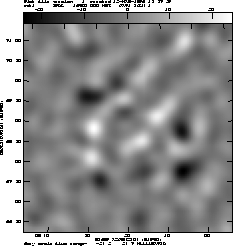
Figure 2:
Combined map of 13.5-, 15.5- and 16.5-GHz CAT data, weighted as
 to maximise the CMB component. The map has been CLEANed to
remove the long-range correlations due to the sparse sampling of the
aperture plane. The greyscale units are
to maximise the CMB component. The map has been CLEANed to
remove the long-range correlations due to the sparse sampling of the
aperture plane. The greyscale units are 
 scale
scale
The collaboration with Jodrell Bank and IAC Tenerife on analysis of data from
the Tenerife switched-beam systems has been continuing. An important
development was the recognition that correlated atmospheric effects had been
causing an overestimate of structure in the 33 GHz data. With this corrected,
Hancock et al. (1997a) have given a revised value of the rms power in
CMB structures,  , on
scales of about
, on
scales of about  and carried out a detailed comparison of the
amplitude of primordial fluctuations in the Tenerife data at Dec.
and carried out a detailed comparison of the
amplitude of primordial fluctuations in the Tenerife data at Dec.  versus COBE. Combined with data from smaller scale experiments, the
constraints on the power law index of primordial fluctuations is
versus COBE. Combined with data from smaller scale experiments, the
constraints on the power law index of primordial fluctuations is 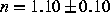 (see Fig. 1), which is fully compatible with inflation.
Data from the switched-beam Tenerife systems has now been taken at several
further declinations. Results from a strip at Dec.  have been
reported by Gutierrez et al. (1997), and compared successfully with
features deduced by Bunn et al., using the COBE data, thus
confirming their CMB origin.
have been
reported by Gutierrez et al. (1997), and compared successfully with
features deduced by Bunn et al., using the COBE data, thus
confirming their CMB origin.
The Sunyaev-Zel'dovich effect is the scattering of CMB photons to higher
energies as they interact with the hot gas in galaxy clusters. At frequencies
below the peak of the CMB spectrum ( GHz) this is manifested as an
apparent decrease in the temperature of the CMB toward the cluster. Since the
increase of the CMB energy density with redshift (
GHz) this is manifested as an
apparent decrease in the temperature of the CMB toward the cluster. Since the
increase of the CMB energy density with redshift ( ) exactly
cancels the decrease of surface brightness with redshift (
) exactly
cancels the decrease of surface brightness with redshift ( ), the surface brightness of the S-Z effect is independent of
redshift, a fact with profound consequences. One of these is that S-Z
observations can be used, in conjunction with redshift-dependent X-ray data,
to calculate the distance to a cluster, and hence find the value of the Hubble
constant. Another is that clusters can be detected via their S-Z effect at
very high redshifts where they are essentially impossible to detect optically
or via X-rays. We have been using the Ryle Telescope to observe the S-Z effect
in X-ray selected clusters, and to search for very high-redshift clusters.
), the surface brightness of the S-Z effect is independent of
redshift, a fact with profound consequences. One of these is that S-Z
observations can be used, in conjunction with redshift-dependent X-ray data,
to calculate the distance to a cluster, and hence find the value of the Hubble
constant. Another is that clusters can be detected via their S-Z effect at
very high redshifts where they are essentially impossible to detect optically
or via X-rays. We have been using the Ryle Telescope to observe the S-Z effect
in X-ray selected clusters, and to search for very high-redshift clusters.
The S-Z effect and 
To our previous detections of S-Z decrements in X-ray selected clusters we have
added A611, A990, A1423, A1995 and A2111, making a total of 12
detected clusters. We have also further observed some of our previous
detections, improving the signal-to-noise, and in some cases the resolution, by
using different array configurations of the telescope. A spectacular example of
the results of long integrations in several arrays is shown in figure
3, showing an S-Z image of the cluster A1413, resolved in both
dimensions and agreeing well with the distribution of X-ray emitting gas
observed by ROSAT. A determination of the Hubble constant based on these
data using an ellipsoidal model for the gas distribution gives  , in excellent agreement with our
previous result of
, in excellent agreement with our
previous result of 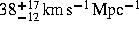 from the
cluster A2218. A further four clusters for which we have full X-ray information
(0016+16, A697, A773 and A1914) are currently being analysed.
from the
cluster A2218. A further four clusters for which we have full X-ray information
(0016+16, A697, A773 and A1914) are currently being analysed.
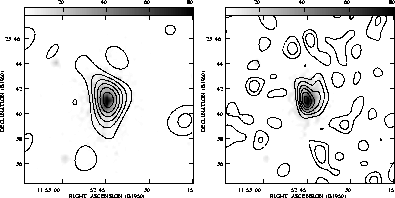
Figure 3:
Ryle Telescope images of the S-Z effect in A1413 (contours) overlaid on ROSAT PSPC (greyscale) image. (Left panel) Image at  resolution; the contour interval is
  ). (Right panel) Image at
  resolution; the contour
interval is
resolution; the contour
interval is  ). Dotted contours are
negative. (From Grainge et al.1996).
). Dotted contours are
negative. (From Grainge et al.1996).
High-redshift clusters
As part of a programme to try to detect high-redshift clusters, we observed
three high- quasar fields with the RT, on the assumption that the quasars
might either be in clusters, or be biassed into quasar catalogues by the
gravitational magnification of an intervening cluster. In the field of the
quasar fields with the RT, on the assumption that the quasars
might either be in clusters, or be biassed into quasar catalogues by the
gravitational magnification of an intervening cluster. In the field of the
 quasar pair PC1643+4631A&B (figure 4
we discovered a strong decrement,
with no evidence of a cluster of galaxies in a serendipitous ROSAT
observation of the field, nor in subsequent optical/IR imaging. The most
conservative interpretation of these observations is of a
quasar pair PC1643+4631A&B (figure 4
we discovered a strong decrement,
with no evidence of a cluster of galaxies in a serendipitous ROSAT
observation of the field, nor in subsequent optical/IR imaging. The most
conservative interpretation of these observations is of a  cluster at
  --1.5 lensing the quasars behind it. Such an
object is highly unusual in standard hierarchical structure-formation
models. The alternative explanation is that it is a similarly massive cluster
containing the quasars, at
--1.5 lensing the quasars behind it. Such an
object is highly unusual in standard hierarchical structure-formation
models. The alternative explanation is that it is a similarly massive cluster
containing the quasars, at  , which is even more difficult for these
theories. We are actively searching for similar objects by observing quasar
pairs with the RT, and already have another promising candidate.
, which is even more difficult for these
theories. We are actively searching for similar objects by observing quasar
pairs with the RT, and already have another promising candidate.
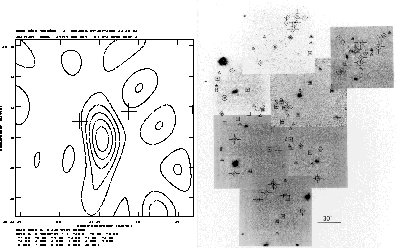
Figure 4:
(Left panel) RT image of the field of the  quasar pair
PC1643+4631A&B (indicated by crosses). The contour interval is
quasar pair
PC1643+4631A&B (indicated by crosses). The contour interval is  . The minimum value of the temperature decrement consistent
with this observation is
. The minimum value of the temperature decrement consistent
with this observation is  --it is larger if the decrement is
significantly resolved. (Right panel) Deep K-band mosaic of the same
field. The quasar positions are marked `A' and `B'. There is no evidence of a
rich cluster, indicating that it must lie at a redshift
--it is larger if the decrement is
significantly resolved. (Right panel) Deep K-band mosaic of the same
field. The quasar positions are marked `A' and `B'. There is no evidence of a
rich cluster, indicating that it must lie at a redshift  .
.
Hancock et al. (1997b) have considered the implications for cosmological
parameters of recent CMB anisotropy data, of the type shown in
Fig. 1. Assuming
a cold dark matter inflationary model with scale-invariant fluctuations and zero
cosmological constant, they are able to constrain  to
to  at 95%
confidence. Coupled with nucleosynthesis information, the current data favour a
low value for the Hubble constant, which, depending on the calibration of the
Saskatoon data, is constrained to lie in the range
at 95%
confidence. Coupled with nucleosynthesis information, the current data favour a
low value for the Hubble constant, which, depending on the calibration of the
Saskatoon data, is constrained to lie in the range  .
.
Maisinger et al. (1996) and Jones et al. (1996) have considered the application of a new two-channel version of the Maximum Entropy (MEM) approach to reconstructing the CMB sky in the presence of instrument noise and Galactic contaminants. The application so far has been to data from the VSA and Tenerife experiments, but it seems likely that this approach will prove very powerful in application to satellite experiments also.
In a series of papers, Hobson & Magueijo (1996) and Magueijo & Hobson
(in press a,b) have investigated the effects of
finite sky coverage on the spectral resolution  in the
estimation of the CMB angular power spectrum
in the
estimation of the CMB angular power spectrum  and the
subsequent determination of cosmological parameters. By proposing a
statistic for the detection of secondary (Doppler) peaks in the CMB
power spectrum, the significance level at which such peaks may be
detected was calculated for a large range of prototype interferometer
and single-dish CMB experiments. In particular, their work focussed
on investigating experimental design features required to distinguish
between competing cosmological theories, such as cosmic strings and
inflation. Concentrating on inflationary models, special attention
was paid to the measurement of the total cosmological density
and the
subsequent determination of cosmological parameters. By proposing a
statistic for the detection of secondary (Doppler) peaks in the CMB
power spectrum, the significance level at which such peaks may be
detected was calculated for a large range of prototype interferometer
and single-dish CMB experiments. In particular, their work focussed
on investigating experimental design features required to distinguish
between competing cosmological theories, such as cosmic strings and
inflation. Concentrating on inflationary models, special attention
was paid to the measurement of the total cosmological density
 by various proposed CMB experiments. In particular
they considered the performance of low noise all-sky satellite
experiments and intermediate noise high-resolution deep patch
single-dish experiments.
by various proposed CMB experiments. In particular
they considered the performance of low noise all-sky satellite
experiments and intermediate noise high-resolution deep patch
single-dish experiments.