


We have been concerned with two crucial problems: i, What processes regulate
the star formation rate in a galaxy? and ii, How does star formation activity,
perhaps coupled with interactions between galaxies, affect the interstellar
medium? These problems are closely linked since the cold HI and/or  interstellar clouds form the raw material for future star formation episodes.
Using multi-frequency radio studies we have developed and successfully applied
a technique for determining the past history of star formation within galaxies by
modelling the energy losses and transport of cosmic-ray electrons
(Lisenfeld et al. 1996). We also determine the structure and dynamics of the
cold ISM via matched-resolution observations of neutral hydrogen (HI;
VLA) and molecular material ( ; JCMT) which we relate to the
star-formation history. Most interestingly, in the interacting pair
NGC4490/85, Clemens et al. (1995, 1996) have shown that stripping of the total
ISM has occurred in the smaller galaxy, NGC4485, whereas NGC4490 shows
evidence of a galactic-scale outflow of neutral gas driven by star-formation
heating of the ISM; such processes are likely to be very important in the
early stages of galactic evolution.
; JCMT) which we relate to the
star-formation history. Most interestingly, in the interacting pair
NGC4490/85, Clemens et al. (1995, 1996) have shown that stripping of the total
ISM has occurred in the smaller galaxy, NGC4485, whereas NGC4490 shows
evidence of a galactic-scale outflow of neutral gas driven by star-formation
heating of the ISM; such processes are likely to be very important in the
early stages of galactic evolution.
Our theoretical studies have concentrated on the development of a numerical code to model star formation on a galactic scale. The code, developed by Sleath and Alexander, models the cloud population in a galaxy as a collisional system in an imposed potential; the clouds also accrete material from the background ISM and undergo star formation either spontaneously, or by being hit by a supernova shock from a previous star formation event (self-propagating star formation). Importantly, this model for the cloud population incorporates feedback, self-regulation and stochastic processes. Sleath & Alexander (1995, 1996a, 1996b) have shown that the self-propagating mechanism provides feedback which reinforces the orbit-crowding effects of weak spiral arms so as to produce spiral structures composed of new stars. Although the feedback processes we considered were relatively simple we found excellent quantitative agreement between our simulations and the observed star formation rate of our own Galaxy, as well as predicting a Schmidt-like scaling law for the star formation rate which is in excellent agreement with the best observational constraints. Mott & Alexander (1997) have extended these studies to the investigation of the effects of a bar potential alone.
A significant observational and theoretical programme has led to very important advances in our understanding of radio source physics. Observationally we have obtained imaging of the very highest quality with the VLA which has permitted detailed investigations of jets to be made in a sample of radio galaxies. Theoretically we have succeeded in formulating an analytical model for the large-scale structure of radio sources which reproduces the principal observational data very well.
Hardcastle et al. have extended earlier observational work of Black and co-workers to a sample of radio galaxies at higher luminosity (Hardcastle et al. 1997; Hardcastle 1996; Leahy et al. 1997). The most striking result of this investigation is the detection of jets in approximately 70 per cent of the sample, independent of luminosity (and hence distance). The implications of this result are that the increased jet kinetic power seen in higher-luminosity sources is due to an increased mass flux in the jet rather than increased jet velocity. Detailed studies of the jets in FRI radio galaxies (Hardcastle et al. 1996, 1997) have shown evidence in favour of a model in which a fast moving inner jet is surrounded by a slower-moving envelope.
In a series of papers, Baker and co-workers (Baker, Hunstead & Brinkman 1995, 1996; Baker & Hunstead 1996a,b; Baker 1996) have considered the viewing-angle dependence and possible beaming of both the optical and X-ray emission in quasars. They find evidence for a beamed X-ray component, but argue that the optical continuum emission can best be explained via orientation dependent reddening alone provided there is significant dust, both in a region best described as a torus, and also within the torus opening angle. Baker & Hunstead (1997) have also studied a new complete sample of CSS quasars drawn from the 408MHz Molongolo survey; this sample promises to offer significant new insights into these enigmatic objects.
Kaiser & Alexander have formulated a new analytical model for the large-scale structure of FRII radio sources which predicts the observed self-similar structure and temporal evolution through the power-linear-size diagram (Kaiser & Alexander 1996,1997). In this model an initially ballistic jet is reconfined by the pressure of its own cocoon; the jet then remains in pressure balance with the cocoon until it reaches the hotspot. Their model can now be applied to various problems in radio-source physics and used to address questions concerning the cosmological evolution of radio sources, their environment and host galaxies. Scheuer (1996) has used the classic test of lobe-asymmetry, combined with additional information on jet-sidedness, to constrain hotspot advance speeds. Scheuer has also considered the re-alignment of a black hole whose angular-momentum axis is misaligned with that of its accretion disc (Scheuer & Feiler 1996).
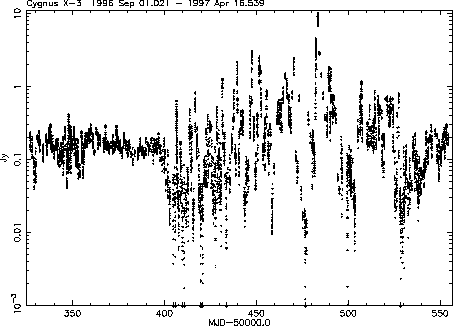
Figure 5:
The flux density of Cygnus X-3 at 15GHz over about 8 months.
Note the ``quenching", extremely low fluxes immediately preceding flares.
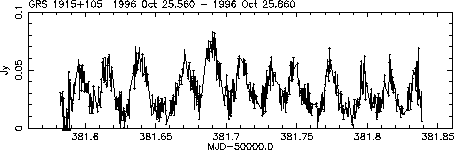
Figure 6:
GRS 1915+105 observed at 15GHz during an active period.
We have continued to use the CLFST to search for radio counterparts of Gamma Ray Bursts (GRBs). A GRB-specific multi-beam observing mode has been developed for the CLFST, which allows a wide-field to be monitored for transient radio events. Data are taken with short integration times (down to 1.5s), and notification of GRBs is received only a few seconds after their detection with the Compton satellite by using the BACODINE (the BATSE COordinates DIstribution NEtwork) system via the internet. Koranyi et al. (1995) found no variability of radio emission from radio sources in the field of GRB940301 on timescales of 1 to 36 days after the GRB (with a limit of 80mJy in a 12-hour synthesis); they also provided some limits on any prompt radio emission from this GRB on the timescale of hours. Deeper limits on any prompt radio emission are provided by Dessenne et al. (1996) for GRB950430 and GRB950706. GRB950430 was, fortuitously, within one of the beams of CLFST while it was operating in the GRB monitoring mode, so 1-second limits of about 70Jy or less can be placed on any radio emission before, during or after this burst. The limits these observations place on the luminosity ratio of any prompt radio emission to the gamma ray emission are over an order of magnitude deeper than previously available.
Mapping observations with the Ryle Telescope in relation to the CMB normally extend for 12 hours. Shorter times can be used for monitoring flux densities; in particular, the sources in the vicinity of the fields mapped by CAT are regularly observed. At 15GHz, some of them vary in a spectacular manner and simultaneous observations with CAT are crucial. The remaining gaps in the observing programme are used for calibration and for monitoring the flux density of a variety of sources. These include low-frequency variables, detected in the 151MHz surveys; sources with extreme spectra peaking in the region near or above 10GHz [in conjunction with Edge, Institute of Astronomy]; and several Galactic X-ray binaries.
The binaries which have been regularly monitored are Cygnus X-3, GRS 1915+105 and Cygnus X-1. Each is the subject of continuing collaborations with X-ray, infrared and other radio observers. Results of note include the detection of the 5.6-day period in Cygnus X-1 (IAU Circ 6544); the detection of the largest radio flare in Cygnus X-3 for several years (see fig 5 ); and the discovery of a new class of quasi-periodic oscillations, with periods ranging from 20min upwards, in GRS 1915+105 (see fig 6 ), which are probably related to the extraordinary X-ray variations in this object.