


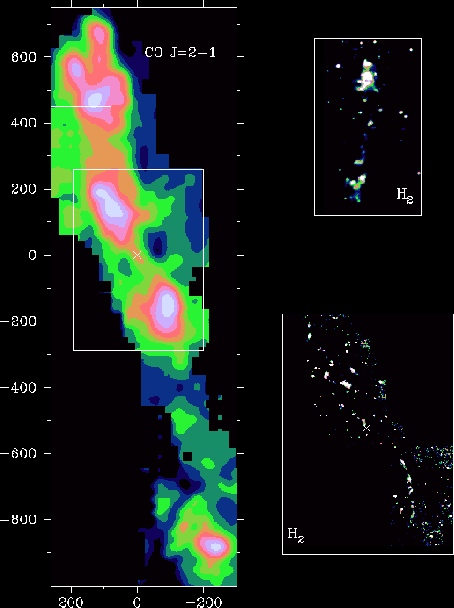
Figure 7:
CO 2-1 image of the RNO43 molecular outflow (left) obtained with the
JCMT. The cross marks the location of the driving protostar. The two
images on the right show details of the flow in the  S(1) line
obtained at UKIRT.
S(1) line
obtained at UKIRT.
We have continued our studies of the structure and evolution of protostellar
outflow sources, in particular addressing the question of how molecular gas is
accelerated by optical jets. Bence, Richer & Padman (1996) have published an
extensive CO study of the RNO43 outflow, which demonstrates that molecular gas
is accelerated primarily in the bowshock of the atomic jet (Fig 7).
Molecular hydrogen imaging confirms this hypothesis and high resolution
spectroscopy of the  S(1) line at 2
 m has for the first time produced
unequivocal spectral evidence for bowshocks in the form of double-peaked line
profiles just behind the jet shock (Bence, Richer & Wright, 1997). The overall
outflow structure requires that the driving jet has a varying ejection
direction, possibly caused by disk precession due to the presence of a binary
companion.
m has for the first time produced
unequivocal spectral evidence for bowshocks in the form of double-peaked line
profiles just behind the jet shock (Bence, Richer & Wright, 1997). The overall
outflow structure requires that the driving jet has a varying ejection
direction, possibly caused by disk precession due to the presence of a binary
companion.
Measurements of outflow structure on very small scales can potentially
constrain the acceleration mechanism for high-velocity molecular gas close to
the driving source. Chandler et al. (1996) have used the high spatial
resolution provided by the Owens Valley millimeter array to show that the
outflow lobes in the young, low-luminosity, protostars TMC1 and TMC1A are
conical very close to the star (Fig 8). Near-infrared reflection
nebulosity coincides with the high-velocity gas, and suggests that the outflows
in these sources have evacuated a cavity along the flow axis. Models of the
near-infrared and the high-velocity CO emission allow us to determine the
inclination of the flows to the line of sight, and to derive opening angles of
the outflow cones in the range  --
--  . Such large opening
angles cannot be explained if the outflows are driven by a steady jet, and
provide further evidence of the need for a wandering jet, as is suggested by
the multiple bowshocks observed in RNO43.
. Such large opening
angles cannot be explained if the outflows are driven by a steady jet, and
provide further evidence of the need for a wandering jet, as is suggested by
the multiple bowshocks observed in RNO43.
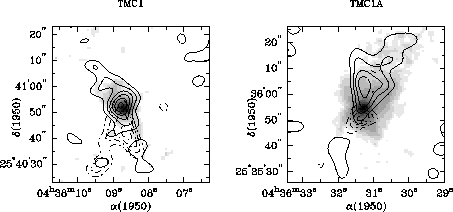
Figure 8:
Greyscale images of the 2 m continuum reflection nebulosity in the
embedded protostars TMC1 and TMC1A, with contours of the
high-velocity CO emission obtained using the Owens Valley millimeter
array. The blueshifted gas is denoted by solid contours, and the
redshifted by dot-dashed contours. The reflection nebulosity traces
the cavity evacuated by the wind or jet driving each outflow.
m continuum reflection nebulosity in the
embedded protostars TMC1 and TMC1A, with contours of the
high-velocity CO emission obtained using the Owens Valley millimeter
array. The blueshifted gas is denoted by solid contours, and the
redshifted by dot-dashed contours. The reflection nebulosity traces
the cavity evacuated by the wind or jet driving each outflow.
The JCMT-CSO interferometer has been used to measure the submillimetre continuum emission with sub-arcsecond resolution in a number of protostellar objects. The emission is believed to originate from the protostellar accretion disk with a size of about 100 AU. Four objects have been studied in detail in the period covered by this report: VLA1623, NGC2024 FIR6, and NGC1333 IRAS4A & B. In all cases, the submillimetre fluxes detected by the interferometer are only a small fraction of the fluxes measured with single dishes at the same frequency: this demonstrates directly that the majority of the flux arises from a massive envelope with a size of order 2000AU, with the unresolved disk being of relatively low mass. These data have been intepreted as an indication of the relative youth of these four protostars (about 10,000 years), the bulk of their final stellar mass having yet to be accreted.
Observations at 345 and 460GHz of the disc around HL Tau, which is probably a slightly more evolved object, have been combined with lower frequency observations from OVRO to provide the first detailed model of such a disk based on observations that resolve the continuum emission. The best fit to the data is obtained with a relatively steep fall-off of surface density with radius and an high spectral index for the emissivity of the dust grains, indicating small particles, at least at radii greater than about 50AU.
Data on a several more young low-mass stars were also obtained and are being analysed. Other objects observed with the interferometer included Herbig Ae/Be stars (the higher-mass analogues of T Tauri stars), the recombination-line masers in MWC349 and the compact source in the galactic centre Sgr A*. Preliminary observations of starburst galaxies were also made and will be followed up when the sensitivity has been improved.