


With the successful commissioning of the full COAST array, our aperture
synthesis observations of evolved giant and supergiant stars now encompass both
aperture-masking studies, using the WHT alone, as well as those employing COAST. Most recently, a programme of contemporaneous observations at the two
telescopes has been initiated so as to permit full sampling of the visibility
function on both short ( m) and long (4--10m) baselines at any epoch.
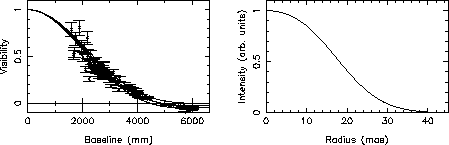
Figure 9:
Visibilities and reconstructed radial brightness distribution for
Betelgeuse at 830 nm as measured in October 1995. At this wavelength the
star is strongly limb-darkened, with flux extending to radii of
approximately 40mas.
Haniff, with Wilson and Dhillon at the RGO (Wilson, Dhillon & Haniff, in press), have successfully monitored the evolution of the surface asymmetries of Alpha Orionis (Betelgeuse) over an 8-week period in 94/95 using the WHT. Modelling of the intensity structure required the presence of three compact features superposed on the stellar disk. While the fluxes and sizes of these features were consistent with a convective origin, there was no correlation between their evolution and a large and rapid reduction in the integrated brightness of the source observed over the same time period. These data also show strong evidence for structure on scales much larger than the photospheric diameter, which is interpreted as indicative of a newly formed dust halo.
Measurements of Betelgeuse, obtained with COAST in 1995 October, provided the first demonstration of the imaging of a resolved stellar disk with a separated element interferometer. Unusually, at that epoch the stellar brightness distribution was highly symmetric, an upper limit of 4 per cent being placed on the relative flux of any compact asymmetric feature present (Burns et al., in preparation). A new and detailed analysis of the radial brightness distribution of the star shows a flat-topped and strongly limb-darkened form (see figure 9). In view of the extreme intensity profile exhibited by the star, Burns (in preparation) has developed a new Bayesian description for limb-darkening based on a Gauss-Hermite expansion which permits a much more efficient and robust chacterization of such strongly limb-darkened disks.
Our studies of Mira variables have now begun to concentrate on monitoring specific targets, selected on the basis of previous WHT measurements, with the COAST array. Initial observations of R Leonis have revealed direct evidence for a change in apparent diameter as a function of pulsation phase (Burns et al., in preparation) in a number of wavelength channels. These data suggest that, for the first time, reliable diagnostics may soon become available for verifying the time-dependent atmospheric models describing these stars.