Next: Timescale measurements for atmospheric Up: Timescale measurements by previous Previous: Normalising the short-timescale component Contents
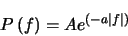
In many of their observations there is excess power at low frequencies, attributed to long-timescale motion of the image centroid (this excess power in the power spectrum is sometimes fitted empirically by adding another exponential term to Equation 2.1).
Equation 2.1 can be used to predict the form of the
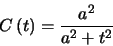
high frequency component of the temporal autocorrelation of stellar
speckle patterns. After normalisation as described in
Chapter 2.2.1, the temporal autocorrelation
 corresponding to Equation 2.1
has the form:
corresponding to Equation 2.1
has the form:
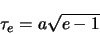
The coherence timescale  for the case described by
Equation 2.1 will be:
for the case described by
Equation 2.1 will be:
 |
(2.3) |
Many measurements of the atmospheric coherence time for
speckle imaging have been made at a variety of observatory sites. At

 wavelength the measured timescales are usually found to be
a few milliseconds or tens of milliseconds
(Scaddan & Walker, 1978; Karo & Schneiderman, 1978; Parry et al. , 1979; Dainty et al. , 1981; Vernin & Muñoz-Tuñón, 1994; Roddier et al. , 1990; Marks et al. , 1999; Lohmann & Weigelt, 1979)
although Aime et al. (1981) report timescales as long as a few hundred
milliseconds under good conditions.
wavelength the measured timescales are usually found to be
a few milliseconds or tens of milliseconds
(Scaddan & Walker, 1978; Karo & Schneiderman, 1978; Parry et al. , 1979; Dainty et al. , 1981; Vernin & Muñoz-Tuñón, 1994; Roddier et al. , 1990; Marks et al. , 1999; Lohmann & Weigelt, 1979)
although Aime et al. (1981) report timescales as long as a few hundred
milliseconds under good conditions.
It will now be of interest to compare these experimental results and empirical analysis with atmospheric simulations.
Bob Tubbs 2003-11-14