Next: Atmospheric models Up: Lucky Exposures Previous: The temporal power spectrum Contents
The layered model of atmospheric turbulence used for my simulations is supported by a number of experimental studies at Roque de los Muchachos observatory, La Palma (Vernin & Muñoz-Tuñón (1994); Wilson & Saunter (2003); Avila et al. (1997)); the model would also provide realistic results for many other good observatory sites.
 |
Following the work of Tatarski (1961), the refractive index
fluctuations within a given layer in the simulations can be described
by their second order structure function:
 |
(2.4) |
 is the refractive index at
position
is the refractive index at
position  and
and
 is
the statistical variance in refractive index between two parts of the
wavefront separated by a distance
is
the statistical variance in refractive index between two parts of the
wavefront separated by a distance  in an atmospheric
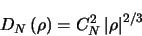
layer. For the case of an isotropic turbulent layer following the
Kolmogorov model, this structure function
in an atmospheric
layer. For the case of an isotropic turbulent layer following the
Kolmogorov model, this structure function  depends only on the
strength of the turbulence:
depends only on the
strength of the turbulence:
 is simply a constant of proportionality which
describes the strength of the turbulence. For the case of an
atmosphere stratified into a series of horizontal layers,
is simply a constant of proportionality which
describes the strength of the turbulence. For the case of an
atmosphere stratified into a series of horizontal layers,
 can be taken as a function of the height
 above ground level. Under these conditions Equation
2.5 will only be valid within a layer of constant
.
above ground level. Under these conditions Equation
2.5 will only be valid within a layer of constant
.
The phase perturbations introduced into wavefronts by this layered
atmosphere can be described by the second order structure function for
the phase perturbations (Equation 1.3). This
function is dependent on the integral of
along the light path  and the wavenumber
  as follows:
(
 here is equivalent to
 in Tatarski (1961)).
Equation 2.6 can be more conveniently described in
terms of wavelength  and the angular distance of the source
from the zenith
and the angular distance of the source
from the zenith  :
:
Using Equations 1.4 and 2.7 we can
also write  in terms of
:
in terms of
:
varies only weakly with wavelength
at red and infra-red wavelengths, so the variation of
with wavelength can be approximated by:
 and
and 
 . Under good seeing conditions, the
  apertures discussed in Chapter 1.2.3 would
correspond to between
apertures discussed in Chapter 1.2.3 would
correspond to between  and
and 
 diameter telescopes at these
wavelengths. For observations in the near infra-red K-band
would correspond to
diameter telescopes at these
wavelengths. For observations in the near infra-red K-band
would correspond to  , while at B-band telescopes would
have
, while at B-band telescopes would
have  or
or  diameter.
Saint-Jacques & Baldwin (2000) undertook detailed atmospheric seeing measurements with the Joint Observatory Seeing Experiment (JOSE - Saint-Jacques et al. (1997); Wilson et al. (1999)) at the William Herschel Telescope, located at the same observatory as the NOT. The experimental setup consisted of an array of Shack-Hartmann sensors capable of measuring the wavefront tilt as a function of position and time in the aperture plane (see Figure 1.9). They found experimentally that the dominant atmospheric phase fluctuations at the William Herschel Telescope (WHT) are frequently associated with a single wind velocity, but also found evidence for gradual change in the phase perturbations applied to wavefronts as the perturbations progressed downwind. This can be explained either by turbulent boiling taking place within an atmospheric layer as it is blown past the telescope, or by the turbulence associated experimentally with one layer actually being distributed in several separate screens, with a narrow range of different wind velocities for the each of the screens (distributed about the measured mean wind velocity). This evolution of the turbulent structure for an atmospheric layer is consistent with the decorrelation with time of turbulent layers found by Caccia et al. (1987), although unlike Roque de los Muchachos observatory they found the typical atmosphere above Haute-Provence to have several such turbulent layers travelling at distinctly different wind velocities. Similar experiments were undertaken using binary stars at the WHT by Wilson (2003). The SLODAR technique (Wilson, 2002) was applied to these binary observations to obtain the heights of the turbulent layers as well as their wind velocities. Preliminary results provided by Wilson (2003) indicated that several turbulent layers with very different wind velocities were present on some of the nights. On at least one night, most of the turbulence was found at very low altitude above the WHT, and it is not necessarily certain that the same conditions would be present at the NOT further up the mountain.
For my numerical simulations I have ignored the possibility of turbulent boiling taking place within individual atmospheric layers because of the lack of a suitable mathematical model for the boiling process. Models which are free of boiling but which have multiple Taylor screens with a scatter of wind velocities describing each individual atmospheric layer can adequately fit existing experimental results, and these are the most widely used models for atmospheric simulations. This form of multiple Taylor screen model is usually known as a wind-scatter model.
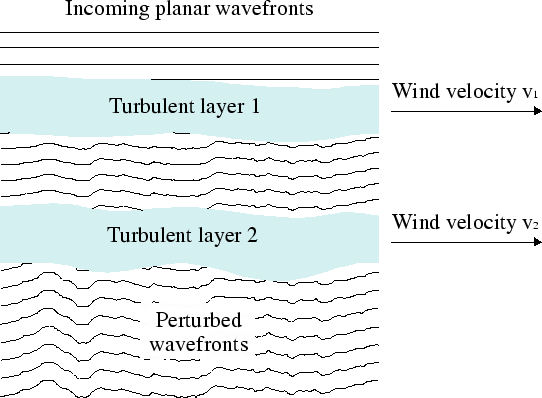
Each of the atmospheric layers has a characteristic velocity for bulk
motion ( and
and  for the two layers in
Figure 2.3) corresponding to the mean local wind
velocity at the altitude of the layer.
for the two layers in
Figure 2.3) corresponding to the mean local wind
velocity at the altitude of the layer.