Next: Isoplanatic angle for atmospheric Up: Timescale measurements for atmospheric Previous: Single Taylor screen model Contents
 , with
no power on spatial frequencies larger than this. The size of the
outer scale was determined by the available computer memory. Both
simulations produced wavefront perturbations with the same coherence
length
, with
no power on spatial frequencies larger than this. The size of the
outer scale was determined by the available computer memory. Both
simulations produced wavefront perturbations with the same coherence
length  . Images from filled circular apertures with diameters
between
. Images from filled circular apertures with diameters
between  and
and  were generated at a large number of
discrete time points.
were generated at a large number of
discrete time points.
|
Photometric measurements were made at a fixed point in the image plane
corresponding to each of the simulated apertures at each time point,
and the temporal autocorrelation of this data was
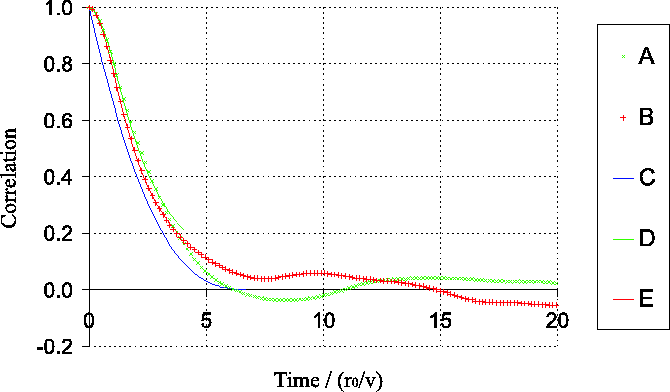
calculated. Figure 2.4 shows two example
autocorrelations for an aperture diameter of  . There is
relatively good agreement between the model of Aime et al. (1986)
(Equation 2.2) and the normalised
autocorrelation data from numerical simulations up to time differences
corresponding to the coherence timescale
. There is
relatively good agreement between the model of Aime et al. (1986)
(Equation 2.2) and the normalised
autocorrelation data from numerical simulations up to time differences
corresponding to the coherence timescale  . For larger time
differences Equation 2.2 tends quickly to
zero, while the simulation data usually drifted either side of zero
somewhat. This may be due to the limited timescale of the simulations
(a few hundred times , which is not long enough to average
very many realisations of the longer timescale changes in the speckle
pattern). Similar results were found for all of the aperture diameters
simulated, and the temporal power spectra were found to agree with the
model of Aime et al. (1986).
. For larger time
differences Equation 2.2 tends quickly to
zero, while the simulation data usually drifted either side of zero
somewhat. This may be due to the limited timescale of the simulations
(a few hundred times , which is not long enough to average
very many realisations of the longer timescale changes in the speckle
pattern). Similar results were found for all of the aperture diameters
simulated, and the temporal power spectra were found to agree with the
model of Aime et al. (1986).
 |
The coherence
timescale was then calculated from each simulation using
the method described in Chapter 2.2.1. A plot of
the variation of the coherence timescale with telescope aperture
diameter is shown in Figure 2.5.
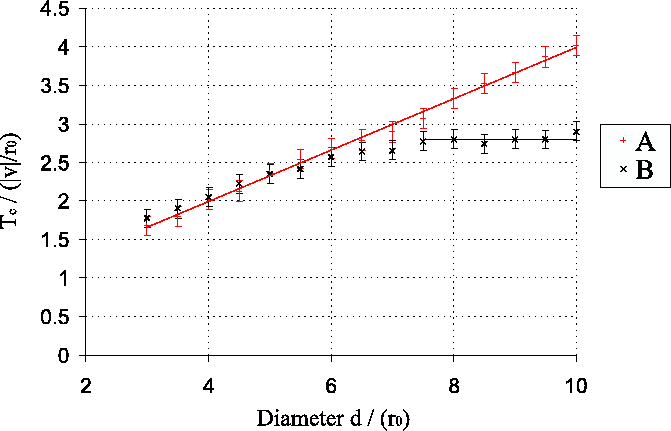 |
The red line in Figure 2.5 is a linear regression fit
to the measured timescale for simulations with a single
Taylor screen. The equation for this best fit line is:
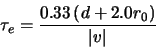
 , as predicted in
Appendix A. The value of was
found to be larger than predicted by my simplified model by a constant
amount
, as predicted in
Appendix A. The value of was
found to be larger than predicted by my simplified model by a constant
amount
 . This is consistent
with a small region of the atmospheric layers extending
. This is consistent
with a small region of the atmospheric layers extending  into areas
  and
and  in Figure A.3 being correlated
with the phase perturbations in area
in Figure A.3 being correlated
with the phase perturbations in area  . The same hypothesis would
explain why the measured temporal autocorrelations shown in
Figure 2.4 as curves A and B lie to
the right of the prediction corresponding to my simplified model
(curve C) over the left-hand part of the graph.
. The same hypothesis would
explain why the measured temporal autocorrelations shown in
Figure 2.4 as curves A and B lie to
the right of the prediction corresponding to my simplified model
(curve C) over the left-hand part of the graph.
For small aperture diameters, the simulations with a two-layer
atmosphere have very similar timescales to those with a single
atmospheric layer. However there is a knee at
 , and at
diameters larger than this the timescale appears to be
constant at:
, and at
diameters larger than this the timescale appears to be
constant at:
 is the average wind velocity for the two
layers. It is of interest to compare this timescale with that
predicted by Equations 2.11 and
2.12. For this atmospheric model, the wind scatter
is the average wind velocity for the two
layers. It is of interest to compare this timescale with that
predicted by Equations 2.11 and
2.12. For this atmospheric model, the wind scatter
 is equal to:
 |
(2.16) |
can be written in terms of :
 |
(2.17) |
 of these simulations however
(remembering that the errors in the simulations are correlated for
different aperture diameters).
of these simulations however
(remembering that the errors in the simulations are correlated for
different aperture diameters).
Figure 2.5 implies that the timescale for changes in the speckle pattern found at the focus of a well figured astronomical telescope may increase somewhat with aperture diameter if the atmospheric turbulence is moving with a common wind velocity. This would not be the case if there is a substantial scatter in the wind velocities, as the timescale saturates at a level close to that predicted by Equation 2.12. Vernin & Muñoz-Tuñón (1994) found that the scatter in the velocities of the turbulent layers above the NOT is small enough that the timescale for speckle patterns using the full aperture of the NOT should be twice the timescale which would be found with small apertures, or that for standard adaptive optics correction. This is consistent with measurements by Saint-Jacques & Baldwin (2000) which indicated that a single wind velocity (or narrow range of wind velocities) dominates above La Palma. This contrasts with results at a number of other observatories (e.g. Parry et al. (1979); Vernin & Roddier (1973); Caccia et al. (1987); Roddier et al. (1993)) where either strong turbulence is found in several layers with differing wind velocities, or there is little evidence for any bulk motion of the atmospheric perturbations across the telescope aperture. Wilson (2003) also found evidence for significant dispersion in the wind velocities above the WHT on some nights.
Bob Tubbs 2003-11-14