Next: Exposure selection from simulated Up: Lucky Exposures Previous: Numerical simulations Contents
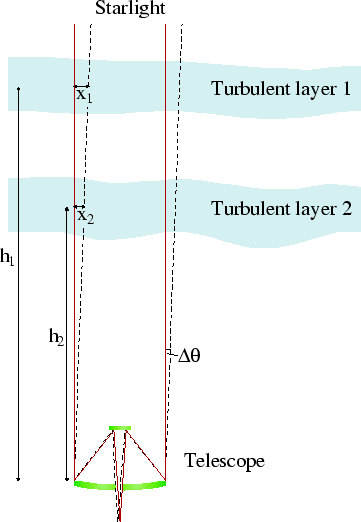
 , the offset
  in the
position of the light paths as they intersect a layer at a height
in the
position of the light paths as they intersect a layer at a height  is given by:
 |
(2.18) |
between the paths is sufficiently large, the atmospheric perturbations
applied to light from the two astronomical targets will differ. This
variation in the atmospheric perturbations with angle is closely
analogous to the change in the atmospheric perturbations as time
elapses and the atmospheric layers move past the telescope in the wind
scatter model described in Chapter 2.3.3. Whereas
the motion of the atmospheric layers as a function of time was
determined by the wind velocities for the wind-scatter case, the
relative motion of the atmospheric layers as a function of angular
separation from the reference star is determined by the heights of the
layers above the telescope.
 |
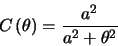
The angular separation at which the atmospheric perturbations applied to the light from the two stars becomes uncorrelated is called the isoplanatic angle. For a wind scatter model consisting of thin Taylor screens, the calculation of the isoplanatic angle is undertaken in an identical manner to the calculation of the timescale for decorrelation of the speckle pattern described above. The numerical simulations investigating the effect of relative motions of atmospheric layers on the image plane speckle pattern in Chapter 2.3.3 would be equally applicable to the study of isoplanatic angle, and the results can be used here directly. The similarity between the temporal properties and isoplanatic angle for wind-scatter models has been noted by a number of previous authors including Roddier et al. (1982a).
The calculation of the isoplanatic angle for atmospheres consisting of
a number of layers of Kolmogorov turbulence is described in
Roddier et al. (1982b), following a similar argument to that for
atmospheric coherence time calculations described in
Roddier et al. (1982a). The isoplanatic angle is inversely proportional to
the weighted scatter  of the turbulent layer heights:
![\begin{displaymath}
\Delta h=\left [ \frac{ \int h^{2} C_{N}^{2} \left ( h \righ...
...^{2} \left ( h \right ) \mbox{d}h} \right )^{2} \right ]^{1/2}
\end{displaymath}](img273.png) |
(2.19) |
 on telescope diameter
for the wind scatter model described in
Chapter 2.3.3.
on telescope diameter
for the wind scatter model described in
Chapter 2.3.3.
The decorrelation of the speckle pattern for a target with increasing
angular distance  from a reference star is expected to follow
a similar relationship to that for the temporal decorrelation of a
speckle pattern (Equation 2.2). The
cross-correlation of the speckle patterns
from a reference star is expected to follow
a similar relationship to that for the temporal decorrelation of a
speckle pattern (Equation 2.2). The
cross-correlation of the speckle patterns
 should thus obey the relationship:
 depends on the relative separations of the atmospheric
layers.
depends on the relative separations of the atmospheric
layers.
I have not repeated the numerical simulations here for the case of
isoplanatism as the new simulations would be computationally identical
to those performed for the measurements of the timescale -
the only difference would be in the units used. The vertical axis in
Figure 2.5 is labelled , but it could
equally have been labelled isoplanatic angle  . The plot
would then correspond to the variation in isoplanatic angle as a
function of telescope diameter for two models of the atmosphere. The
model corresponding to curve A would be an atmosphere with a
single layer at an altitude of , with the isoplanatic angle
on the vertical axis plotted in units of
. The plot
would then correspond to the variation in isoplanatic angle as a
function of telescope diameter for two models of the atmosphere. The
model corresponding to curve A would be an atmosphere with a
single layer at an altitude of , with the isoplanatic angle
on the vertical axis plotted in units of

 . The model corresponding to curve
B would have two layers each with half the value of
. The model corresponding to curve
B would have two layers each with half the value of
 and at altitudes of
  and
and  .
.
A number of different measures of the isoplanatic angle have been
suggested in the literature. In order to provide consistency with the
discussion of atmospheric timescales in
Chapters 2.2 and
2.3, I will take the isoplanatic angle
for speckle imaging to be that at which the correlation
of the speckle pattern for two objects drops to  of the
value obtained near the reference star. For an atmosphere consisting
of Taylor screens, the value of will be dependent on the
relative motions of the Taylor screens with angle in same way as
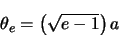
depends on the relative motions with time. For the model
described by Equation 2.20, will
be:
of the
value obtained near the reference star. For an atmosphere consisting
of Taylor screens, the value of will be dependent on the
relative motions of the Taylor screens with angle in same way as
depends on the relative motions with time. For the model
described by Equation 2.20, will
be:
 |
(2.21) |
Vernin & Muñoz-Tuñón (1994) suggest the isoplanatic angle for short exposure
imaging with the full aperture of the NOT will be significantly
larger than the isoplanatic angle expected for non-conjugate adaptive
optics (or for interferometric techniques involving small
apertures). This is due to the turbulent layers being distributed over
a narrow range of heights above the telescope. With non-conjugate
adaptive optics the isoplanatic angle is determined by the typical
height of the turbulence (whereas with large telescope apertures the
isoplanatic angle for speckle imaging techniques such as Lucky Exposures is
related to the scatter of different altitudes over which
the turbulence is distributed rather than the absolute height). In
calculating the isoplanatic angle for non-conjugate adaptive optics,
the deformable mirror (typically positioned in a re-imaged pupil
plane) can be treated like an additional layer of atmospheric
turbulence which cancels out the phase perturbations along one line of
sight, but contributes additional perturbation for objects
significantly off-axis.
Measurements of the isoplanatic angle for speckle imaging at a number
of observatories have typical given values in the range 
 to
to
 for observations at
 wavelength (see
e.g. Vernin & Muñoz-Tuñón (1994); Roddier et al. (1982a)). The isoplanatic angle for speckle
observations is expected to be about
wavelength (see
e.g. Vernin & Muñoz-Tuñón (1994); Roddier et al. (1982a)). The isoplanatic angle for speckle
observations is expected to be about  larger than that for
adaptive optics, based on measurements by Vernin & Muñoz-Tuñón (1994). The
isoplanatic angle for observations at I-band should be a further
factor of two larger due to the relationship between the coherence
length
larger than that for
adaptive optics, based on measurements by Vernin & Muñoz-Tuñón (1994). The
isoplanatic angle for observations at I-band should be a further
factor of two larger due to the relationship between the coherence
length  and the wavelength
(Equation 2.9).
and the wavelength
(Equation 2.9).