


Next: Comparison of limiting magnitudes Up: Limiting magnitude of reference Previous: Limiting magnitude of reference Contents
 diameter
(Noll, 1976). To obtain diffraction-limited images from larger
telescopes, the shape of the perturbations in the wavefront across the
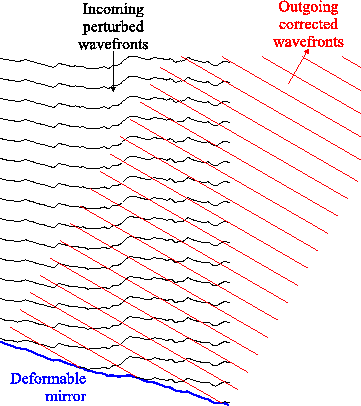
telescope aperture must be measured and actively corrected. Deformable
mirrors in a re-imaged pupil-plane are most often used to introduce
additional optical path which corrects the perturbations introduced by
the atmosphere as shown schematically in
Figure 1.8. One of the simplest systems for
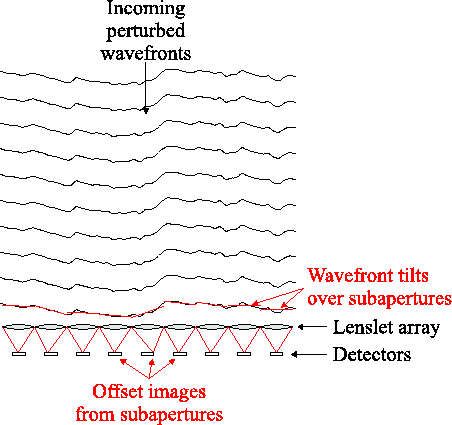
measuring the shape of the wavefront is a Shack-Hartmann array (see
Figure 1.9). This consists of a series of
subapertures typically of
diameter
(Noll, 1976). To obtain diffraction-limited images from larger
telescopes, the shape of the perturbations in the wavefront across the
telescope aperture must be measured and actively corrected. Deformable
mirrors in a re-imaged pupil-plane are most often used to introduce
additional optical path which corrects the perturbations introduced by
the atmosphere as shown schematically in
Figure 1.8. One of the simplest systems for
measuring the shape of the wavefront is a Shack-Hartmann array (see
Figure 1.9). This consists of a series of
subapertures typically of  diameter, positioned across a
telescope pupil-plane. The wavefront sensor accepts light from the
reference star, while light from the science object (or light at a
science imaging wavelength) is directed to a separate imaging
camera. Each subaperture contains a focusing element which generates
an image of the reference source, and the position offset of these
images is used to calculate the mean gradient of the wavefront phase
over each subaperture. The gradient measurements can then be pieced
together to provide a model for the shape of the wavefront
perturbations. This model is then fed into the wavefront corrector. In
order to accurately correct the rapidly fluctuating atmosphere using a
stable servo-feedback loop, the process must typically be repeated ten
times per atmospheric coherence time (see
e.g. Hardy (1998); Karr (1991)). The atmospheric coherence time itself is
usually found to be shorter for measurements through small
subapertures than for imaging through the full telescope aperture, as
will be discussed further in Chapter 2 (see also
Roddier et al. (1982a)).
diameter, positioned across a
telescope pupil-plane. The wavefront sensor accepts light from the
reference star, while light from the science object (or light at a
science imaging wavelength) is directed to a separate imaging
camera. Each subaperture contains a focusing element which generates
an image of the reference source, and the position offset of these
images is used to calculate the mean gradient of the wavefront phase
over each subaperture. The gradient measurements can then be pieced
together to provide a model for the shape of the wavefront
perturbations. This model is then fed into the wavefront corrector. In
order to accurately correct the rapidly fluctuating atmosphere using a
stable servo-feedback loop, the process must typically be repeated ten
times per atmospheric coherence time (see
e.g. Hardy (1998); Karr (1991)). The atmospheric coherence time itself is
usually found to be shorter for measurements through small
subapertures than for imaging through the full telescope aperture, as
will be discussed further in Chapter 2 (see also
Roddier et al. (1982a)).
 |
 |
Bob Tubbs 2003-11-14