Next: Isoplanatic patch Up: Limiting magnitude of reference Previous: Limiting magnitude of reference Contents
 diameter subapertures in
about one tenth of the atmospheric coherence time for the
subapertures. This is a similar problem to the correction of image
position for Lucky Exposures, and I will now compare the two limiting magnitudes
directly.
diameter subapertures in
about one tenth of the atmospheric coherence time for the
subapertures. This is a similar problem to the correction of image
position for Lucky Exposures, and I will now compare the two limiting magnitudes
directly.
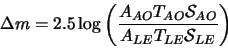
In the simplest approximation, the limiting magnitude for measurement
of image position is set by the requirement for a minimum number of
photons in the image core. The number of photons in the image core is
proportional to the photon flux density  from the star at the
observing wavelength, the collecting area of the aperture
from the star at the
observing wavelength, the collecting area of the aperture  , the
exposure time
, the
exposure time  and the Strehl ratio of the image
  . If
the number of photons required in the image core is the same in both
cases, and the losses in the optics and the detector are the same,
then from Equation 1.10 the limiting magnitude for
adaptive optics will be poorer by:
. If
the number of photons required in the image core is the same in both
cases, and the losses in the optics and the detector are the same,
then from Equation 1.10 the limiting magnitude for
adaptive optics will be poorer by:
 and
and  refer to the adaptive optics and
Lucky Exposures cases respectively. For the case described in
Figure 1.4b the telescope diameter for the
Lucky Exposures case is seven times the adaptive optics subaperture
diameter. Passive Lucky Exposures observations can have ten times longer exposure
times than adaptive optics wavefront sensors, but the Strehl ratio in
the subapertures of an adaptive optics wavefront sensor is typically
twice that in a Lucky Exposure. This means that Lucky Exposures should be able
to use stars which are about seven magnitudes fainter than would be
required for near diffraction-limited imaging with adaptive
optics. The faintest reference stars which provide good adaptive
optics correction at I-band are
refer to the adaptive optics and
Lucky Exposures cases respectively. For the case described in
Figure 1.4b the telescope diameter for the
Lucky Exposures case is seven times the adaptive optics subaperture
diameter. Passive Lucky Exposures observations can have ten times longer exposure
times than adaptive optics wavefront sensors, but the Strehl ratio in
the subapertures of an adaptive optics wavefront sensor is typically
twice that in a Lucky Exposure. This means that Lucky Exposures should be able
to use stars which are about seven magnitudes fainter than would be
required for near diffraction-limited imaging with adaptive
optics. The faintest reference stars which provide good adaptive
optics correction at I-band are  (Graves et al. , 1998), in broad
agreement with the arguments here.
(Graves et al. , 1998), in broad
agreement with the arguments here.
Recent studies (e.g. Ragazzoni & Farinato (1999)) have shown that novel wavefront sensors such as Pyramid sensors can improve the reference star limiting magnitude for adaptive optics by several magnitudes at extremely large telescopes, but the gains for moderate sized telescopes such as those described in this thesis are relatively small. The limiting reference star magnitude is still not competitive with Lucky Exposures.
One approach which may overcome the problems with the reference source limiting magnitude for adaptive optics is the use of artificial reference stars, typically provided by light scattered from a high power laser pointing along the line of sight of the telescope. A number of observatories are currently developing such laser systems.