


Next: Limiting magnitude of reference Up: Performance of ground-based high Previous: Performance of ground-based high Contents
 at a given wavelength
  is defined in
terms of the amplitude
is defined in
terms of the amplitude  of the electromagnetic waves:
 exist such as the Johnson magnitude
system (Aller et al. , 1982).
exist such as the Johnson magnitude
system (Aller et al. , 1982).
For observations in a given waveband the apparent magnitude of the
faintest reference source which can be used for a high-resolution
imaging technique is called the reference source limiting magnitude
 . The applicability of the imaging technique depends on the
density
. The applicability of the imaging technique depends on the
density
 of stars brighter than this
limiting magnitude on the night sky. For the range of limiting
magnitudes appropriate to most of the imaging techniques described
here this density is relatively well fit over the majority of the
night sky by
of stars brighter than this
limiting magnitude on the night sky. For the range of limiting
magnitudes appropriate to most of the imaging techniques described
here this density is relatively well fit over the majority of the
night sky by
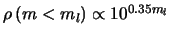 (see e.g. Bahcall & Soneira (1984); Cox (2000)). Improving the limiting magnitude
for any one of the imaging techniques by only one magnitude typically
doubles the sky coverage of the technique, dramatically
improving the range of astronomical studies which can be undertaken by
that technique.
(see e.g. Bahcall & Soneira (1984); Cox (2000)). Improving the limiting magnitude
for any one of the imaging techniques by only one magnitude typically
doubles the sky coverage of the technique, dramatically
improving the range of astronomical studies which can be undertaken by
that technique.
