Astronomical imaging from Michelson interferometers with separated
elements has been demonstrated by a number of authors
(e.g. Young et al. (2003); Baldwin et al. (1996); Monnier (2003); Burns et al. (1997)). The principles of
the technique are the same as bispectral analysis of images taken
through non-redundant aperture masks at a single telescope as
described above. Each telescope in a separate element interferometer
array is equivalent to one subaperture of the aperture mask. In
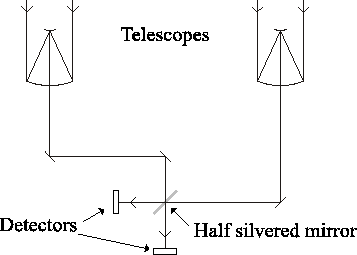
separate element interferometers the light is often combined using
half-silvered mirrors in a pupil-plane as shown in
Figure 1.7, rather than in an image plane. With no active
wavefront correction on the individual telescopes and photon-counting
detectors the limiting magnitude for this method is similar to that of
bispectrum imaging at single telescopes. All existing and planned
separate-element interferometers have some form of adaptive optics
correction (often only the image position or tip-tilt
component). The limiting magnitude of reference source required for
adaptive optics correction sets an upper limit on the limiting
magnitude for these arrays, and this is discussed in the next section.
Figure 1.7:
Schematic showing pupil-plane beam
combination in a two-telescope optical interferometer.
 |
Bob Tubbs
2003-11-14


