


Next: The effect of mirror Up: Experimental method Previous: Experimental method Contents

 and
and
 (around the R and I astronomical wavebands).
The optimum aperture size to use for the Lucky Exposures method depends on a
compromise between the probability of obtaining a short exposure with
a high Strehl ratio and the limiting magnitude of reference star that
can be used. The numerical simulations presented in
Chapter 2.3.3 suggested that this compromise would
be met for telescopes with diameter  seven or eight times greater
than the atmospheric coherence length
seven or eight times greater
than the atmospheric coherence length  . The value of
depends both on the atmospheric conditions and the wavelength at which
the observations are undertaken, as described by
Equations 2.8 and
2.9. is estimated to be
. The value of
depends both on the atmospheric conditions and the wavelength at which
the observations are undertaken, as described by
Equations 2.8 and
2.9. is estimated to be 
 at I-band
under the median summer seeing conditions at the NOT site
(Vernin & Muñoz-Tuñón, 1994; Muñoz-Tuñón et al. , 1997), making the
at I-band
under the median summer seeing conditions at the NOT site
(Vernin & Muñoz-Tuñón, 1994; Muñoz-Tuñón et al. , 1997), making the 
 aperture of this
telescope ideally suited to Lucky Exposures experiments in this waveband at this
time of year. The exceptionally good astronomical conditions at this
site in the summer can be partially attributed to the thermal
inversion layer(s) usually being at a lower altitude than the
observatory (Figure 3.1).
aperture of this
telescope ideally suited to Lucky Exposures experiments in this waveband at this
time of year. The exceptionally good astronomical conditions at this
site in the summer can be partially attributed to the thermal
inversion layer(s) usually being at a lower altitude than the
observatory (Figure 3.1).
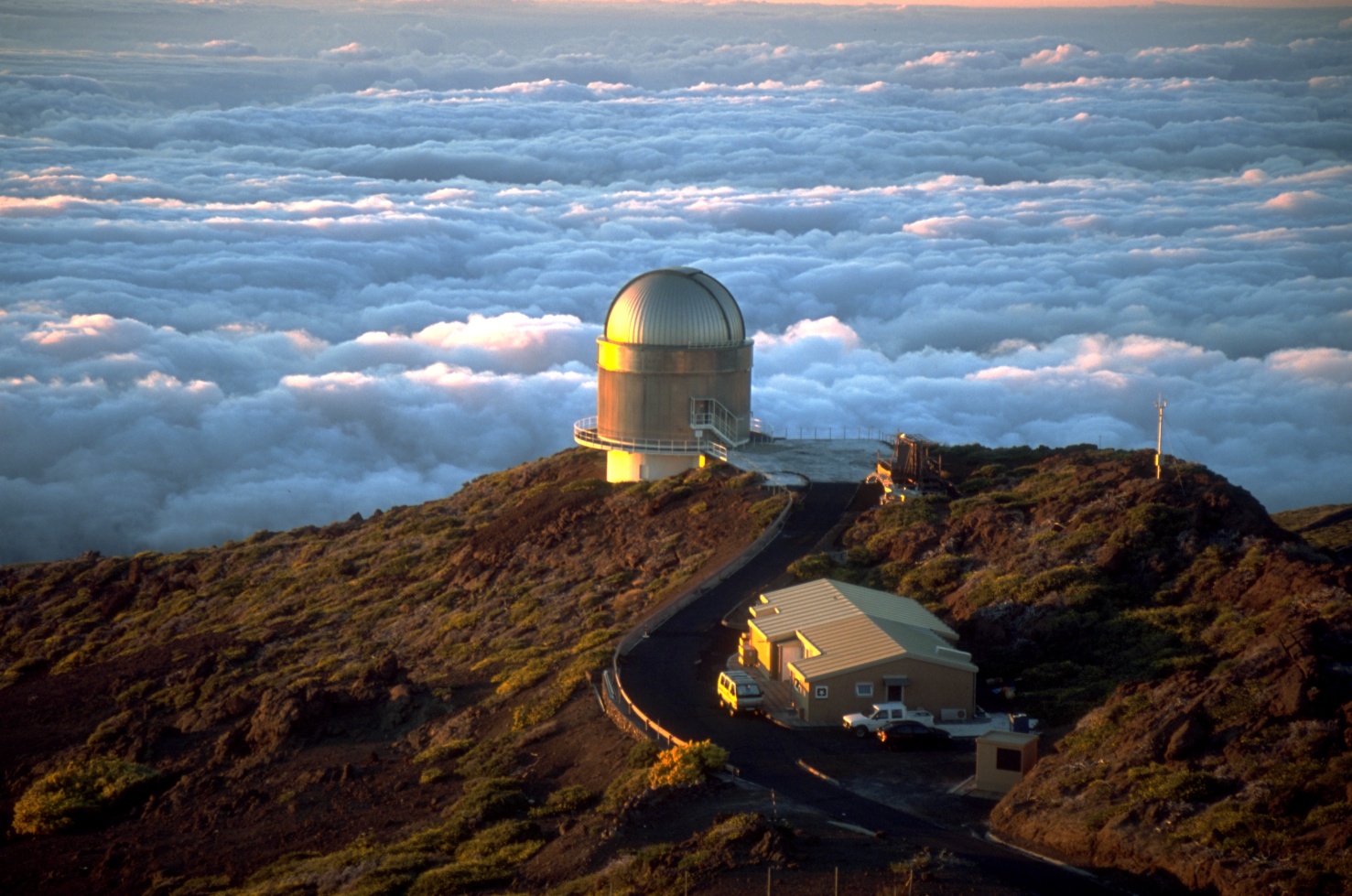 |
In May 2000 high frame-rate imaging observations were undertaken by
John Baldwin, Craig Mackay and Graham Cox at the NOT using the JOSE
camera. In order to accurately characterise the temporal
characteristics of the atmosphere, the observations were made with
high frame rates with no autoguider in operation. All of the stars
observed were relatively bright (with  ) allowing the shape of the
stellar PSF to be recorded with high signal-to-noise in each short
exposure.
) allowing the shape of the
stellar PSF to be recorded with high signal-to-noise in each short
exposure.
Bob Tubbs 2003-11-14