


Next: Results with binary stars Up: Observational results with single Previous: Temporal properties of the Contents
The Strehl ratio for the shift-and-add image using all the exposures
is plotted as a function of this time difference in curve B
of Figure 3.18, alongside curve A,
the temporal autocorrelation of the speckle pattern previously shown
in Figures 3.16 and
3.17. Qualitatively the curves appear similar
suggesting that the decorrelation process is not substantially
different for the brightest speckle than for the fixed point chosen in
the image plane. Both curves are almost equally affected by the
telescope oscillation as would be expected. If we ignore the effects
of the telescope oscillation, the brightest speckle does appear to
decorrelate slightly more quickly at first than the autocorrelation
curve for the measurements taken at a fixed location in the
image. Also shown in the Figure are the Strehl ratios obtained in the
final image when the best  % of exposures are used, based upon the
Strehl ratio and position of the brightest speckle measured in a
different short exposure in the same run (i.e. taken at a slightly
different time). If we ignore the effects of the telescope
oscillation, this appears to decay slightly more slowly than the other
timescales, perhaps indicating that the atmospheric coherence time is
slightly extended during the times of the best exposures. This is a
small effect, and it is clear that the timescales for the decay of the
brightest speckle are very close to the coherence timescale of the
speckle pattern.
% of exposures are used, based upon the
Strehl ratio and position of the brightest speckle measured in a
different short exposure in the same run (i.e. taken at a slightly
different time). If we ignore the effects of the telescope
oscillation, this appears to decay slightly more slowly than the other
timescales, perhaps indicating that the atmospheric coherence time is
slightly extended during the times of the best exposures. This is a
small effect, and it is clear that the timescales for the decay of the
brightest speckle are very close to the coherence timescale of the
speckle pattern.
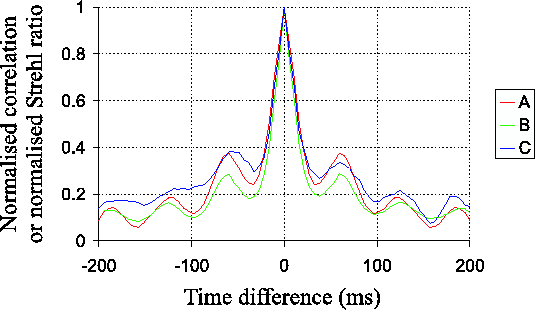 |
Figure 3.18 shows that the timescale for the
decay of the brightest speckle is  --
--
 brought about
predominantly by the
brought about
predominantly by the 
 telescope oscillation. If exposure
times greater than this are used, one would expect the typical Strehl
ratios of the exposures to be reduced. This was tested experimentally
by splitting the dataset on
telescope oscillation. If exposure
times greater than this are used, one would expect the typical Strehl
ratios of the exposures to be reduced. This was tested experimentally
by splitting the dataset on  Aquilae into groups of five
consecutive exposures. The five exposures in each group were added
together without re-centring to form a single exposure with five times
the duration. The best % of these
Aquilae into groups of five
consecutive exposures. The five exposures in each group were added
together without re-centring to form a single exposure with five times
the duration. The best % of these  exposures is shown as
a contour plot in Figure 3.19b alongside the
shift-and-add image from the best % of the original
exposures is shown as
a contour plot in Figure 3.19b alongside the
shift-and-add image from the best % of the original  exposures in Figure 3.19a. The increase in exposure time
from to brings about a reduction in the Strehl
ratio of the best % from
exposures in Figure 3.19a. The increase in exposure time
from to brings about a reduction in the Strehl
ratio of the best % from  for Figure 3.19a to
 for Figure 3.19b. The image FWHM is increased
from
for Figure 3.19b. The image FWHM is increased
from 
 to
to  . It is clear that the
amplitude of the telescope oscillation is small enough that relative
good image quality can still be obtained with exposure times as long
as using the Lucky Exposures method.
. It is clear that the
amplitude of the telescope oscillation is small enough that relative
good image quality can still be obtained with exposure times as long
as using the Lucky Exposures method.
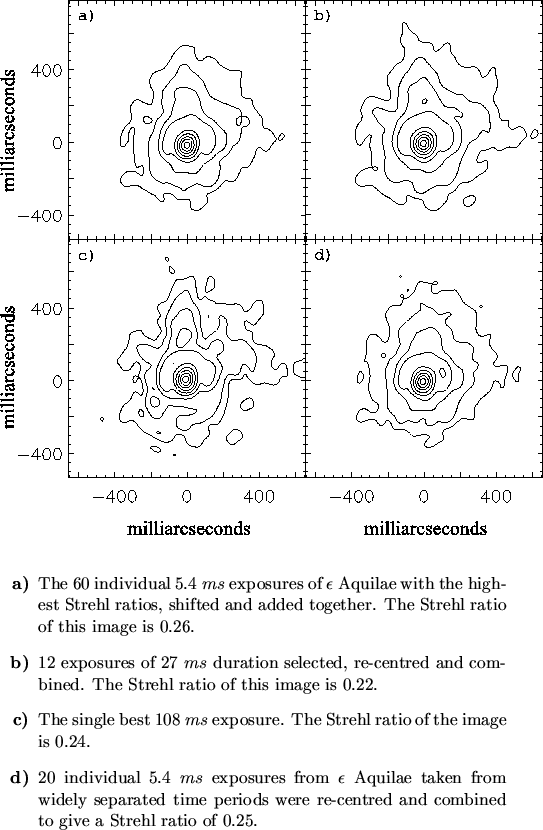 |
Figure 3.19c shows the single best  exposure
formed by summing together without re-centring consecutive short
exposures from the run on Aquilae. The Strehl ratio for
this image is
exposure
formed by summing together without re-centring consecutive short
exposures from the run on Aquilae. The Strehl ratio for
this image is  . The small amplitude of the telescope oscillation
seen in movies generated from the raw short exposures around the
moment that the constituent short exposures were taken may partly
explain the high Strehl ratio obtained. It is clear that the
atmospheric timescale must have been quite long at the time this
exposure was taken. Although the Strehl ratios are comparable, the
shift-and-add images shown in Figures 3.19a and
3.19b show much less structure in the wings of the PSF
than the single exposure of Figure 3.19c. This is
probably due to the shift-and-add images being the average of many
atmospheric realisations, which helps to smooth out the fluctuations
in the wings of the PSF. To demonstrate that this is not simply an
integration-time effect, Figure 3.19d shows a
shift-and-add image with the same total integration time and similar
Strehl ratio (
. The small amplitude of the telescope oscillation
seen in movies generated from the raw short exposures around the
moment that the constituent short exposures were taken may partly
explain the high Strehl ratio obtained. It is clear that the
atmospheric timescale must have been quite long at the time this
exposure was taken. Although the Strehl ratios are comparable, the
shift-and-add images shown in Figures 3.19a and
3.19b show much less structure in the wings of the PSF
than the single exposure of Figure 3.19c. This is
probably due to the shift-and-add images being the average of many
atmospheric realisations, which helps to smooth out the fluctuations
in the wings of the PSF. To demonstrate that this is not simply an
integration-time effect, Figure 3.19d shows a
shift-and-add image with the same total integration time and similar
Strehl ratio ( ) to Figure 3.19c, but using
individual short exposures taken at widely separated times. The wings
of the PSF are substantially smoother than for the single
exposure of Figure 3.19c. This suggests that a
significant fraction of the noise in these images results from the
limited number of atmospheric realisations used in generating them.
) to Figure 3.19c, but using
individual short exposures taken at widely separated times. The wings
of the PSF are substantially smoother than for the single
exposure of Figure 3.19c. This suggests that a
significant fraction of the noise in these images results from the
limited number of atmospheric realisations used in generating them.


