


Next: Varying the fraction of Up: Results with binary stars Previous: Results with binary stars Contents
 Boötis

 binary Boötis, each
comprising
binary Boötis, each
comprising  short exposures. During both of these runs the
binary drifted slightly across the detector due to telescope tracking
problems. The parts of each of the two runs were identified where both
binary components were well within the readout region of the CCD (more
than
short exposures. During both of these runs the
binary drifted slightly across the detector due to telescope tracking
problems. The parts of each of the two runs were identified where both
binary components were well within the readout region of the CCD (more
than  pixels from the edge), and only these short exposures were
used in the following analysis.
pixels from the edge), and only these short exposures were
used in the following analysis.
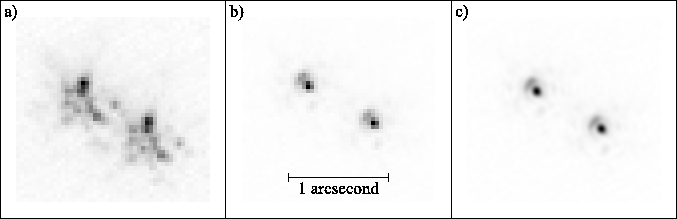
Two example short exposures of Boötis are shown in
Figures 3.20a and
3.20b. Figure 3.20a is
typical of the data set (with a Strehl ratio close to the median)
while Figure 3.20b has an unusually high Strehl
ratio of  . In both of these exposures there is strong similarity
between the shapes of the speckle patterns around each binary
component, suggesting that the PSF due to the atmosphere is the same
for both stars. The small differences which are visible between the
images of the two binary companions can partly be explained by the
different alignment of the stellar images with respect to the pixel
grid of the CCD. Figure 3.20c shows the effect
of sinc-resampling the image shown in
Figure 3.20b to have four times as many pixels
in each dimension, revealing a hint of the first Airy ring. The
similarities between the stellar images of the two binary companions
is even more pronounced in this resampled image.
. In both of these exposures there is strong similarity
between the shapes of the speckle patterns around each binary
component, suggesting that the PSF due to the atmosphere is the same
for both stars. The small differences which are visible between the
images of the two binary companions can partly be explained by the
different alignment of the stellar images with respect to the pixel
grid of the CCD. Figure 3.20c shows the effect
of sinc-resampling the image shown in
Figure 3.20b to have four times as many pixels
in each dimension, revealing a hint of the first Airy ring. The
similarities between the stellar images of the two binary companions
is even more pronounced in this resampled image.
 |
The Lucky Exposures image selection procedure was applied to the data using the
approach described in Chapter 3.3.2. The left-hand
brighter component of Boötis was initially used as the
reference star.