Next: Strehl ratios obtained for zeta Bootis Up: Results with binary stars Previous: Data taken on zeta Bootis Contents
 Boötis data
several times. In each case the images of the two binary components
appear very similar, suggesting that the field is isoplanatic with
little variation in the imaging PSF as a function of position.
Boötis data
several times. In each case the images of the two binary components
appear very similar, suggesting that the field is isoplanatic with
little variation in the imaging PSF as a function of position.
Some of the results from the Boötis data are summarised in
Figure 3.21.
Figure 3.21a shows an image generated from
the short exposures have the highest  % of Strehl ratios as
measured on the left-hand component of Boötis. The stellar
images appear almost diffraction limited, with the first Airy ring
clearly visible. The diffuse halo surrounding the stars is very faint
and barely visible in the image. Figure 3.21b
shows the result when the process is repeated using the right-hand
star as the reference for measuring Strehl ratio and the position of
the brightest speckle. Figures 3.21a and
3.21b are almost indistinguishable to the
eye, emphasising the high degree of isoplanatism and the good
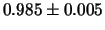
signal-to-noise in the images. The Strehl ratio for the reference star
in each case is
% of Strehl ratios as
measured on the left-hand component of Boötis. The stellar
images appear almost diffraction limited, with the first Airy ring
clearly visible. The diffuse halo surrounding the stars is very faint
and barely visible in the image. Figure 3.21b
shows the result when the process is repeated using the right-hand
star as the reference for measuring Strehl ratio and the position of
the brightest speckle. Figures 3.21a and
3.21b are almost indistinguishable to the
eye, emphasising the high degree of isoplanatism and the good
signal-to-noise in the images. The Strehl ratio for the reference star
in each case is  .
.
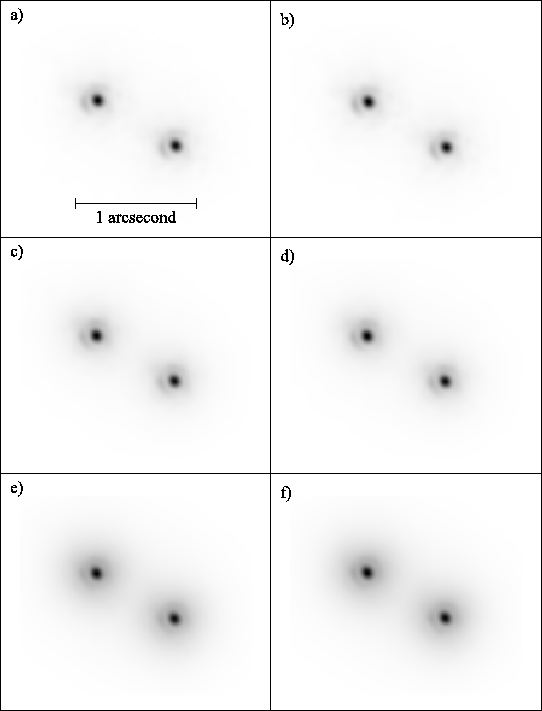 |
Figures 3.21c and
3.21d show images generated in a similar way
but using the short exposures which have the highest  of Strehl
ratios. A diffuse halo is clearly visible around both stars slightly
reducing the Strehl ratio for the reference star images to
of Strehl
ratios. A diffuse halo is clearly visible around both stars slightly
reducing the Strehl ratio for the reference star images to  .
.
Figures 3.21e and
3.21f show images generated in a similar way
but using all of the short exposures regardless of Strehl ratio. The
diffuse halos are much more prominent around the stars reducing the
Strehl ratio for the reference star images to  . These represent
the conventional shift-and-add images from the same data.
. These represent
the conventional shift-and-add images from the same data.
For all six images shown in Figure 3.21, the
Strehl ratio for the binary companion was found to be only
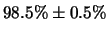 as high as that of the reference star. This indicates a small
level of decorrelation between the shapes of the stellar images for
the two binary components as recorded on the detector. It is likely
that the decorrelation comes partially from noise sources such as
detector readout noise, photon shot noise, and in particular the
pixellation of the stellar image on the detector. Both the exposure
selection step and the image re-centring have a tendency to coherently
add the noise components in the image of the reference star to give an
artificially high Strehl ratio for this binary component. This effect
is described in detail by Nieto & Thouvenot (1991) for the photon-shot noise
component. The noise contribution is not expected to show strong
correlation between the separate binary components, so the Strehl
ratio for the binary companion should not be systematically affected
in this way.
as high as that of the reference star. This indicates a small
level of decorrelation between the shapes of the stellar images for
the two binary components as recorded on the detector. It is likely
that the decorrelation comes partially from noise sources such as
detector readout noise, photon shot noise, and in particular the
pixellation of the stellar image on the detector. Both the exposure
selection step and the image re-centring have a tendency to coherently
add the noise components in the image of the reference star to give an
artificially high Strehl ratio for this binary component. This effect
is described in detail by Nieto & Thouvenot (1991) for the photon-shot noise
component. The noise contribution is not expected to show strong
correlation between the separate binary components, so the Strehl
ratio for the binary companion should not be systematically affected
in this way.
It is clear from Figures 3.21a to
3.21f that the imaging PSF degrades
gradually as the fraction of exposures selected is increased. The
gradual nature of this change may be extremely useful in astronomical
programs as the performance of the Lucky Exposures method can be adjusted
according to the scientific needs. If an astronomical target is too
faint to give good signal to noise using only the best  of
exposures, the astronomer can choose to use a larger fraction of
exposures at the expense of a small degradation in the image
quality. If the observational data are stored in a suitable manner,
the fraction of exposures selected can be adjusted after the
observations have been completed (during the data reduction) in order
to give the highest quality science results.
of
exposures, the astronomer can choose to use a larger fraction of
exposures at the expense of a small degradation in the image
quality. If the observational data are stored in a suitable manner,
the fraction of exposures selected can be adjusted after the
observations have been completed (during the data reduction) in order
to give the highest quality science results.
Bob Tubbs 2003-11-14