


Next: Results using model 2 Up: Results from numerical simulations Previous: Results from numerical simulations Contents
 gain stages were
first undertaken using model 1 for the individual gain stages (where
the additional impact ionisation electrons were chosen from a Poisson
distribution). In the simulations the same value of the gain
gain stages were
first undertaken using model 1 for the individual gain stages (where
the additional impact ionisation electrons were chosen from a Poisson
distribution). In the simulations the same value of the gain  was
used for each of the stages. The total gain of the
multiplication register was thus given by
was
used for each of the stages. The total gain of the
multiplication register was thus given by  . The three
simulations used three different values of chosen to give total
multiplication register gains
. The three
simulations used three different values of chosen to give total
multiplication register gains  of
of  ,
,  and
and
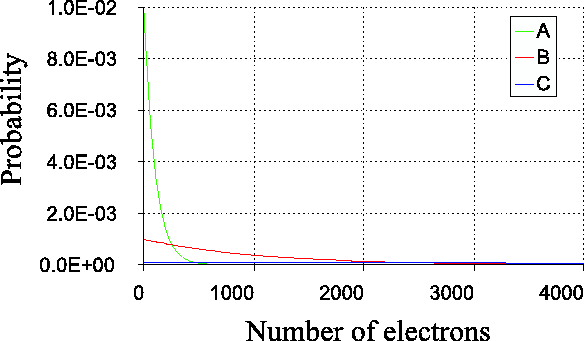
 . The probability distributions for the output electrons in
these three simulations are shown in
Figure 4.2.
. The probability distributions for the output electrons in
these three simulations are shown in
Figure 4.2.
 |
The probability distributions for the output electrons are well
approximated by decaying exponential curves for large values of
 . This is highlighted in Figure 4.3a
where the curves are plotted on a logarithmic scale. The probability
curves appear as straight lines over a wide range of in the
plot. For very large values of the probability reaches the
computational accuracy of the software corresponding to a value of
. This is highlighted in Figure 4.3a
where the curves are plotted on a logarithmic scale. The probability
curves appear as straight lines over a wide range of in the
plot. For very large values of the probability reaches the
computational accuracy of the software corresponding to a value of
 , and beyond this point the probability calculations are
dominated by noise. Figure 4.3b shows an
expanded view of the probability distributions for small
. Exponential curves were least-squares fitted to the probability
curves for the large region, and these are extrapolated as dashed
curves in this plot. For small values of (
, and beyond this point the probability calculations are
dominated by noise. Figure 4.3b shows an
expanded view of the probability distributions for small
. Exponential curves were least-squares fitted to the probability
curves for the large region, and these are extrapolated as dashed
curves in this plot. For small values of ( ) the
probability curve begins to fall very slightly below the best fit
exponential before dropping rapidly to zero for
) the
probability curve begins to fall very slightly below the best fit
exponential before dropping rapidly to zero for  .
.
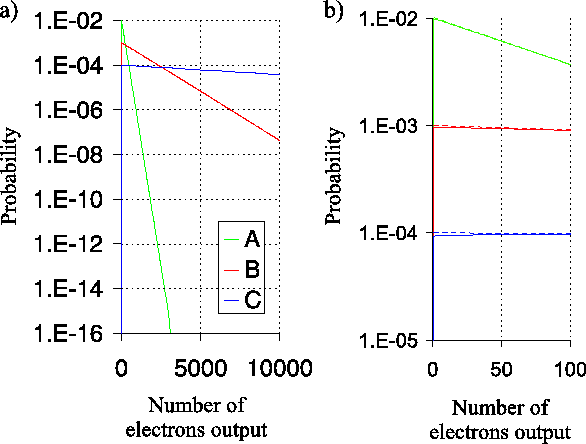 |
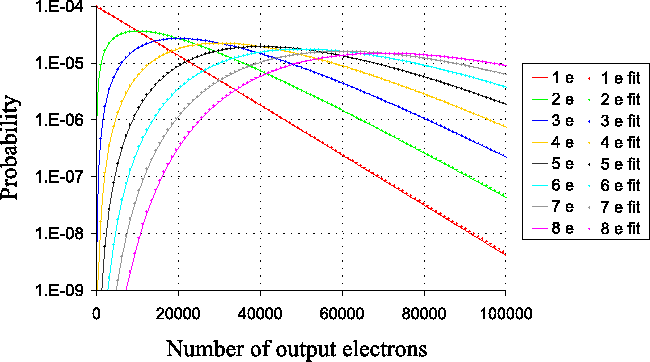
Figure 4.4 shows similar plots for a
stage register with overall gain with different numbers
of input electrons. The general shape of the curves was not strongly
dependent on the number of gain stages  as long as was large.
 |
Based upon the exponential fits in
Figure 4.3, we can say that the
probability distributions for the number of output electrons produced
when one input electron enters an electron multiplying CCD with a
large number of gain stages can be approximated by the function:
is an integer describing the number of output electrons and
 is the overall gain of the multiplication register.
If we approximate Equation 4.25 as a
continuous function and convolve it with itself we get an
approximation for the probability distribution given two input
electrons:
With further convolutions, and taking approximations for the case of
large gain and a large number  of input electrons, I obtained
the following model for the probability distribution for the output
electrons:
of input electrons, I obtained
the following model for the probability distribution for the output
electrons:
is the number of output electrons. Individual data points
calculated using this equation are included in
Figure 4.4 alongside the appropriate
probability curves calculated numerically for model 1. The
approximation described by Equation 4.27
does not differ substantially from the numerically calculated curves
even for one or two input electrons (although slightly better
approximations for one and two input electrons are given by
Equations 4.25 and
4.26 respectively).
Bob Tubbs 2003-11-14




