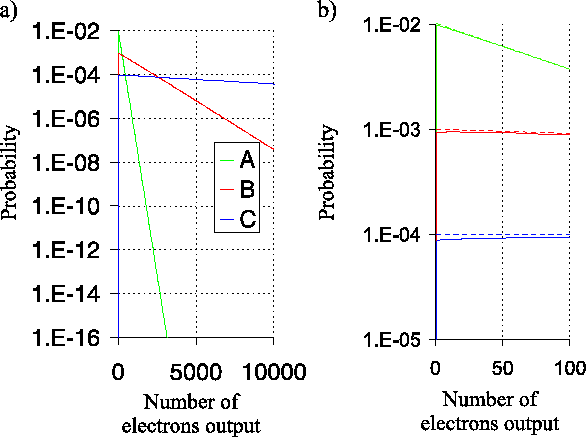
Figure 4.5 shows the probability
distribution for the output electrons when the gain stages are
described by model 2 (where electrons entering the gain stage can
generate at most one electron by impact ionisation in that gain
stage). The general shape of the curves is very similar to those
produced by model 1 (see Figure 4.3 for
comparison). With model 2 the curves fall away to zero slightly more
quickly for small values of  . The approximations described by
Equations 4.25 to
4.27 are also good descriptions for
the output probability distributions with this model for the gain
stages.
. The approximations described by
Equations 4.25 to
4.27 are also good descriptions for
the output probability distributions with this model for the gain
stages.
Figure 4.5:
The probability distribution for the number of output
electrons from a multiplication register of  stages using model 2
for the gain stages with a single electron input to the register. With
this model each electron input to one gain stage is only allowed to
take part in one impact ionisation process within that stage. Curves
A, B and C correspond to simulations with
total gains of 100, 1000 and 10000. Panel b) shows an
enlargement of one portion of the plot in panel a). The
curves in panel a) were well fitted with exponential
functions for the case of large numbers of output electrons, and these
fits have been extrapolated as dashed lines in panel b).
stages using model 2
for the gain stages with a single electron input to the register. With
this model each electron input to one gain stage is only allowed to
take part in one impact ionisation process within that stage. Curves
A, B and C correspond to simulations with
total gains of 100, 1000 and 10000. Panel b) shows an
enlargement of one portion of the plot in panel a). The
curves in panel a) were well fitted with exponential
functions for the case of large numbers of output electrons, and these
fits have been extrapolated as dashed lines in panel b).
 |
It is perhaps not surprising that the probability distributions for
the output electrons with the two different gain stage models
considered here are so similar, given that it is the discretisation of
the signal into individual electrons which dominates the
signal-to-noise performance of the register, and not the internal
properties of the individual gain stages. Even if the gain stages of a
real multiplication register differ slightly from either of the models
described above, it seems likely that
Equation 4.25 will provide a good
approximation to the distribution of output electrons given one input
electron.
Bob Tubbs
2003-11-14


