Next: Charge transfer efficiency problems Up: CCD measurements Previous: CCD measurements Contents
Figure 4.7 shows a small region of one short exposure taken while the camera was attached to the NOT on 2003 June 29. Long exposure imaging of the field displayed here showed that it did not contain any bright sources, so the detected flux is known to be much less than one photo-electron per pixel in this short exposure.
 |
A small number of pixels in the short exposure show signal levels which are significantly higher than the typical noise in the image. It is likely that a photo-electron (or dark current electron) was generated in most of these pixels. The pixels with high signal levels found in several thousand short exposures such as this were found to be correlated with the locations of faint sources in the field, suggesting that they do indeed correspond to photon events.
Figure 4.8 shows a histogram of the Digital Numbers (DNs)
output from the camera in  exposures similar to the one shown in
Figure 4.7 (and including the exposure shown). The
peak of the histogram can be relatively well fit by a Gaussian
distribution, as shown in Figure 4.8a. The centre of this
Gaussian distribution corresponds to the mean signal when no photons
are detected in a pixel. The width of the Gaussian corresponds to the
RMS readout noise. A least-squares fit to the data gave a value of
exposures similar to the one shown in
Figure 4.7 (and including the exposure shown). The
peak of the histogram can be relatively well fit by a Gaussian
distribution, as shown in Figure 4.8a. The centre of this
Gaussian distribution corresponds to the mean signal when no photons
are detected in a pixel. The width of the Gaussian corresponds to the
RMS readout noise. A least-squares fit to the data gave a value of

 for the centre of the Gaussian. The fitted Gaussian
dropped to
for the centre of the Gaussian. The fitted Gaussian
dropped to  of the peak value
  from the centre,
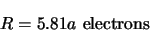
implying an RMS readout noise of . If each corresponds
to
from the centre,
implying an RMS readout noise of . If each corresponds
to  electrons leaving the multiplication register, the RMS readout
noise
electrons leaving the multiplication register, the RMS readout
noise  will be:
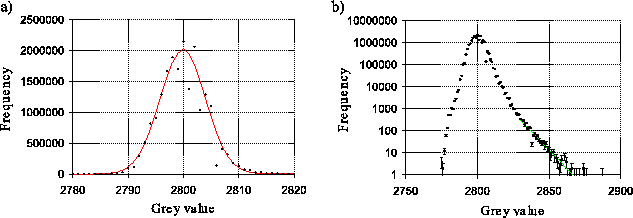 |
Figure 4.8b shows the same measurement data plotted on a
logarithmic scale. The frequency distribution is well fit by an
exponentially decaying function for high s (more than  from
the centre of the Gaussian) as would be expected given the presence of
photo-electrons in some of the pixels. The best fit exponential had a
decay constant of
from
the centre of the Gaussian) as would be expected given the presence of
photo-electrons in some of the pixels. The best fit exponential had a
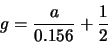
decay constant of  per . The gain of the multiplication
register can be calculated from
Equation 4.25 as:
per . The gain of the multiplication
register can be calculated from
Equation 4.25 as:
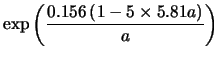
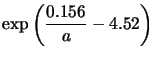
Applying Equation 4.29 to the parameters
given by Equations 4.30 and
4.31 allows us to calculate the efficiency  for counting photo-electrons:
 |
 |
 |
(4.32) |
|
 |
(4.33) |
For  this gives an efficiency for photo-electron detection of:
|
 |
 |
(4.34) |
|
 |
(4.35) |
was expected to be
approximately  based on the electronic setup of the camera).
The reason for the poor photon counting performance is highlighted if
the RMS readout noise is expressed in terms of the mean input signal
provided by one photo-electron (i.e. if the RMS readout noise is
expressed in units of photo-electrons). This is achieved if
Equation 4.30 is divided by
Equation 4.31:
 |
(4.36) |
we can approximate this as:
 |
|
 |
(4.37) |
|
 |
(4.38) |
It should be noted that a readout noise of  photo-electrons at

 pixel rates represents a very substantial improvement over
the read noise of
pixel rates represents a very substantial improvement over
the read noise of  --
-- electrons for the camera used in the
observations described in Chapter 3. State-of-the-art
conventional CCDs can typically only achieve
electrons for the camera used in the
observations described in Chapter 3. State-of-the-art
conventional CCDs can typically only achieve  -- electrons
read noise at these pixel rates (Jerram et al. , 2001).
-- electrons
read noise at these pixel rates (Jerram et al. , 2001).
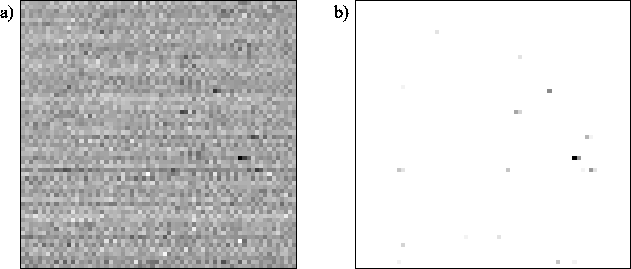
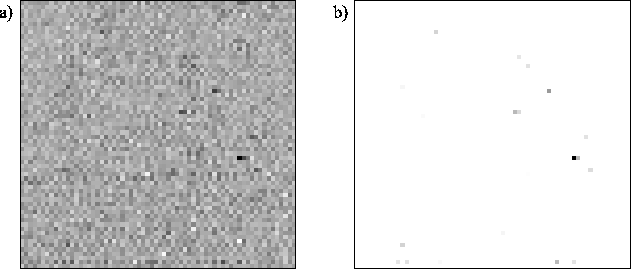
A large part of the RMS noise in the example short exposure shown in
Figure 4.7 is in the form of variations from one
horizontal row of the image to the next. If these fluctuations are
subtracted then the RMS noise is reduced. In order to do this it was
necessary to get a measure of the typical s in each individual row
of the image which was not strongly biased by the few pixels
containing photo-electrons. A histogram was made of the s in each
row of the image. The lowest  of s from the row were then
averaged to provide a value slightly lower than the mean for s in
the row, but not significantly biased by the small number of pixels
containing photo-electrons. This mean value was then subtracted from
all the pixels in the row. The image which resulted after this
procedure was applied to each row in Figure 4.7 is
shown in Figures 4.9a and
4.9b.
of s from the row were then
averaged to provide a value slightly lower than the mean for s in
the row, but not significantly biased by the small number of pixels
containing photo-electrons. This mean value was then subtracted from
all the pixels in the row. The image which resulted after this
procedure was applied to each row in Figure 4.7 is
shown in Figures 4.9a and
4.9b.
 |
This process was applied to the full dataset of frames. The RMS
readout noise calculated from the histogram of the s was reduced to
 electrons, where is the number of electrons per as
before. If the threshold for detection of a photo-electron is set at
electrons, where is the number of electrons per as
before. If the threshold for detection of a photo-electron is set at
 times this RMS noise level, the efficiency of counting
photo-electrons comes to just over
times this RMS noise level, the efficiency of counting
photo-electrons comes to just over  . Although this represents a
substantial improvement over the case where row to row fluctuations
are not subtracted, it will still give poorer signal-to-noise for
imaging than would be obtained by treating the measured s like an
analogue signal.
. Although this represents a
substantial improvement over the case where row to row fluctuations
are not subtracted, it will still give poorer signal-to-noise for
imaging than would be obtained by treating the measured s like an
analogue signal.
These results appear to be typical of the data I have analysed from
the L3Vision camera at the NOT. It is clear that the photon counting
approach would not have been successful with this observational data,
so I will treat the s output from the camera in an analogue
fashion like the output from a conventional CCD camera in the
remainder of this thesis. On later nights of the observing run in 2003
a higher camera gain setting was used, but there has been insufficient
time to analyse that data for inclusion in this thesis.
Bob Tubbs 2003-11-14