CCD measurements

A camera was specifically designed by Craig Mackay to house electron-multiplying CCDs. Both CCD65s and CCD87s from the E2V L3Vision family were used in the camera, both in laboratory tests and at the NOT. The CCDs used were front-illuminated, frame-transfer devices. The physical characteristics of these detectors is summarised in Table 4.1.

Table 4.1: The properties of two E2V CCDs which were investigated, the CCD65 and the CCD87. Both of the detectors used were front illuminated, frame transfer devices.
    Number of light  
Detector Pixel dimensions sensitive pixels Image area
CCD65 $20\times30$ $\mu m$ $524\times288$ $10.5\times8.6$ $mm$
CCD87 $16\times16$ $\mu m$ $512\times512$ $8.2\times8.2$ $mm$


The detector being used was cooled in a liquid nitrogen dewar to $-130$ $C$ in order to minimise the dark current. Figure 4.6 shows a CCD65 in the camera dewar. The CCD was read out by an Astrocam 4100 controller modified to provide a variable high voltage clock signal for the multiplication register of the CCD.
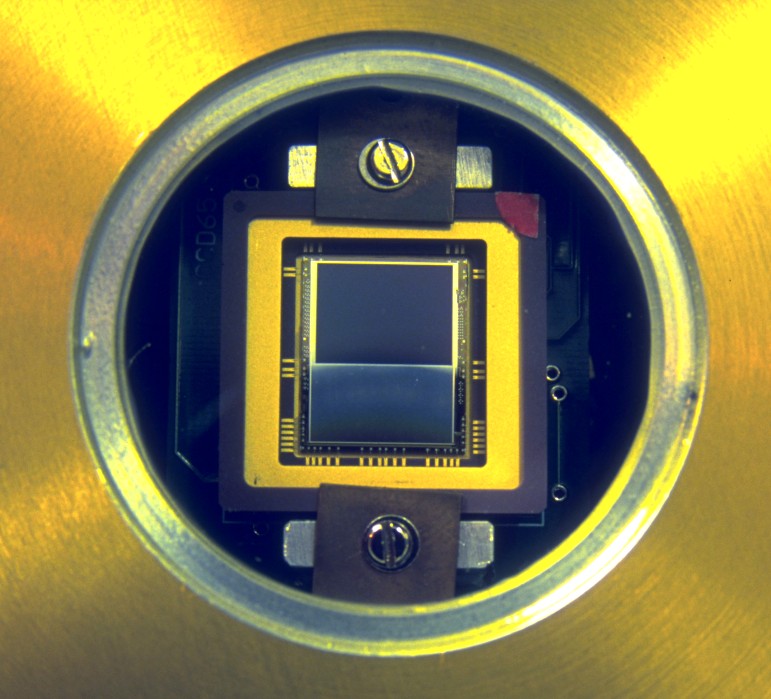
Figure 4.6: The CCD65 detector in the camera dewar. The mask covering the store area of the CCD can be seen on the lower half of the detector. The imaging area is in the upper part of the CCD.
\begin{figure}\begin{center}
\epsfig{file=ccd_analysis/ccd65,width=8cm}\end{center}\end{figure}


Subsections
Bob Tubbs 2003-11-14