


Next: Observations in July 2001 Up: Observations Previous: Observations Contents

 long pass filter (called HiRac I and
edge respectively). The bandpass of the HiRac I
filter is approximately top-hat shaped with a centre wavelength of
long pass filter (called HiRac I and
edge respectively). The bandpass of the HiRac I
filter is approximately top-hat shaped with a centre wavelength of
 and a width of
  . The long wavelength limit was
set by the sensitivity curve of the front-illuminated CCD for
observations using the edge filter. Figure 5.5
shows simple models for the responses of the filters (based on the
data available from the manufacturers). Also shown are estimates of
the combined photon-detection efficiency of the telescope, filter and
instrument based on estimates of the quantum efficiency of the
front-illuminated CCD, the reflection coefficients for the dewar
window and lens, and the reflectivity of the telescope and instrument
mirrors.
. The long wavelength limit was
set by the sensitivity curve of the front-illuminated CCD for
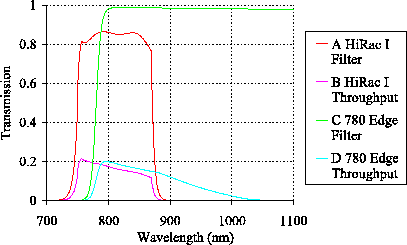
observations using the edge filter. Figure 5.5
shows simple models for the responses of the filters (based on the
data available from the manufacturers). Also shown are estimates of
the combined photon-detection efficiency of the telescope, filter and
instrument based on estimates of the quantum efficiency of the
front-illuminated CCD, the reflection coefficients for the dewar
window and lens, and the reflectivity of the telescope and instrument
mirrors.
 |
Bob Tubbs 2003-11-14