


Next: Results Up: Data reduction Previous: Fourier filtering Contents
 frames of a field near the centre of the globular
cluster M13 taken on the night of 2003 July 2. The long exposure
average image of the field (obtained by summing all the frames without
re-centring) can be seen in Figure 5.9. These
observations were taken with a bandpass centred at
frames of a field near the centre of the globular
cluster M13 taken on the night of 2003 July 2. The long exposure
average image of the field (obtained by summing all the frames without
re-centring) can be seen in Figure 5.9. These
observations were taken with a bandpass centred at 
 with a
frame rate of
with a
frame rate of 
 .
.
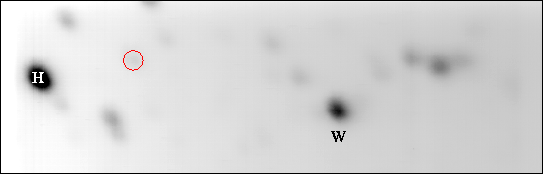 |
The faint star circled in the average image was used as a reference
for selecting and re-centring the short exposures. Stars H and
W with magnitudes of  and
and  from Cohen et al. (1997)
have been labelled in the image. In order to assess the improvement in
the performance of the Strehl selection and re-centring obtained by
Fourier filtering the short exposures using the diffraction-limited
transfer function shown in Figure 5.6, analysis of this
dataset was repeated a number of times both with and without the
filtering process. Figure 5.10a shows the image
obtained when the Strehl ratio and position of the brightest speckle
is calculated from the brightest pixel in the image of this star in
the sinc-resampled short exposures (with no filtering applied). The
exposures with the highest
from Cohen et al. (1997)
have been labelled in the image. In order to assess the improvement in
the performance of the Strehl selection and re-centring obtained by
Fourier filtering the short exposures using the diffraction-limited
transfer function shown in Figure 5.6, analysis of this
dataset was repeated a number of times both with and without the
filtering process. Figure 5.10a shows the image
obtained when the Strehl ratio and position of the brightest speckle
is calculated from the brightest pixel in the image of this star in
the sinc-resampled short exposures (with no filtering applied). The
exposures with the highest  of Strehl ratios were selected and
re-centred to produce the image shown in the figure. The sharpness of
the point source found at the location of the reference star is
artificial - it results from the coherent addition of noise in the
original short exposures brought about by the selection and
re-centring process as discussed in
Chapter 5.4. The images of the other stars
in the field are clearly more compact than in the average image of
Figure 5.9, indicating that the re-centring process is
performing well.
of Strehl ratios were selected and
re-centred to produce the image shown in the figure. The sharpness of
the point source found at the location of the reference star is
artificial - it results from the coherent addition of noise in the
original short exposures brought about by the selection and
re-centring process as discussed in
Chapter 5.4. The images of the other stars
in the field are clearly more compact than in the average image of
Figure 5.9, indicating that the re-centring process is
performing well.
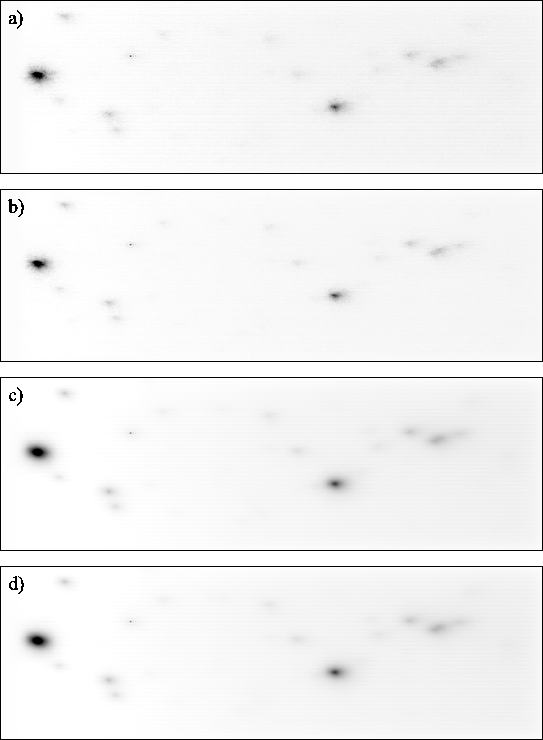 |
Figure 5.10b shows the image obtained when the short exposure images are filtered using the function described in Figure 5.6 before the Strehl ratio and location of the brightest speckle are calculated. The original raw exposures were selected and re-centred based on this data in the same way as for Figure 5.10a. The general characteristics of the image are similar to Figure 5.10a, and the reference star is again artificially sharp. The other stars in the field are slightly more compact in Figure 5.10b with a smaller halo surrounding them. It is clear that the filtering process has improved the image quality.
Figures 5.10c and 5.10d show the
results without filtering and with filtering respectively, using all
of the short exposures in the run. The smoothness of the halos around
the stars makes the improvement in image quality provided by the
filtering less apparent for the comparison of these two images than
for the case of the selected exposures. The FWHM of stars towards the
left-hand side of the field is reduced from 
 without filtering to
  with the filtering, however.
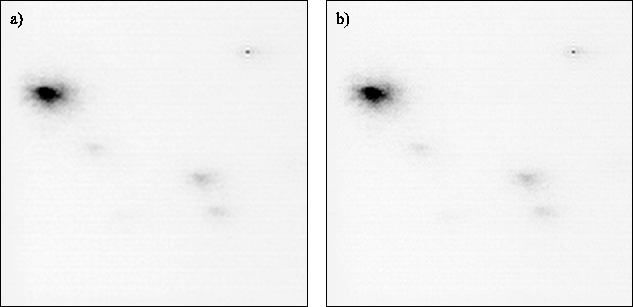
In order to test the performance of the second application of Fourier filtering (the application of the noise filter shown in Figure 5.7 to the selected exposures) I repeated the analysis of Figure 5.10b without filtering the selected exposures when they were re-centred and co-added. The effect of the noise filtering on the final image quality is shown Figure 5.11. This shows an enlargement of part of Figure 5.10b around the left-hand bright star in panel a) using the noise filter, and the result of the same analysis performed without using the noise filter on the selected exposures in b). There is no evidence for blurring of the filtered image, and the highest spatial frequency components in the noise have been suppressed in comparison with Figure 5.11b.
 |
The results of the two approaches to Fourier filtering appeared successful, so these filtering procedures were used in the data reduction presented in the remainder of this chapter (except where specifically stated otherwise in the text).
Bob Tubbs 2003-11-14
