|
Overview of the Sunyaev-Zeldovich Array
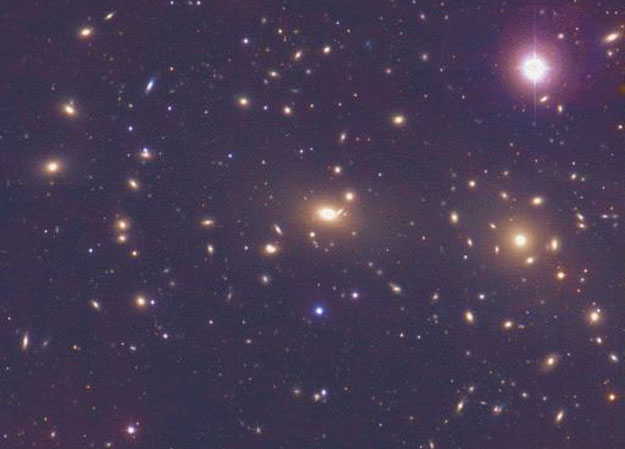
The Sunyaev-Zeldovich Array (SZA) is a radio telescope whose purpose is to search for clusters of galaxies in the Universe using the Sunyaev-Zeldovich Effect. The information gained from the SZA will be used to derive several interesting cosmological results such as the matter density of the Universe and the evolution of clusters over time. The Science Goals given below comprehensively detail the wide-ranging impact that the SZA will have on cosmology. The SZA builds on the previous Sunyaev-Zeldovich Effect experiment that was carried out by the University of Chicago.
The SZA consists of 8 dishes, 3.5 meters across, which will work together as one unit. Such an arrangement yields an angular resolution that is the same as that of a single telescope whose dish is as big as the largest separation between a pair of the 8 telescopes. The telescopes will be compactly arranged, with the largest separation between the dishes being around 40m. This separation between is somewhat small compared to other interferometers: for example the largest separation of the 2.5m diameter dishes of the Very Large Array near Socorro, New Mexico is 36km. In the case of the SZA, the relatively smaller separation is well suited to the angular size of the clusters of galaxies that it detects. The array parameters have been designed to maximize its sensitivity to the weak signal of the Sunyaev-Zeldovich effect.
The telescope will operate in the two frequency bands 26-36 GigaHertz and 85-115 GigaHertz (1 GigaHertz is 1 billion Hertz; for comparison frequencies of a few 1000 Hertz are used in the AM radio band).
The array will be located at the Owens Valley Radio Observatory near Bishop, California. After its first year of operation it will be combined with the the existing Owens Valley Radio Interferometer (six 10.4 m telescopes) and the Berkeley-Illinois-Maryland Association array (ten 6.1 m telescope) to form one large array called Combined Array for Research in Millimeter-wave Astronomy (CARMA) that will allow for detailed follow-up of the clusters.
 The SZA will scan around 12
degrees of the sky in search of signatures of the Sunyaev Zeldovich
Effect. This effect is a distortion in the cosmic microwave background
radiation when seen through a cluster of galaxies. The energetic
electrons in the gas between galaxies in a cluster are capable of
transferring energy to some of the microwave background photons. This
happens to around 1 of every 100 photons, resulting in a deficit of
photons at frequencies below 218 GHz and a surfeit of them above this
frequency. The distortion is tiny, about one-thousandth of a Kelvin in
antenna temperature.
The SZA will scan around 12
degrees of the sky in search of signatures of the Sunyaev Zeldovich
Effect. This effect is a distortion in the cosmic microwave background
radiation when seen through a cluster of galaxies. The energetic
electrons in the gas between galaxies in a cluster are capable of
transferring energy to some of the microwave background photons. This
happens to around 1 of every 100 photons, resulting in a deficit of
photons at frequencies below 218 GHz and a surfeit of them above this
frequency. The distortion is tiny, about one-thousandth of a Kelvin in
antenna temperature.
A telescope array, such as the SZA, is the ideal way of achieving high sensitivity for the extended low-surface brightness emission seen in clusters of galaxies at radio wavelengths. The SZA is also dedicated entirely to searching for clusters of galaxies. Hence, the signal to noise that the SZA will achieve will be much higher due the increased exposure time compared to past searches which used existing telescopes for just a few weeks in a year, further increasing its sensitivity.
The presence of the SZ effect indicates the existence of a cluster of galaxies as their high masses and the energetic electrons present in the cluster gas are responsible for creating distortions in the cosmic background. The distortions produced by lower mass objects are insignificant in comparison. Searching for clusters using the SZE is the most effective way of discovering all clusters that exist in a given part of the sky. This is because the SZE is unaffected by the distance of the cluster from us or equivalently the redshift of the cluster. (The higher the redshift, the greater the distance of an object from us). Hence, the SZA will make invaluable contributions to the current catalog of galaxy clusters. The SZA is also superior to other methods used to search for clusters of galaxies due to its high sensitivity. For example, X-ray observations which are typically used to study clusters are lower in sensitivity at the present time compared to the SZA.
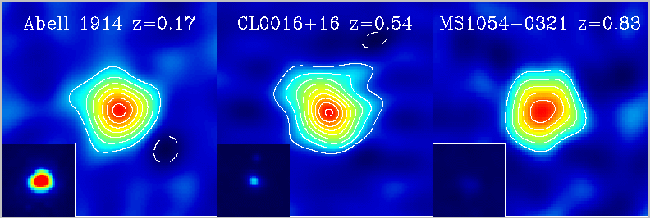
Comparison of the Sunyaev-Zeldovich Effect and X_ray observations of clusters is shown in the image above. Three clusters of differing redshift (z=0.17, 0.54, 0.83) are displayed in the X-ray (in the insets), and in images of the SZ effect. One can note that the X-ray emission falls off with redshift, while the SZ effect hasn't changed much. For this reason, it is essential to use the SZ effect to search for clusters of galaxies.
| |
|
|
Science Goals: Cosmology from the Sunyaev-Zeldovich Array
Clusters discovered by the SZA will be studied in detail (using the SZA, CARMA and other telescopes) to determine their redshifts, mass content and other properties. This wealth of information will enable astronomers to address several key cosmological issues:
-
The number for clusters of galaxies at different redshifts can be
determined. This information can then be used to place constraints on
cosmological parameters such as
- Distance measurements to clusters that are completely independent of other methods. Together with redshift information, this will provide a measure of Hubble constant as well as a means to confirm the determinations of the geometry of the universe found from Type 1a supernovae.
- The matter density of the universe, Omega_M, the dark energy density of the universe, and even possibly the equation of state of dark energy. This is obtained by studying cluster masses and number densities as a function of redshift.
- The SZA sample will allow clusters of galaxies to be used as tracers of formation of structure in the Universe. The Universe is believed to have experienced a phase of inflation very early in its existence, where it grew in size enormously over a very small time. Inflationary theory predicts that small fluctuations in density would have seeded the galaxies and galaxy clusters that we see today. It also predicts that the density fluctuations should be distributed according to a Gaussian function. The cluster samples found by the SZA will enable this prediction to be tested: for example, if the fluctuations have a non-Gaussian distribution, there will be more high-mass clusters especially at high redshift compared to the numbers expected from inflation.
- The clusters themselves can be studied in detail, so that the physics of clusters can be better understood.